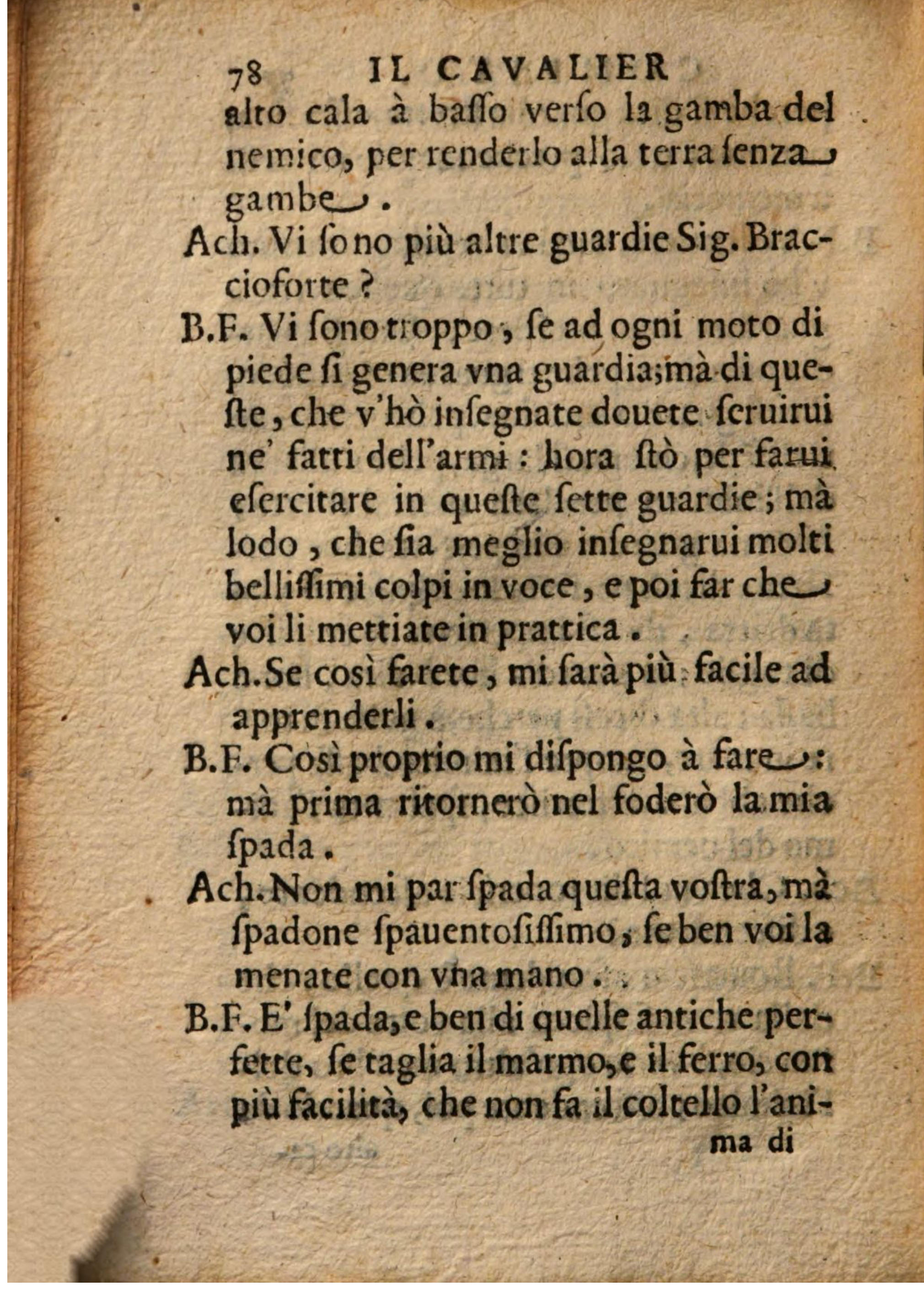
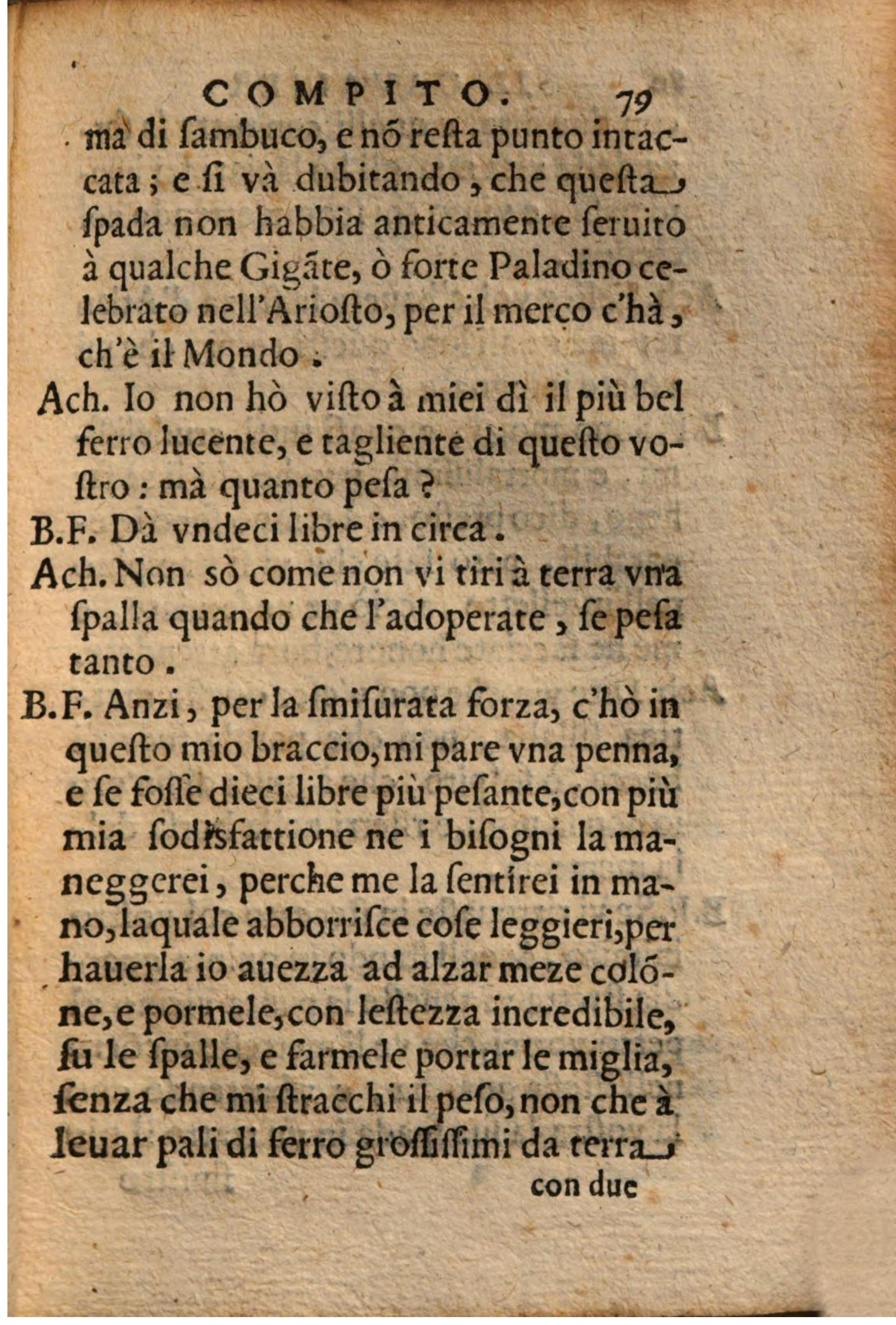
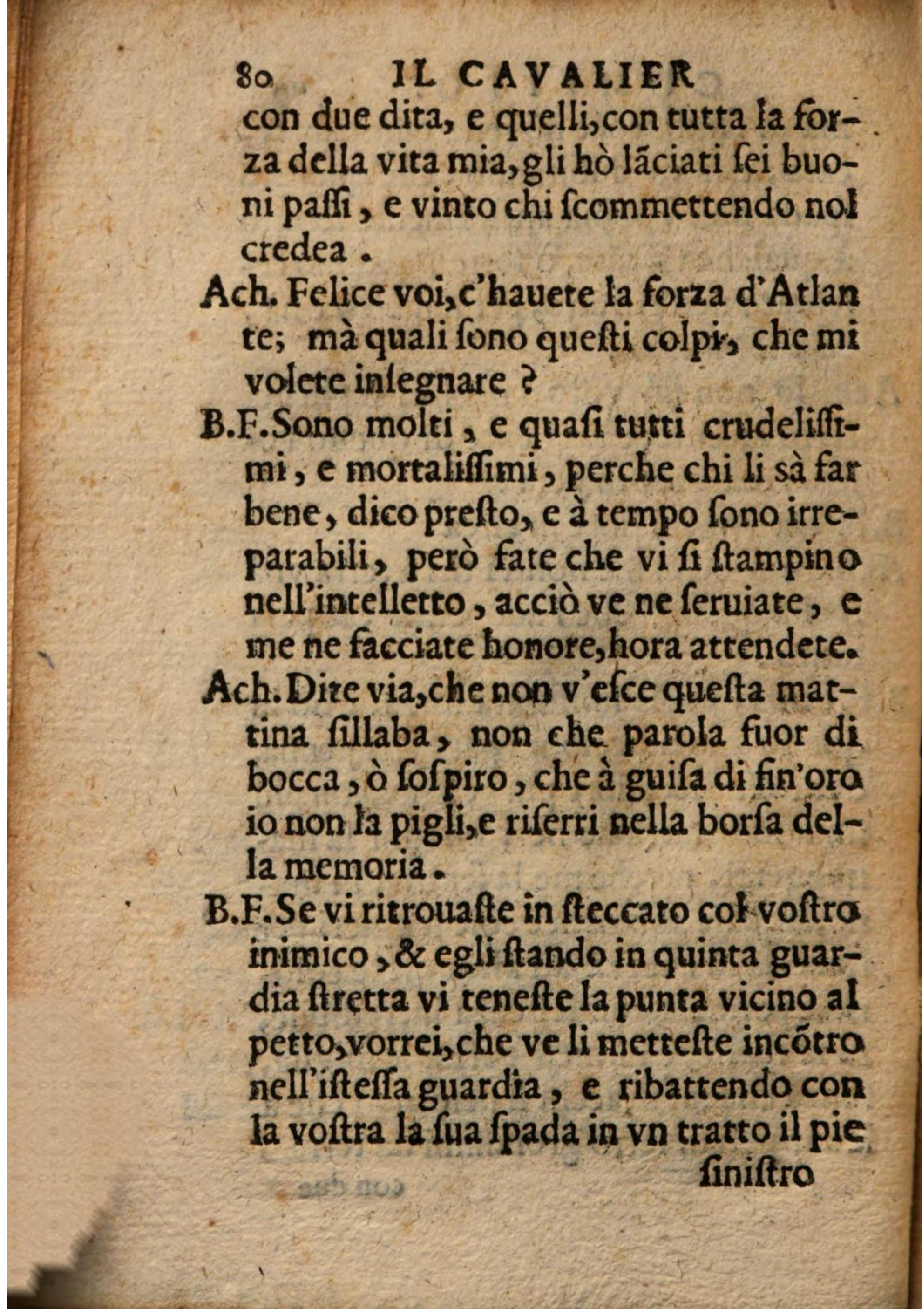
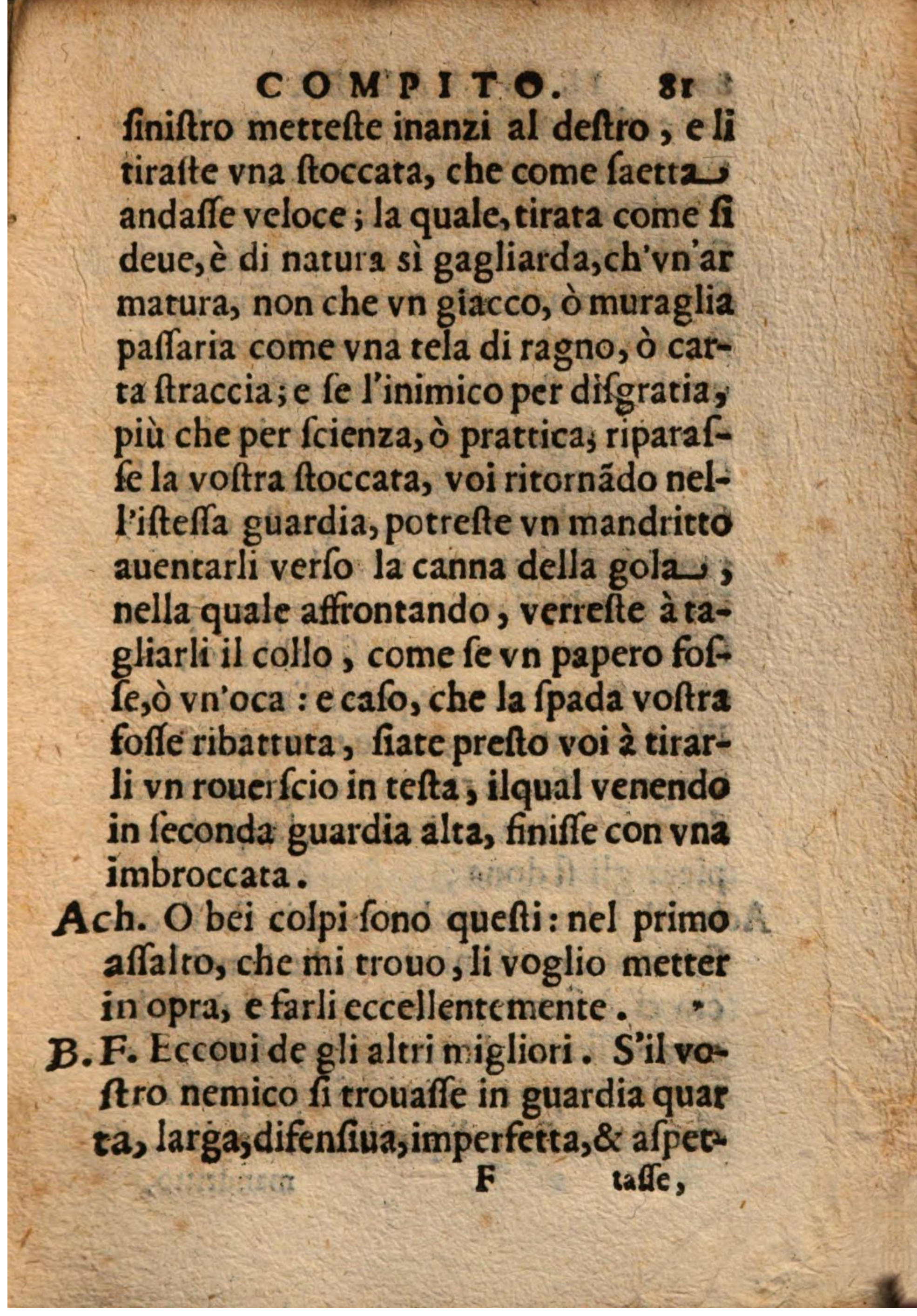
Front Matter
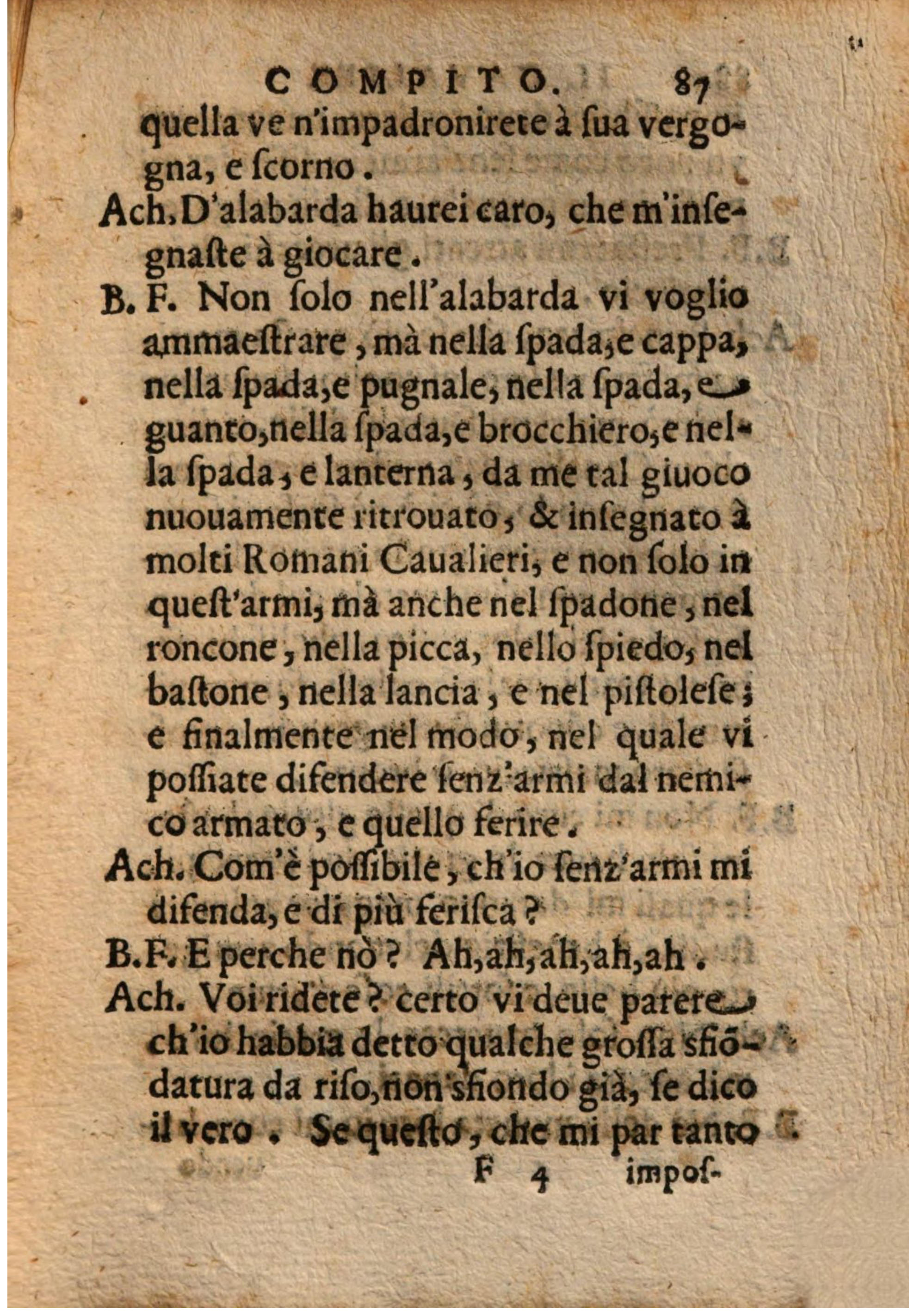
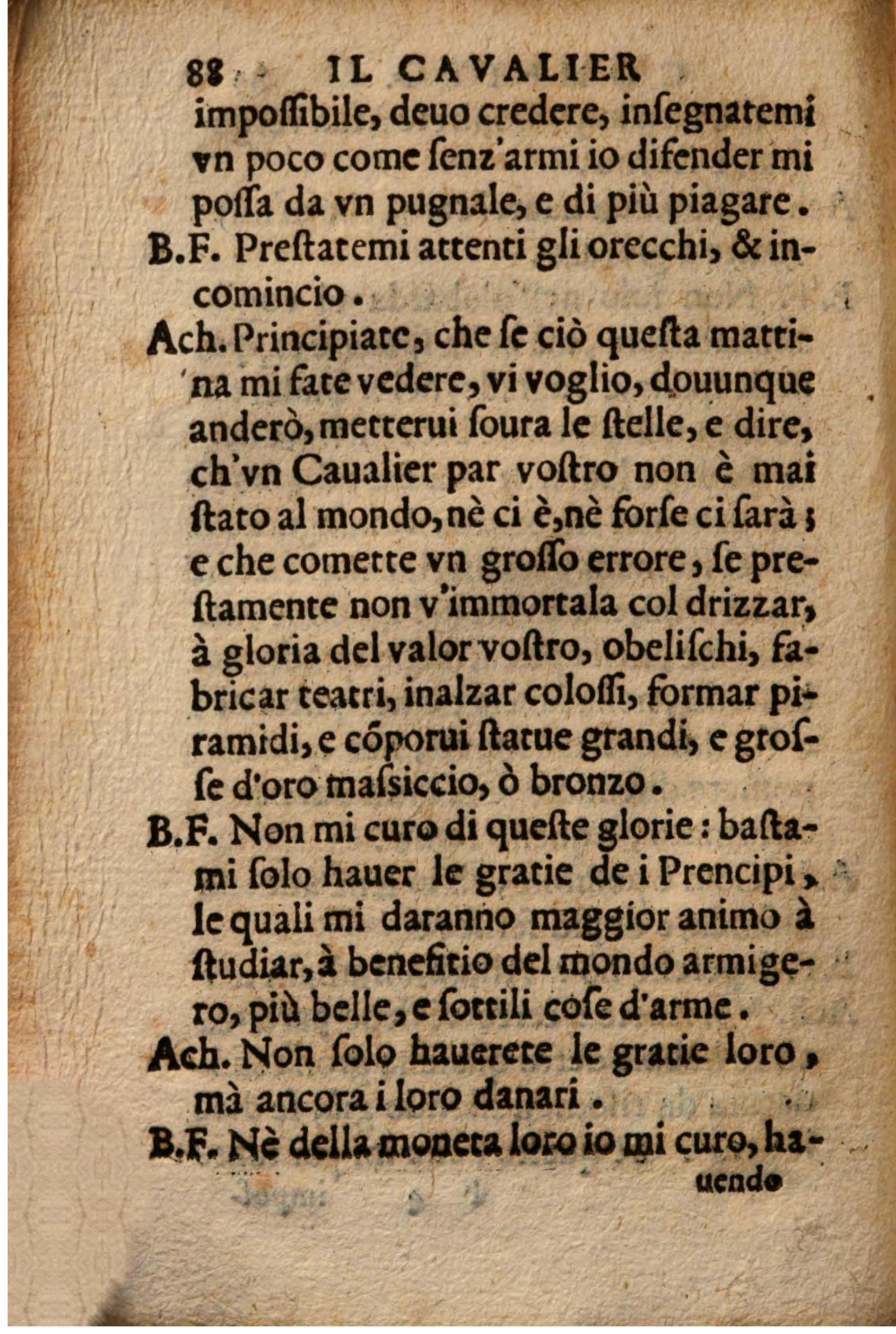
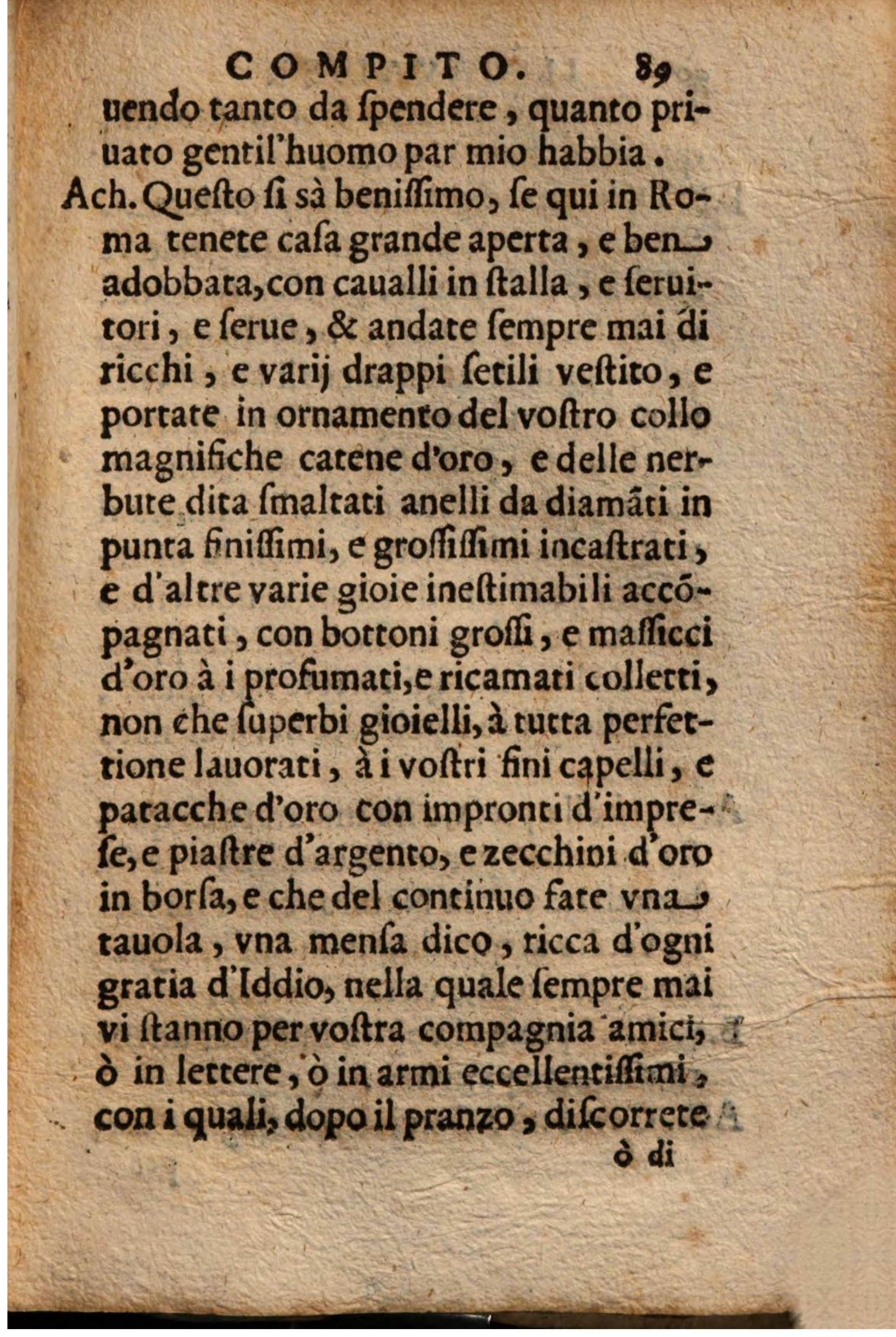
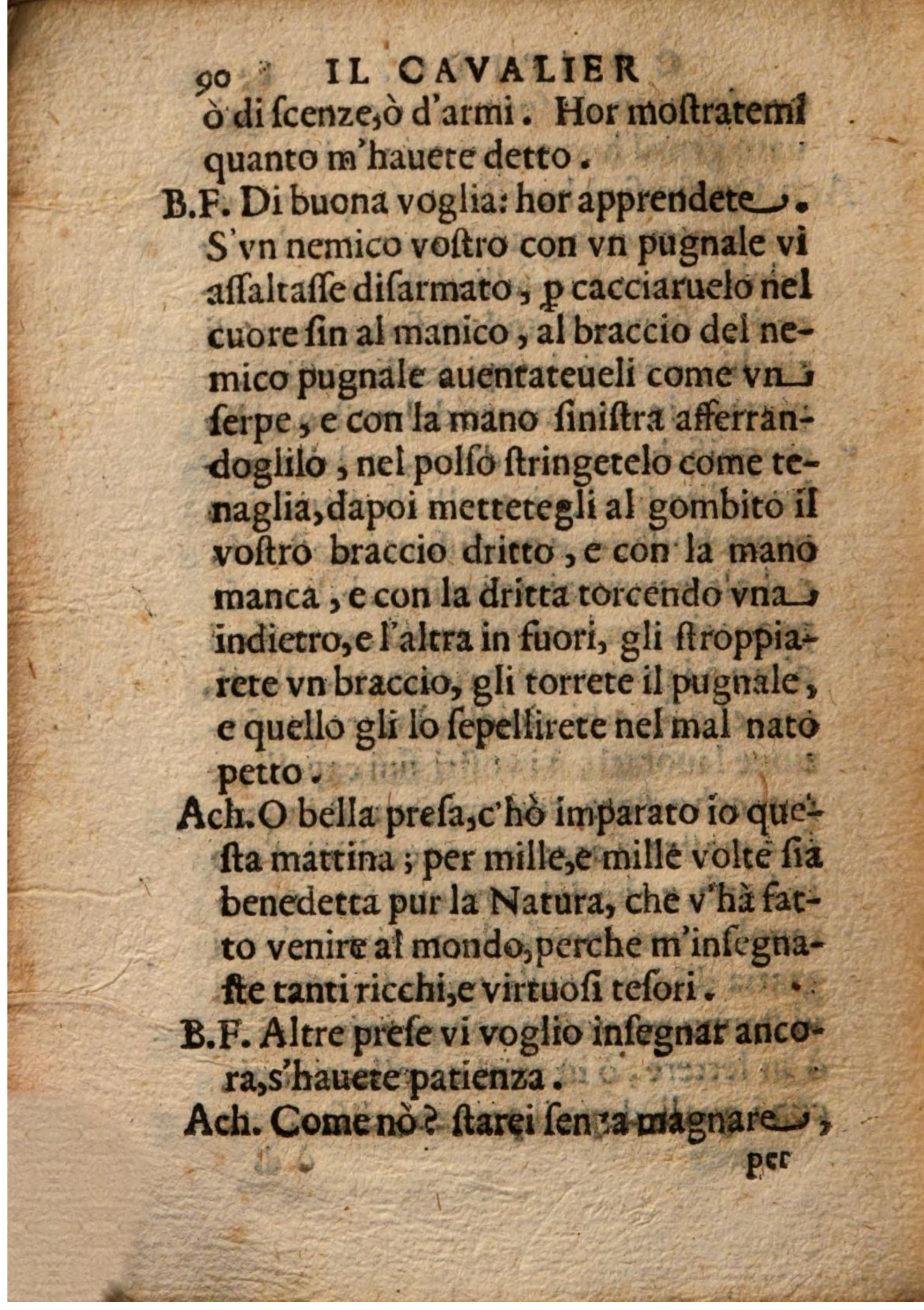
Scan p. 001 | printed p. [unnumbered]
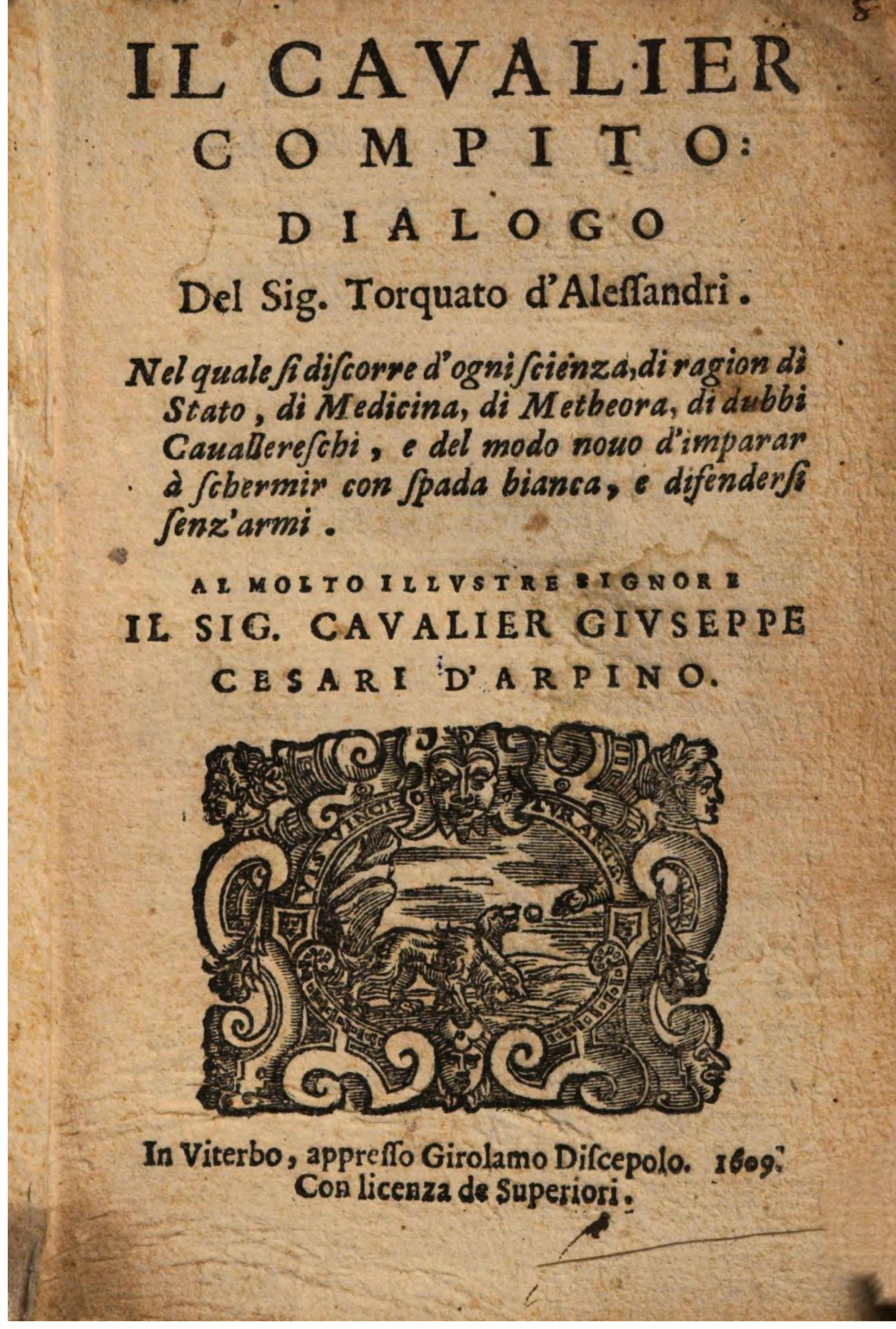
In which is discussed every science, reason of state, medicine, meteorology, chivalric questions, and the new method of learning to fence with the spada bianca [sharp/unblunted sword] and of defending oneself without weapons.
TO THE MOST ILLUSTRIOUS LORD, SIGNOR CAVALIER GIUSEPPE CESARI D'ARPINO.
At Viterbo, at the press of Girolamo Discepolo. 1609. With licence of the Superiors.
COMPITO:
DIALOGO
Del Sig. Torquato d'Aleſſandri .
Nel quale ſi diſcorre d'ogni ſciēza, di ragion di
Stato , di Medicina, di Metheora, di dubbi
Cauallereſchi , e del modo nouo d'imparar
à ſchermir con ſpada bianca, e difenderſi
ſenz'armi .
AL MOLTO ILLVSTRE SIGNORE
IL SIG. CAVALIER GIVSEPPE
CESARI D'ARPINO.
[woodcut device: oval cartouche with a double-faced (Janus) head at top, a right-facing profile head at right, two coats of arms flanking a central scene of a wolf-like beast in a landscape, with a banner motto and elaborate scrollwork frame]
In Viterbo, appreſſo Girolamo Diſcepolo. 1609.
Con licenza de Superiori.
Scan p. 002 | printed p. [unnumbered]
Scan p. 003 | printed p. [unnumbered]
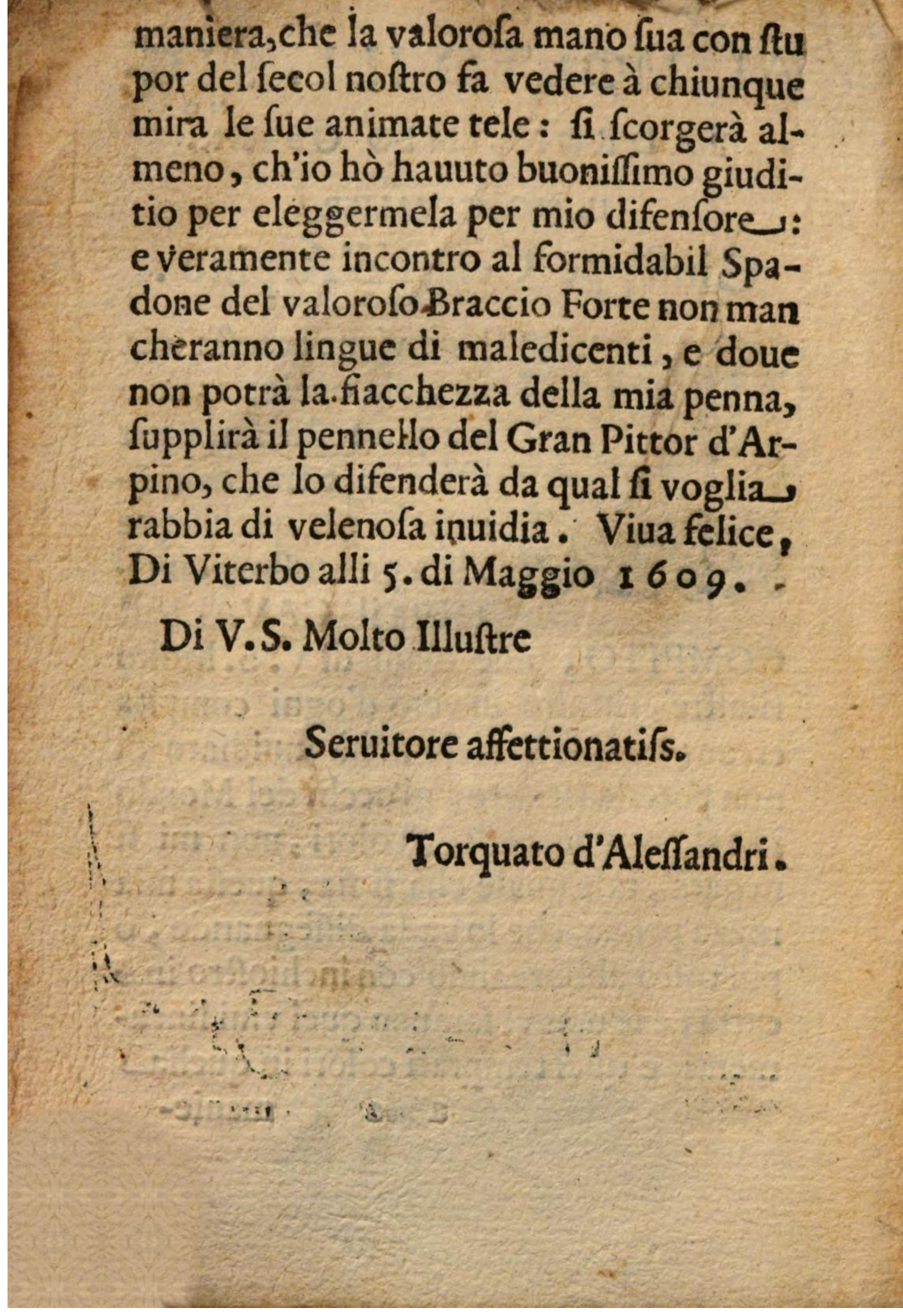
This little work of mine now comes, made by me for amusement and pastime rather than for any other pretension, entitled The Complete Cavalier, a true portrait of every complete good breeding, into the hands of Your Most Illustrious Lordship. And if Heaven has begrudged me the power to portray it before the eyes of the world on canvas with brushes and colours, at least this rough pen of mine, such as it is, will not be denied me, that it may go on designing it, or rather sketching it, with ink on paper. And if it does not have those living features and those tempered colours in that
PADRONE MIO OSSER.ᵐᵒ
IL SIG. CAVALIER
Giuſeppe Ceſari d'Arpino .
[decorated initial: S] E ne viene coteſta mia
picciola operetta , da
me più toſto fatta per
iſcherzo, e trattenimē-
to , che per qualunque
altra pretenſione, inti-
tolata il CAVALIER
COMPITO, alle mani di V. S. Molto
Illuſtre, ritratto in vero d'ogni compita
creanza: E ſe il Cielo m'hà inuidiato di
non poterla ritrarre à gl'occhi del Mondo
in tela con pennelli, e colori, non mi ſi
negarà, tale quale ella ſi ſia, queſta mia
rozza penna, che lo vada diſſegnando , ò
più toſto abbozzando con inchioſtro in
carta ; e ſe non vi ſaranno quei viui linea-
menti, e quei temprati colori in quella
SIGNATURE: a 2
CATCHWORD: manie-
Scan p. 004 | printed p. [unnumbered]
From Viterbo, on the 5th of May 1609.
Of Your Most Illustrious Lordship,
Most affectionate servant,
Torquato d'Alessandri.
por del ſecol noſtro fa vedere à chiunque
mira le ſue animate tele : ſi ſcorgerà al-
meno, ch'io hò hauuto buoniſſimo giudi-
tio per eleggermela per mio difenſore :
e veramente incontro al formidabil Spa-
done del valoroſo Braccio Forte non man
cheranno lingue di maledicenti , e doue
non potrà la fiacchezza della mia penna,
ſupplirà il pennello del Gran Pittor d'Ar-
pino, che lo difenderà da qual ſi voglia
rabbia di velenoſa inuidia . Viua felice,
Di Viterbo alli 5. di Maggio 1609.
Di V. S. Molto Illuſtre
Seruitore affettionatiſſ.
Torquato d'Aleſſandri .
Scan p. 005 | printed p. [unnumbered]
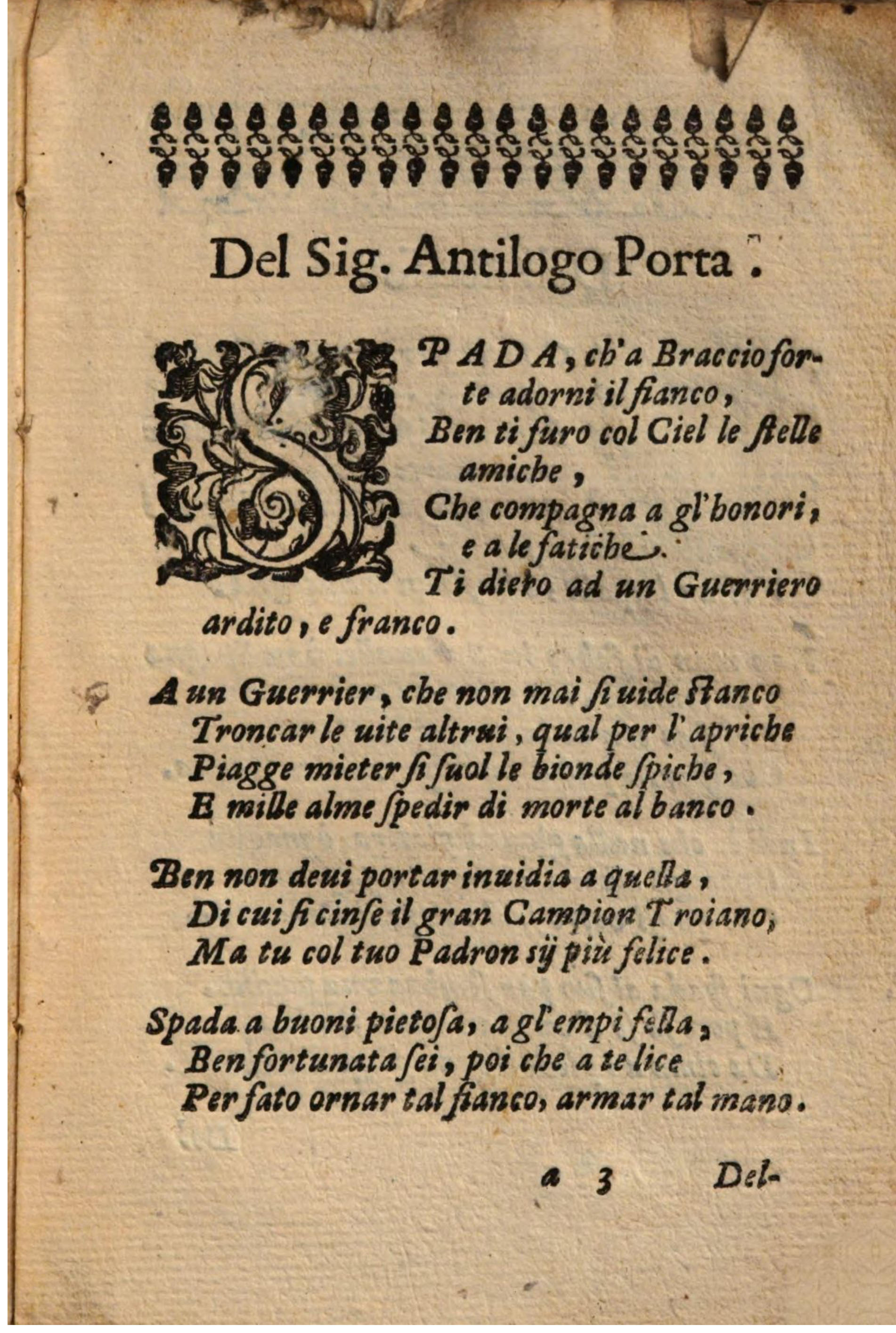
Sword, that adorns Braccioforte's side,
truly the stars of Heaven were friendly to you,
for as companion to honours and to labours
they gave you to a bold and frank Warrior.
To a Warrior who was never seen weary
of cutting down the lives of others, as across the sunlit
slopes one is wont to reap the golden ears of grain,
and to dispatch a thousand souls to death's bench.
Well you need bear no envy of that sword
with which the great Trojan Champion girded himself,
but you, with your Master, be more fortunate.
Sword merciful to the good, cruel to the wicked,
truly fortunate are you, since it is granted you
by fate to adorn such a side, to arm such a hand.
Del Sig. Antilogo Porta .
[decorated initial: S] PADA, ch'a Braccio for-
te adorni il fianco ,
Ben ti furo col Ciel le ſtelle
amiche ,
Che compagna a gl'honori,
e a le fatiche .
Ti diero ad un Guerriero
ardito , e franco .
A un Guerrier , che non mai ſi uide ſtanco
Troncar le uite altrui , qual per l'apriche
Piagge mieter ſi ſuol le bionde ſpiche ,
E mille alme ſpedir di morte al banco .
Ben non deui portar inuidia a quella ,
Di cui ſi cinſe il gran Campion Troiano,
Ma tu col tuo Padron ſÿ più felice .
Spada a buoni pietoſa , a gl'empi fella ,
Ben fortunata ſei , poi che a te lice
Per fato ornar tal fianco, armar tal mano .
SIGNATURE: a 3
CATCHWORD: Del-
Scan p. 006 | printed p. [unnumbered]
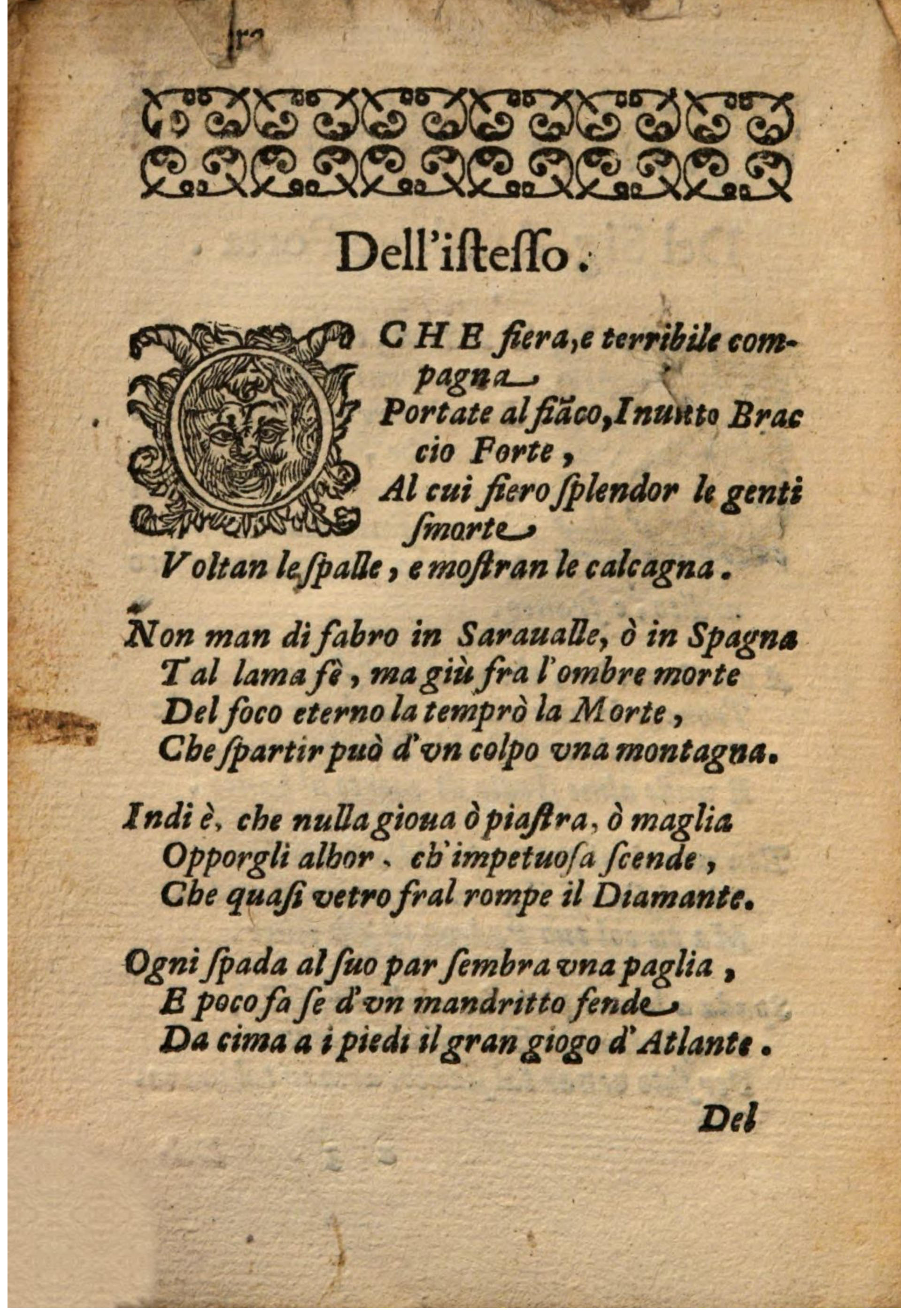
What a fierce and terrible companion you carry at your side, Unconquered Braccioforte, at whose fierce splendour the dismayed peoples turn their backs and show their heels.
No smith's hand in Saravalle or in Spain made such a blade, but down among the dead shadows of the eternal fire Death tempered it, which can split a mountain with one blow.
Hence it is that neither plate nor mail avails to oppose it when it comes down impetuously, for the Diamond shatters it like frail glass.
Every sword compared to it seems a straw, and it does but little if with a mandritto [forehand blow, right to left] it cleaves from top to foot the great yoke of Atlas.
Dell'iſteſſo .
[decorated initial: C, woodcut of a face/mask in a roundel] HE fiera,e terribile com-
pagna
Portate al fiāco, Inuitto Brac
cio Forte ,
Al cui fiero ſplendor le genti
ſmarte
Voltan le ſpalle , e moſtran le calcagna .
Non man di fabro in Saraualle, ò in Spagna
Tal lama fè , ma giù fra l'ombre morte
Del foco eterno la temprò la Morte ,
Che ſpartir può d'vn colpo vna montagna .
Indi è , che nulla gioua ò piaſtra , ò maglia
Opporgli alhor , ch'impetuoſa ſcende ,
Che quaſi vetro fral rompe il Diamante .
Ogni ſpada al ſuo par ſembra vna paglia ,
E poco fa ſe d'vn mandritto fende
Da cima a i piedi il gran giogo d'Atlante .
CATCHWORD: Del
Scan p. 007 | printed p. [unnumbered]
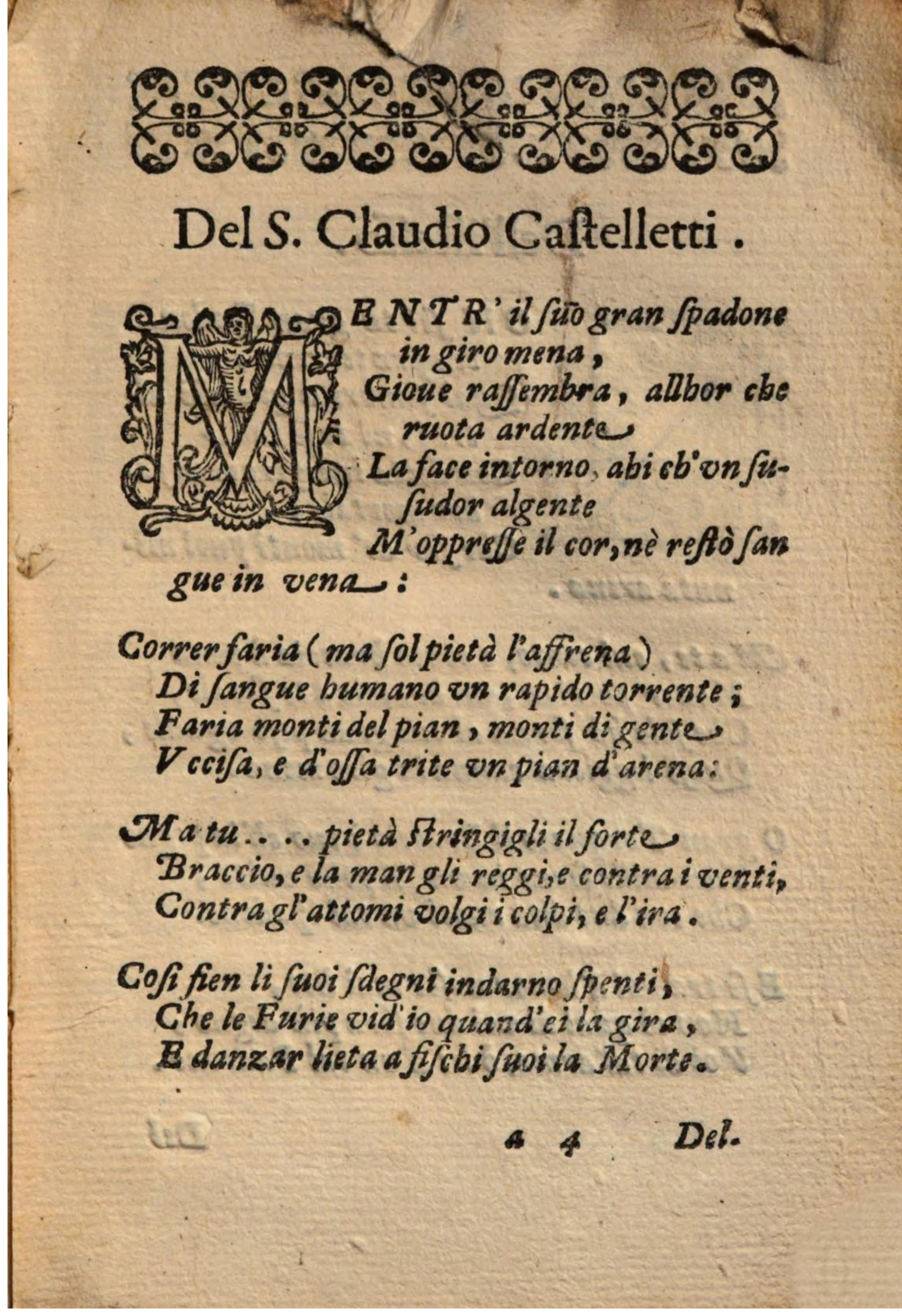
When he wheels his great spadone [great-sword] round in a circle, he resembles Jove when he whirls the burning torch about; ah, a chill sweat oppressed my heart, nor did blood remain in my veins.
He would make a rapid torrent of human blood run (but only pity restrains him); he would make mountains of the plain, mountains of slain people, and of ground-up bones a plain of sand.
But you... pity, bind fast his strong Arm, and rule his hand, and against the winds, against the motes turn his blows and his wrath.
Thus may his scorns be spent in vain, for I saw the Furies when he wheels it, and Death dance gladly to his whistlings.
Del S. Claudio Caſtelletti .
[decorated initial: M, woodcut with a winged figure] ENTR' il ſuo gran ſpadone
in giro mena ,
Gioue raſſembra , allhor che
ruota ardente
La face intorno, hai ch'vn ſu-
ſudor algente
M'oppreſſe il cor, nè reſtò ſan
gue in vena :
Correr faria ( ma ſol pietà l'affrena )
Di ſangue humano vn rapido torrente ;
Faria monti del pian , monti di gente
Vcciſa, e d'oſſa trite vn pian d'arena:
Ma tu.. .. pietà ſtringigli il forte
Braccio, e la man gli reggi,e contra i venti,
Contra gl'attomi volgi i colpi, e l'ira .
Coſi ſien li ſuoi ſdegni indarno ſpenti,
Che le Furie vid'io quand'ei la gira ,
E danzar lieta a fiſchi ſuoi la Morte .
SIGNATURE: a 4
CATCHWORD: Del.
Scan p. 008 | printed p. [unnumbered]
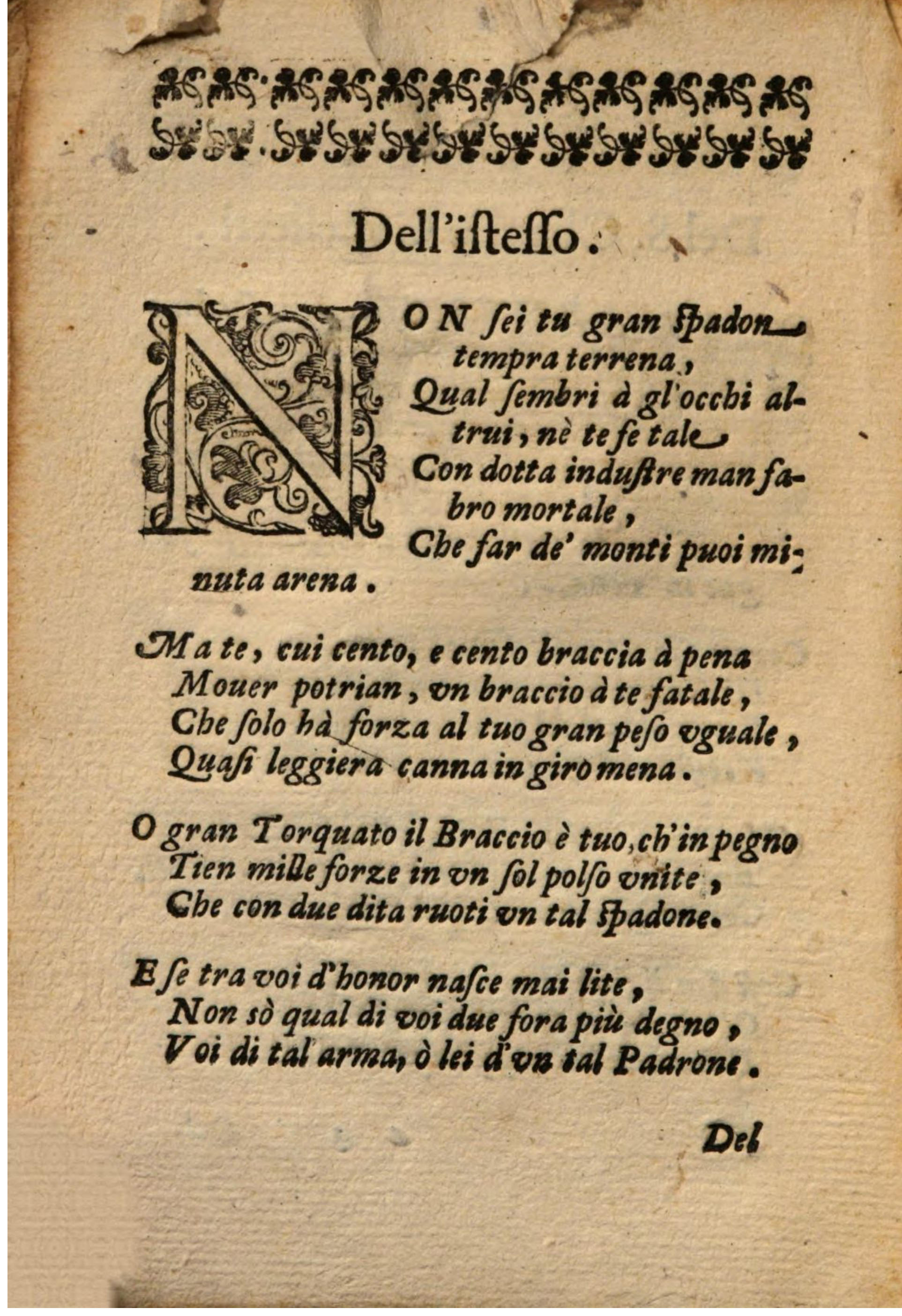
You are not, great Spadone [great-sword], earthly temper, such as you seem to the eyes of others, nor did a mortal smith make you such with learned, skilful hand, you who can make fine sand of mountains.
But you, whom a hundred and a hundred arms could scarcely move, a single arm fatal to you, which alone has strength equal to your great weight, wheels you round almost like a light reed.
O great Torquato, the Arm is yours, which holds in pledge a thousand forces united in a single wrist, so that with two fingers you wheel such a Spadone.
And if between you a quarrel of honour should ever arise, I know not which of you two would be the more worthy: you, of such a weapon, or it, of such a Master.
Dell'iſteſſo .
[decorated initial: N] ON ſei tu gran Spadon
tempra terrena ,
Qual ſembri à gl'occhi al-
trui , nè te ſe tale
Con dotta induſtre man fa-
bro mortale ,
Che far de' monti puoi mi-
nuta arena .
Ma te , cui cento , e cento braccia à pena
Mouer potrian , vn braccio à te fatale ,
Che ſolo hà forza al tuo gran peſo vguale ,
Quaſi leggiera canna in giro mena .
O gran Torquato il Braccio è tuo,ch'in pegno
Tien mille forze in vn ſol polſo vnite ,
Che con due dita ruoti vn tal Spadone .
E ſe tra voi d'honor naſce mai lite ,
Non ſò qual di voi due fora più degno ,
Voi di tal arma, ò lei d'vn tal Padrone .
CATCHWORD: Del
Scan p. 009 | printed p. [unnumbered]
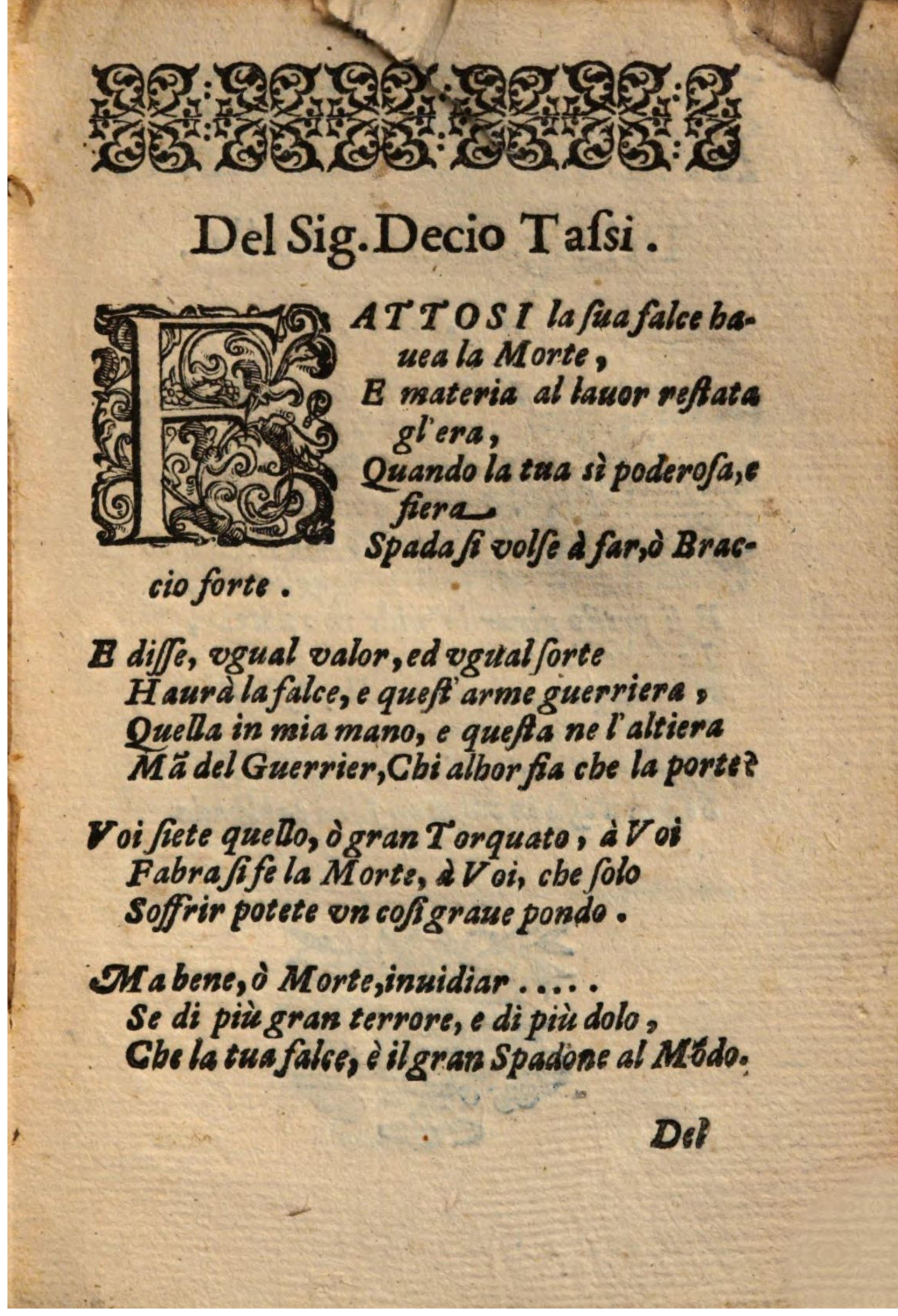
Death had made herself her scythe, and matter for the work still remained to her, when your sword, so powerful and fierce, turned to make [more], O Braccioforte.
And she said: equal valour and equal fortune shall the scythe and this warlike weapon have, the one in my hand, and this in the proud hand of the Warrior. Who then shall there be to bear it?
You are that one, O great Torquato; for You Death was made a smith, for You, who alone can bear so heavy a weight.
But well, O Death, [may you] envy... [him?], if of greater terror and of greater grief than your scythe is the great Spadone [great-sword] to the World.
Del Sig. Decio Taſsi .
[decorated initial: F] ATTOSI la ſua falce ha-
uea la Morte ,
E materia al lauor reſtata
gl'era ,
Quando la tua ſì poderoſa,e
fiera
Spada ſi volſe à far,ò Brac-
cio forte .
E diſſe, vgual valor, ed vgual ſorte
Haurà la falce, e queſt'arme guerriera ,
Quella in mia mano, e queſta ne l'altiera
Mã del Guerrier,Chi alhor ſia che la porte?
Voi ſiete quello, ò gran Torquato , à Voi
Fabra ſi fe la Morte, à Voi, che ſolo
Soffrir potete vn coſ graue pondo .
Ma bene, ò Morte,inuidiar .....
Se di più gran terrore, e di più dolo ,
Che la tua falce, è il gran Spadone al Mōdo.
CATCHWORD: Del
Scan p. 010 | printed p. [unnumbered]
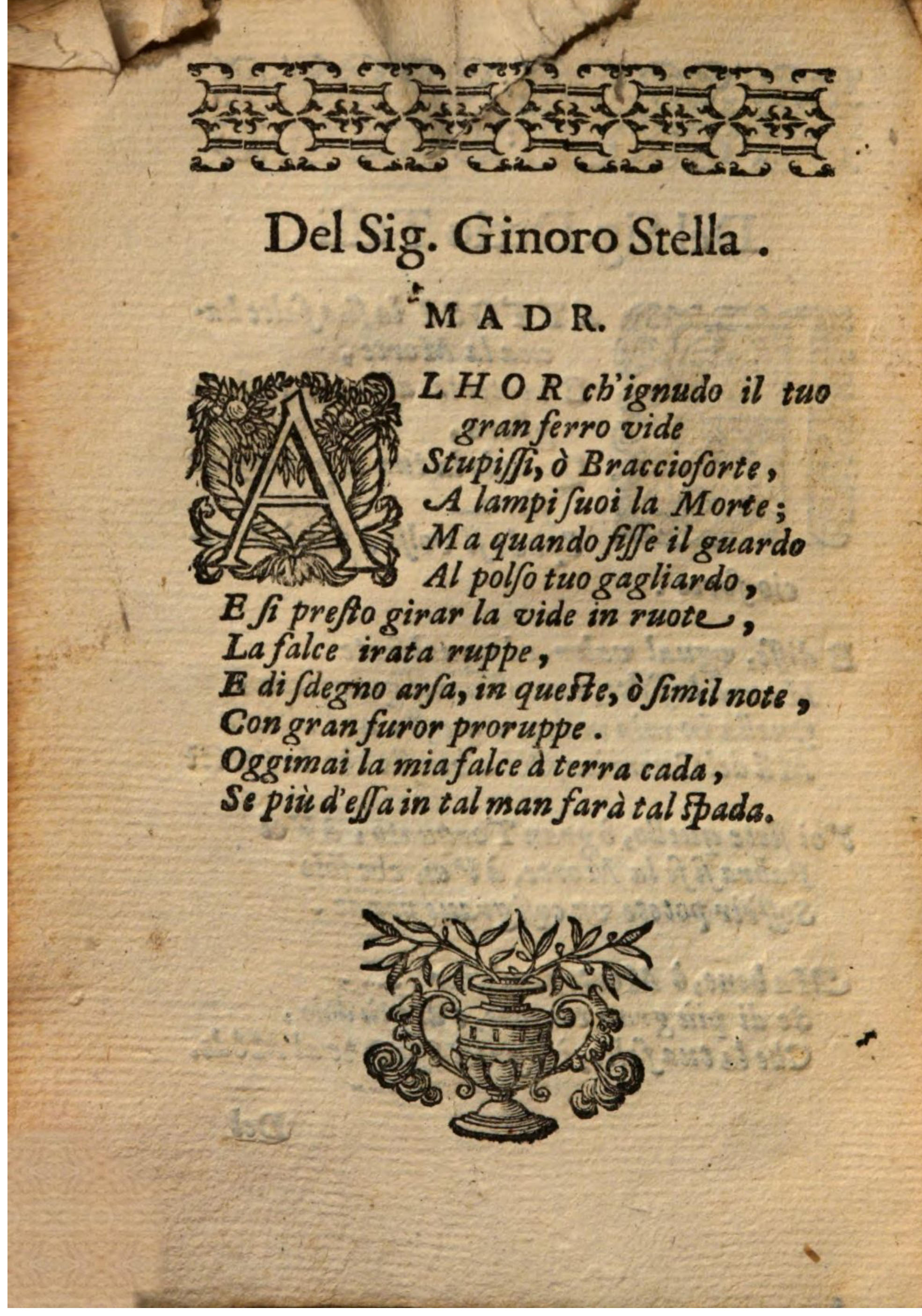
When Death saw your great blade bared, she was astounded, O Braccioforte, at its lightning-flashes; but when she fixed her gaze upon your vigorous wrist, and saw it turn so swiftly in wheeling circles, the wrathful [Death] broke her scythe, and, burning with disdain, in these or similar words burst forth with great fury:
Henceforth let my scythe fall to the ground, if such a sword in such a hand will do more than it.
Del Sig. Ginoro Stella .
MADR.
[decorated initial: A, woodcut with garland/wreath frame] LHOR ch'ignudo il tuo
gran ferro vide
Stupiſſi, ò Braccioforte ,
A lampi ſuoi la Morte ;
Ma quando fiſſe il guardo
Al polſo tuo gagliardo ,
E ſi preſto girar la vide in ruote ,
La falce irata ruppe ,
E di ſdegno arſa, in queſte, ò ſimil note ,
Con gran furor proruppe .
Oggimai la mia falce à terra cada ,
Se più d'eſſa in tal man farà tal ſpada .
[tailpiece ornament: woodcut of a decorated vase/urn with foliage]
Scan p. 011 | printed p. [unnumbered]
MADRIGAL.
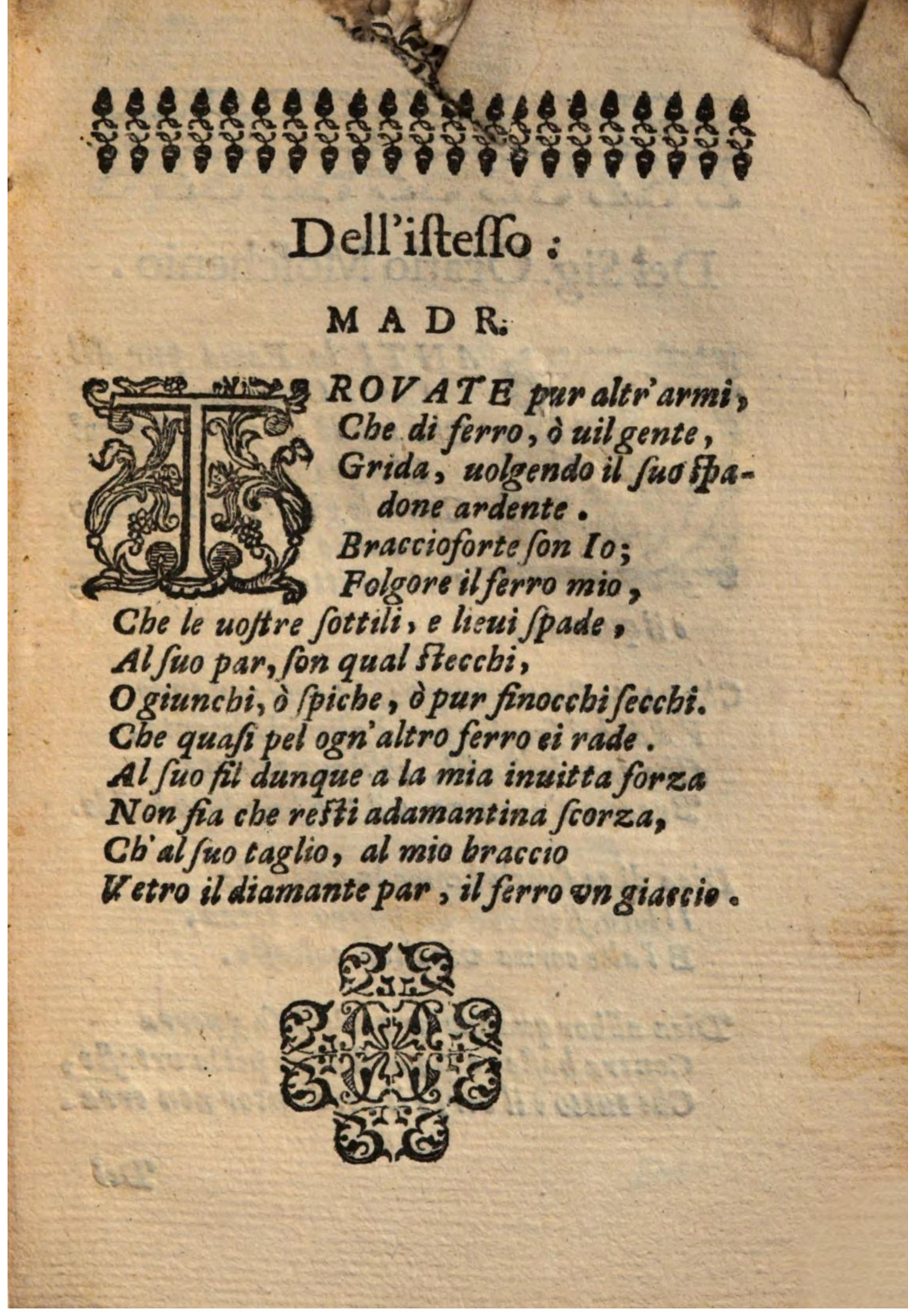
"Go and find yourselves other weapons than iron, you cowardly folk!" he cries, brandishing his burning great sword [spadone].
"I am Braccioforte; my blade is a thunderbolt, and beside it your thin and flimsy swords are like sticks, or reeds, or ears of corn, or dry fennel stalks, for it shaves away almost every other blade as if it were fur. Against its edge, then, and against my unconquered strength, no adamantine shell can hold; for to its cut, and to my arm, the diamond looks like glass, and iron like ice."
Dell'iſteſſo :
MADR.
[decorated initial: T] ROVATE pur altr'armi ,
Che di ferro, ò uil gente ,
Grida , uolgendo il ſuo ſpa-
done ardente .
Braccioforte ſon Io ;
Folgore il ferro mio ,
Che le uoſtre ſottili , e lieui ſpade ,
Al ſuo par, ſon qual ſtecchi ,
O giunchi, ò ſpiche, ò pur finocchi ſecchi.
Che quaſi pel ogn'altro ferro ei rade .
Al ſuo fil dunque a la mia inuitta forza
Non fia che reſti adamantina ſcorza,
Ch'al ſuo taglio, al mio braccio
Vetro il diamante par , il ferro vn giaccio .
[tailpiece ornament: woodcut quatrefoil/cross-shaped foliate device]
Scan p. 012 | printed p. [unnumbered]
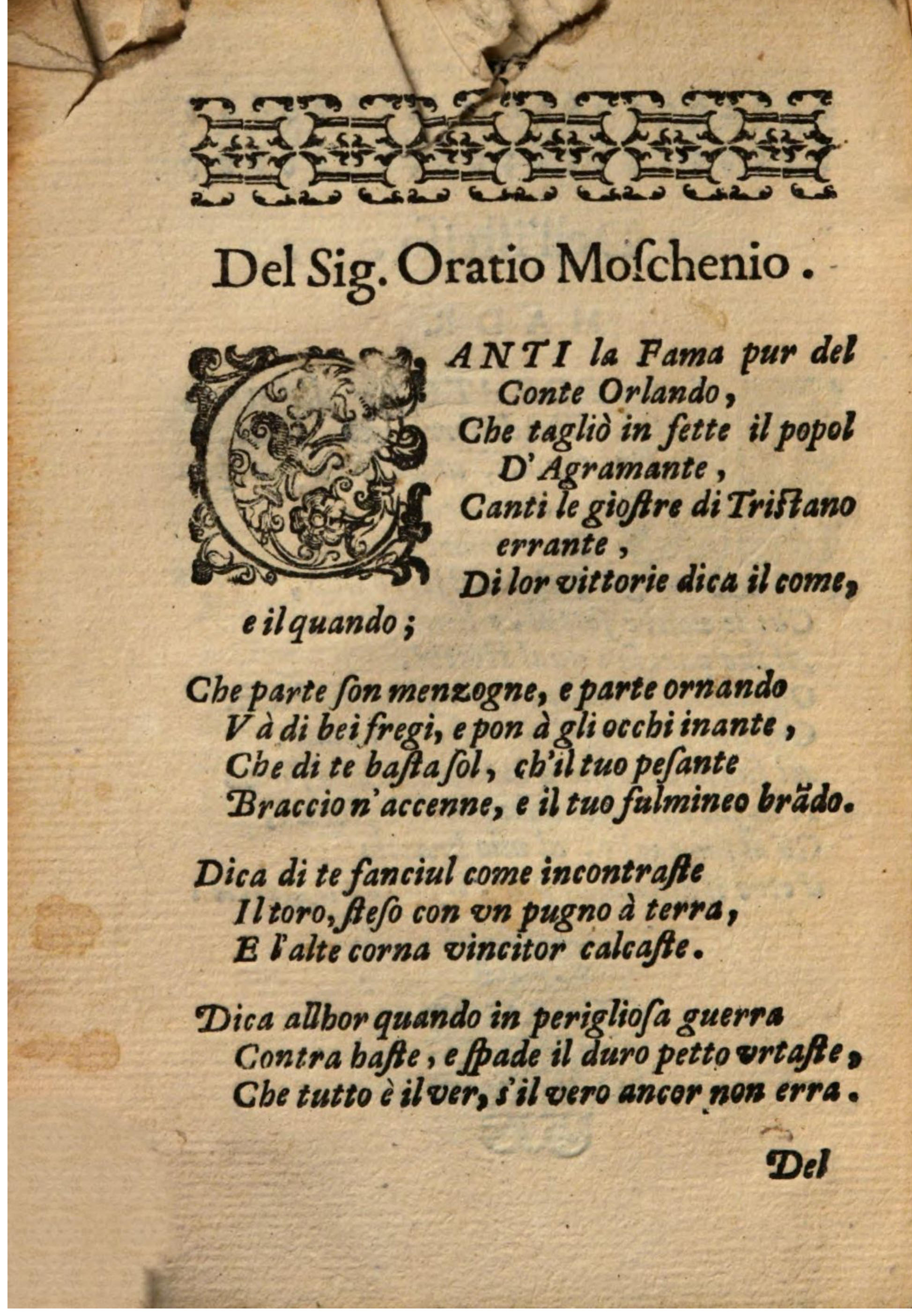
Let Fame indeed sing of Count Orlando, who cut Agramante's people into slices; let it sing of the jousts of Tristan the wandering knight, and tell of their victories, the how and the when. For part of it is lies, and part she goes adorning with fair embellishments and sets before our eyes; whereas of you it is enough only that your heavy arm should give the sign, and your lightning-swift blade.
Let it tell how, as a boy, you met the bull, laid it flat on the ground with a single blow, and, victorious, trod down its lofty horns.
Let it tell then of the time when, in perilous war, you thrust your hard breast against pikes and swords: for all of it is true, if truth itself does not err.
Del Sig. Oratio Moſchenio .
[decorated initial: C, woodcut with foliage] ANTI la Fama pur del
Conte Orlando ,
Che tagliò in fette il popol
D'Agramante ,
Canti le gioſtre di Triſtano
errante ,
Di lor vittorie dica il come,
e il quando ;
Che parte ſon menzogne, e parte ornando
Và di bei fregi, e pon à gli occhi inante ,
Che di te baſta ſol , ch'il tuo peſante
Braccio n'accenne, e il tuo fulmineo brãdo.
Dica di te fanciul come incontraſte
Il toro, ſteſo con vn pugno à terra ,
E l'alte corna vincitor calcaſte .
Dica allhor quando in periglioſa guerra
Contra haſte , e ſpade il duro petto vrtaſte,
Che tutto è il ver, s'il vero ancor non erra .
CATCHWORD: Del
Scan p. 013 | printed p. [unnumbered]
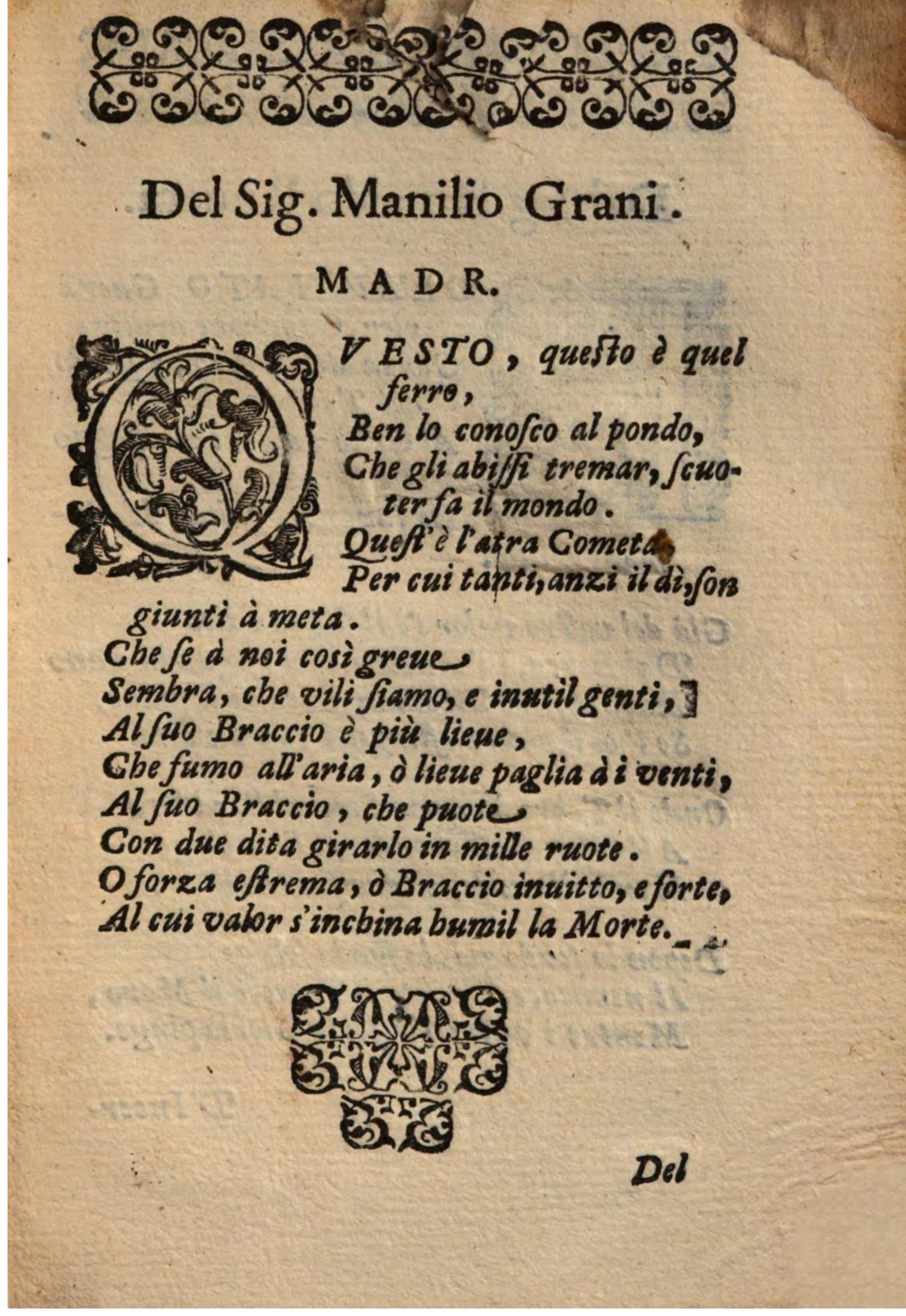
MADRIGAL.
This, this is that iron [blade]; well do I know it by its weight, which makes the abysses tremble and shakes the world. This is that black Comet through which so many, before their day, have reached their end. For if to us it seems so heavy (since we are base and useless folk), to His arm it is lighter than smoke to the air, or light straw to the winds. To His arm, which can whirl it in a thousand circles with two fingers. O utmost strength, O arm unconquered and mighty, before whose valour humble Death bows down.
Del Sig. Manilio Grani .
MADR.
[decorated initial: Q, woodcut with foliage] VESTO , queſto è quel
ferro ,
Ben lo conoſco al pondo,
Che gli abiſſi tremar, ſcuo-
ter fa il mondo .
Queſt'è l'atra Cometa
Per cui tanti,anzi il dì,ſon
giunti à meta .
Che ſe à noi coſì greue
Sembra, che vili ſiamo, e inutil genti ,
Al ſuo Braccio è più lieue ,
Che fumo all'aria , ò lieue paglia à i venti,
Al ſuo Braccio , che puote
Con due dita girarlo in mille ruote .
O forza eſtrema , ò Braccio inuitto, e forte,
Al cui valor s'inchina humil la Morte .
[tailpiece ornament: woodcut foliate device]
CATCHWORD: Del
Scan p. 014 | printed p. [unnumbered]
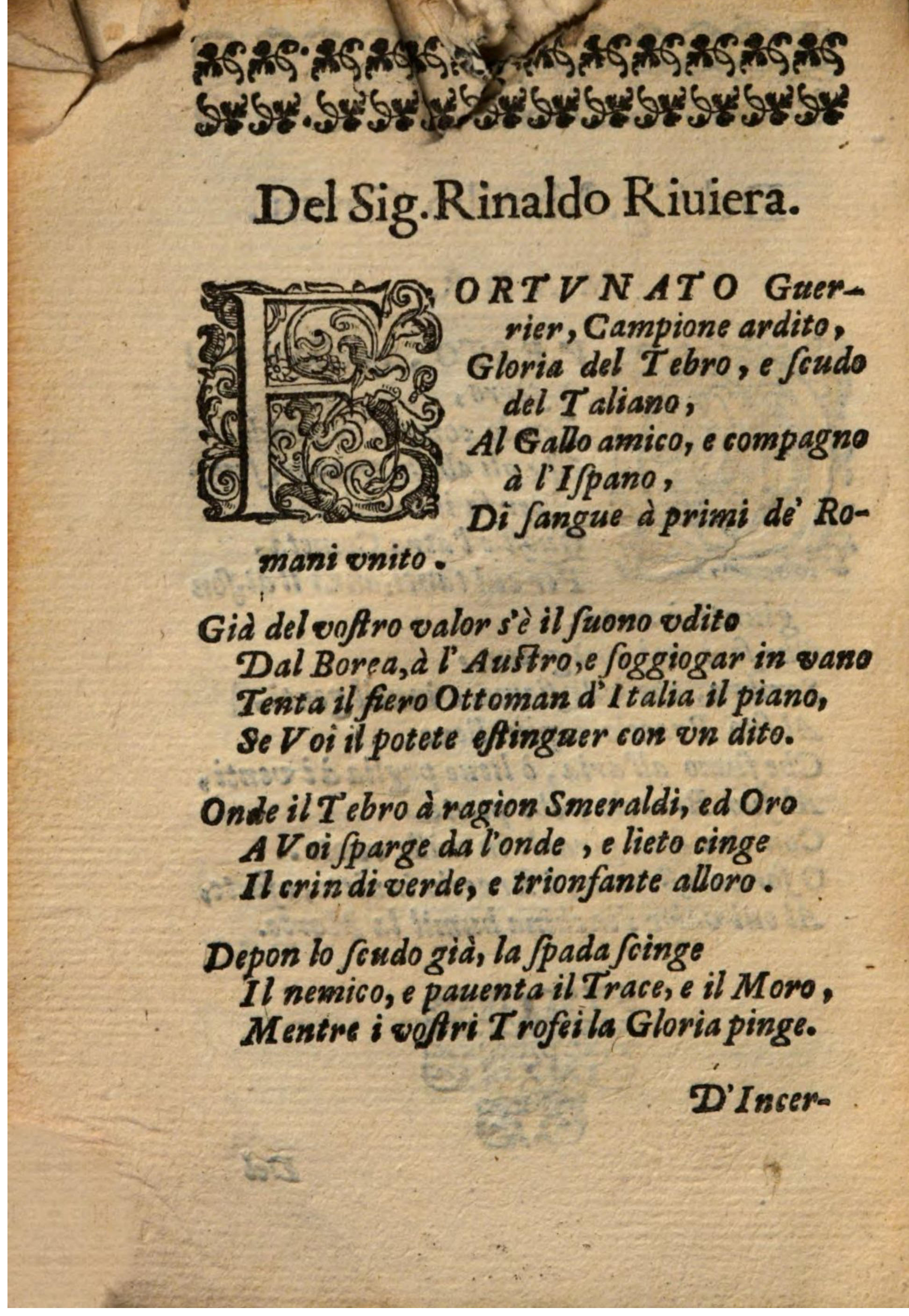
Fortunate warrior, bold champion, glory of the Tiber and shield of the Italian, friend to the Gaul and companion to the Spaniard, joined by blood to the foremost of the Romans.
Already the sound of your valour has been heard from the North wind to the South; and in vain the fierce Ottoman tries to subjugate the plain of Italy, since you could extinguish him with a single finger.
Wherefore the Tiber rightly scatters emeralds and gold to you from its waves, and gladly wreathes your hair with green and triumphant laurel.
The enemy already lays down his shield and ungirds his sword, and the Thracian and the Moor take fright, while Glory paints your trophies.
Del Sig. Rinaldo Riuiera.
[decorated initial: F] ORTVNATO Guer-
rier, Campione ardito ,
Gloria del Tebro , e ſcudo
del Taliano ,
Al Gallo amico, e compagno
à l'Iſpano ,
Di ſangue à primi de' Ro-
mani vnito .
Già del voſtro valor s'è il ſuono udito
Dal Borea,à l'Auſtro,e ſoggiogar in vano
Tenta il fiero Ottoman d'Italia il piano,
Se Voi il potete eſtinguer con vn dito.
Onde il Tebro à ragion Smeraldi, ed Oro
A Voi ſparge da l'onde , e lieto cinge
Il crin di verde, e trionfante alloro .
Depon lo ſcudo già, la ſpada ſcinge
Il nemico, e pauenta il Trace, e il Moro ,
Mentre i voſtri Trofei la Gloria pinge.
CATCHWORD: D'Incer-
Scan p. 015 | printed p. [unnumbered]
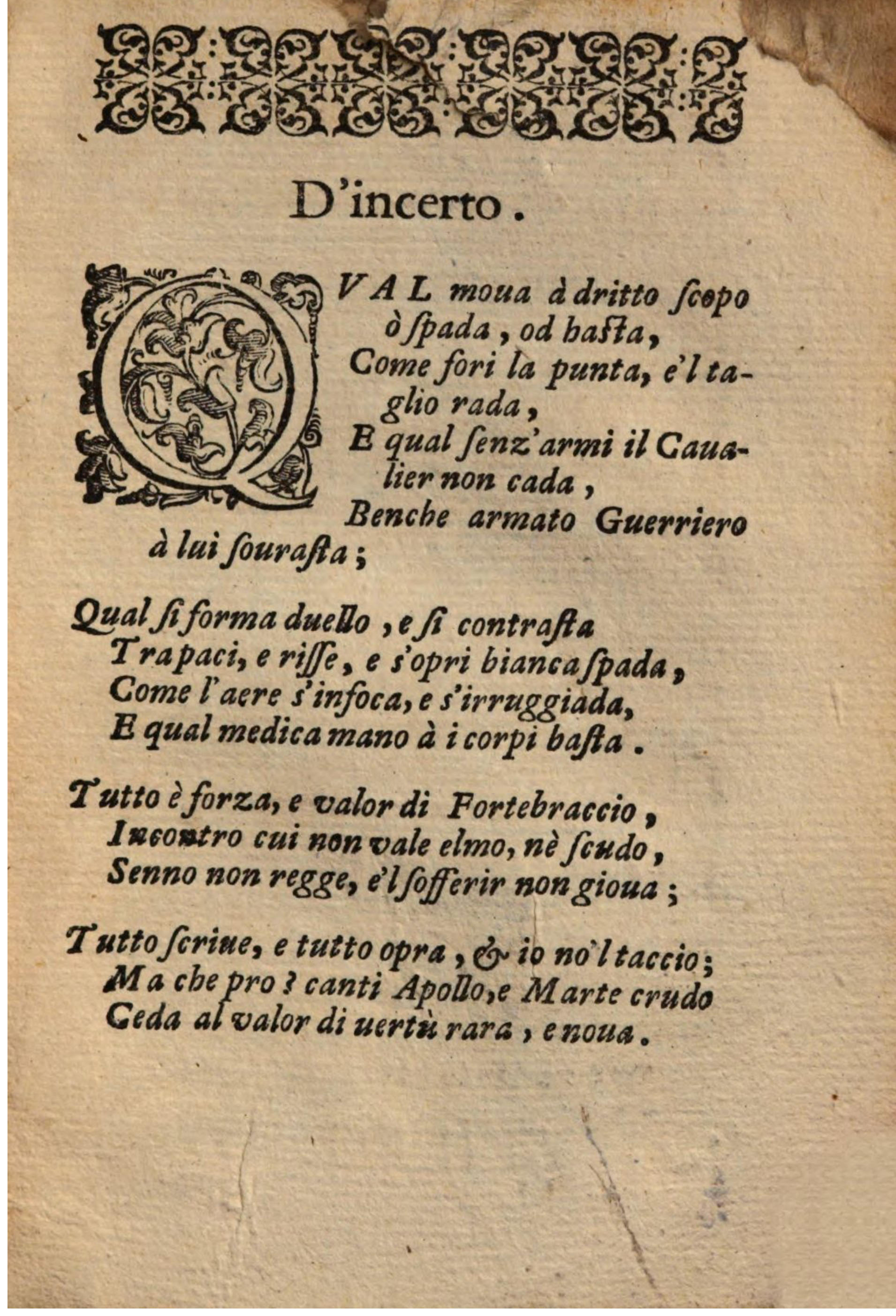
How one may move sword or pike toward its right target, how the point may pierce and the edge shave; and how, without weapons, the Cavalier does not fall, though an armed warrior looms over him;
how a duel is formed and contested amid peace and quarrels, and how the bianca spada [sharp/unblunted sword] is wielded; how the air catches fire and is bedewed; and what healing hand suffices for bodies:
all is the strength and valour of Fortebraccio, against whom neither helmet nor shield avails, wisdom does not govern, and endurance is of no use;
he writes it all and works it all, and I do not keep silent of it. But to what end? Let Apollo sing, and let cruel Mars yield to the valour of rare and novel virtue.
D'incerto .
[decorated initial: Q] V A L moua à dritto ſcopo
ò ſpada , od haſta ,
Come fori la punta, e'l ta-
glio rada ,
E qual ſenz'armi il Caua-
lier non cada ,
Benche armato Guerriero
à lui ſouraſta ;
Qual ſi forma duello , e ſi contraſta
Trà paci, e riſſe, e s'opri bianca ſpada ,
Come l'aere s'infoca, e s'irruggiada,
E qual medica mano à i corpi baſta .
Tutto è forza, e valor di Fortebraccio ,
Incontro cui non vale elmo, nè ſcudo ,
Senno non regge, e'l ſofferir non gioua ;
Tutto ſcriue, e tutto opra , & io no'l taccio ;
Ma che pro ? canti Apollo, e Marte crudo
Ceda al valor di uertù rara , e noua .
Scan p. 016 | printed p. [unnumbered]
Part I · Reason of State
Scan p. 017 | printed p. [unnumbered]
A DIALOGUE.
SPEAKERS
Braccioforte. Achille.
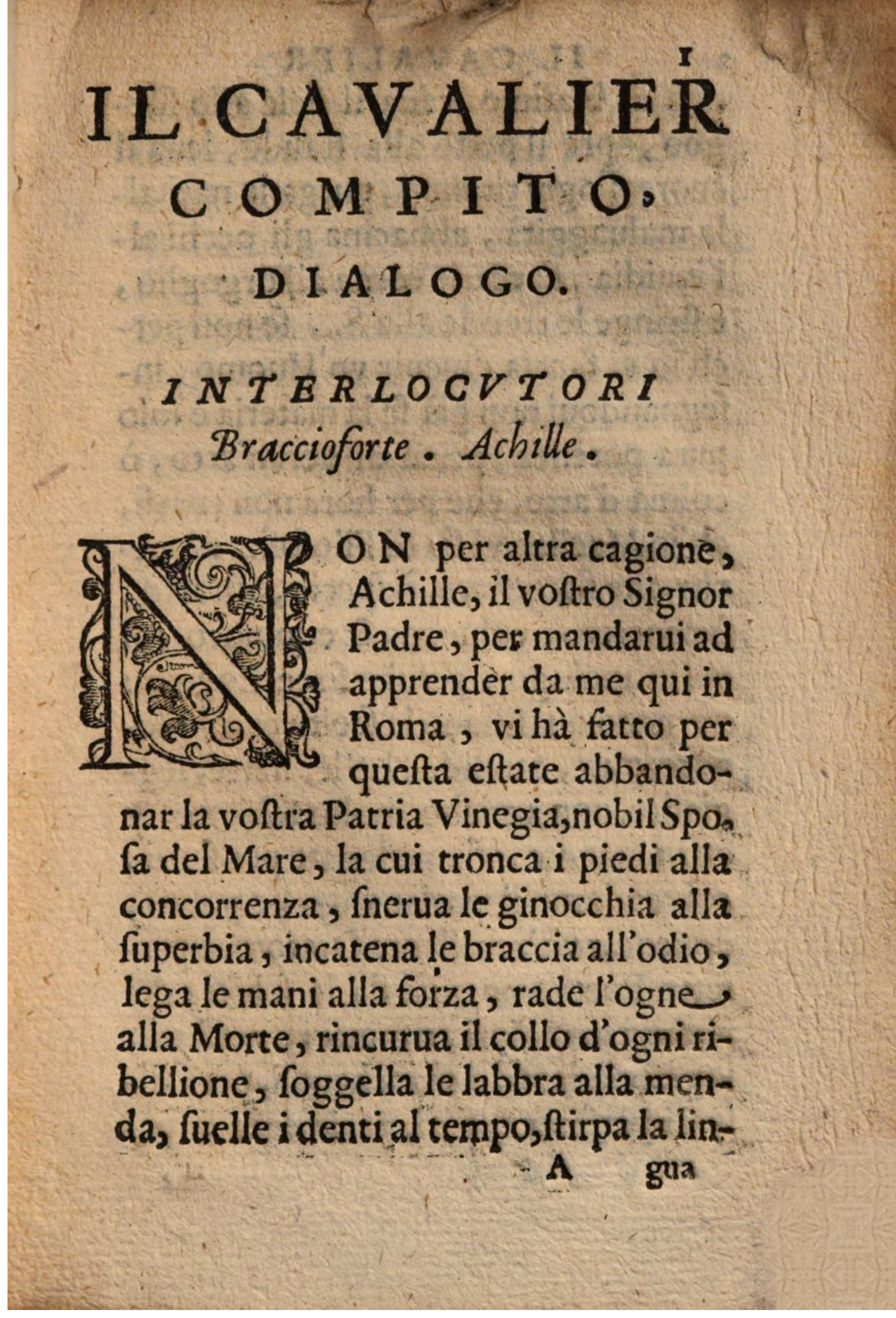
B.F. For no other reason, Achille, has your lord father, in sending you to study with me here in Rome, made you abandon for this summer your native Venice, that noble Bride of the Sea, she who cuts off the feet of rivalry, unnerves the knees of pride, chains the arms of hatred, binds the hands of force, pares the nails of Death, bends down the neck of every rebellion, seals the lips of falsehood, pulls out the teeth of time, uproots the tongue [continued next page]
COMPITO.
DIALOGO.
INTERLOCVTORI
Braccioforte . Achille .
[decorated initial: N] O N per altra cagione ,
Achille, il voſtro Signor
Padre , per mandarui ad
apprender da me qui in
Roma , vi hà fatto per
queſta eſtate abbando-
nar la voſtra Patria Vinegia, nobil Spo-
ſa del Mare , la cui tronca i piedi alla
concorrenza , ſnerua le ginocchia alla
ſuperbia , incatena le braccia all'odio ,
lega le mani alla forza , rade l'ogne
alla Morte , rincurua il collo d'ogni ri-
bellione , ſoggella le labbra alla men-
da, ſuelle i denti al tempo, ſtirpa la lin-
SIGNATURE: A
CATCHWORD: gua
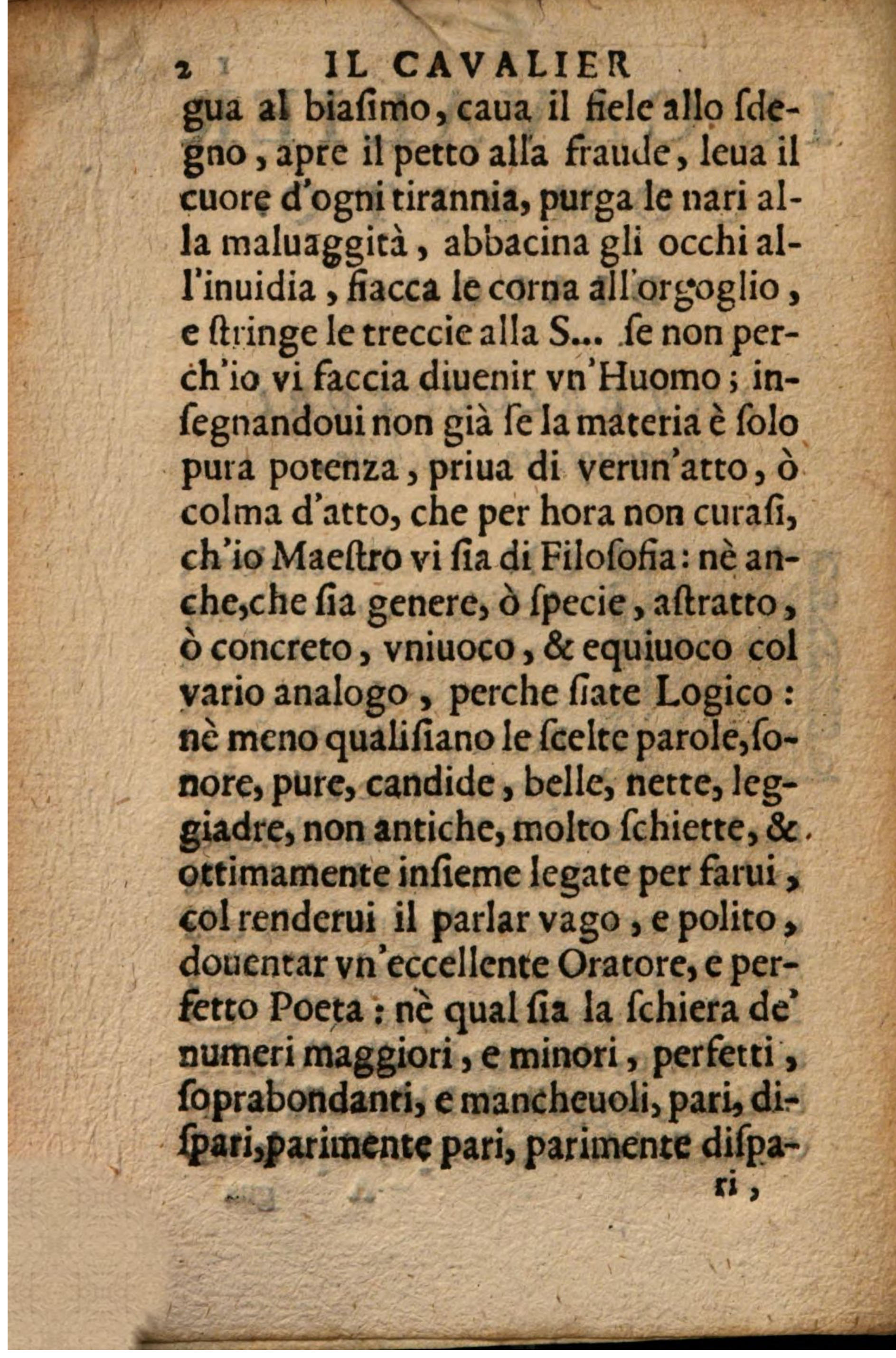
Scan p. 018 | printed p. 2
gua al biaſimo, caua il fiele allo ſde-
gno , apre il petto alla fraude , leua il
cuore d'ogni tirannia, purga le nari al-
la maluaggità , abbacina gli occhi al-
l'inuidia , fiacca le corna all'orgoglio ,
e ſtringe le treccie alla S... ſe non per-
ch'io vi faccia diuenir vn'Huomo ; in-
ſegnandoui non già ſe la materia è ſolo
pura potenza , priua di verun'atto , ò
colma d'atto, che per hora non curaſi,
ch'io Maeſtro vi ſia di Filoſofia : nè an-
che, che ſia genere, ò ſpecie, aſtratto ,
ò concreto , vniuoco , & equiuoco col
vario analogo , perche ſiate Logico :
nè meno qualiſiano le ſcelte parole, ſo-
nore, pure, candide , belle, nette, leg-
giadre, non antiche, molto ſchiette, &
ottimamente inſieme legate per farui ,
col renderui il parlar vago , e polito ,
douentar vn'eccellente Oratore, e per-
fetto Poeta : nè qual ſia la ſchiera de'
numeri maggiori , e minori , perfetti ,
ſoprabondanti , e mancheuoli, pari, di-
ſpari, parimente pari, parimente diſpa-
CATCHWORD: ri,
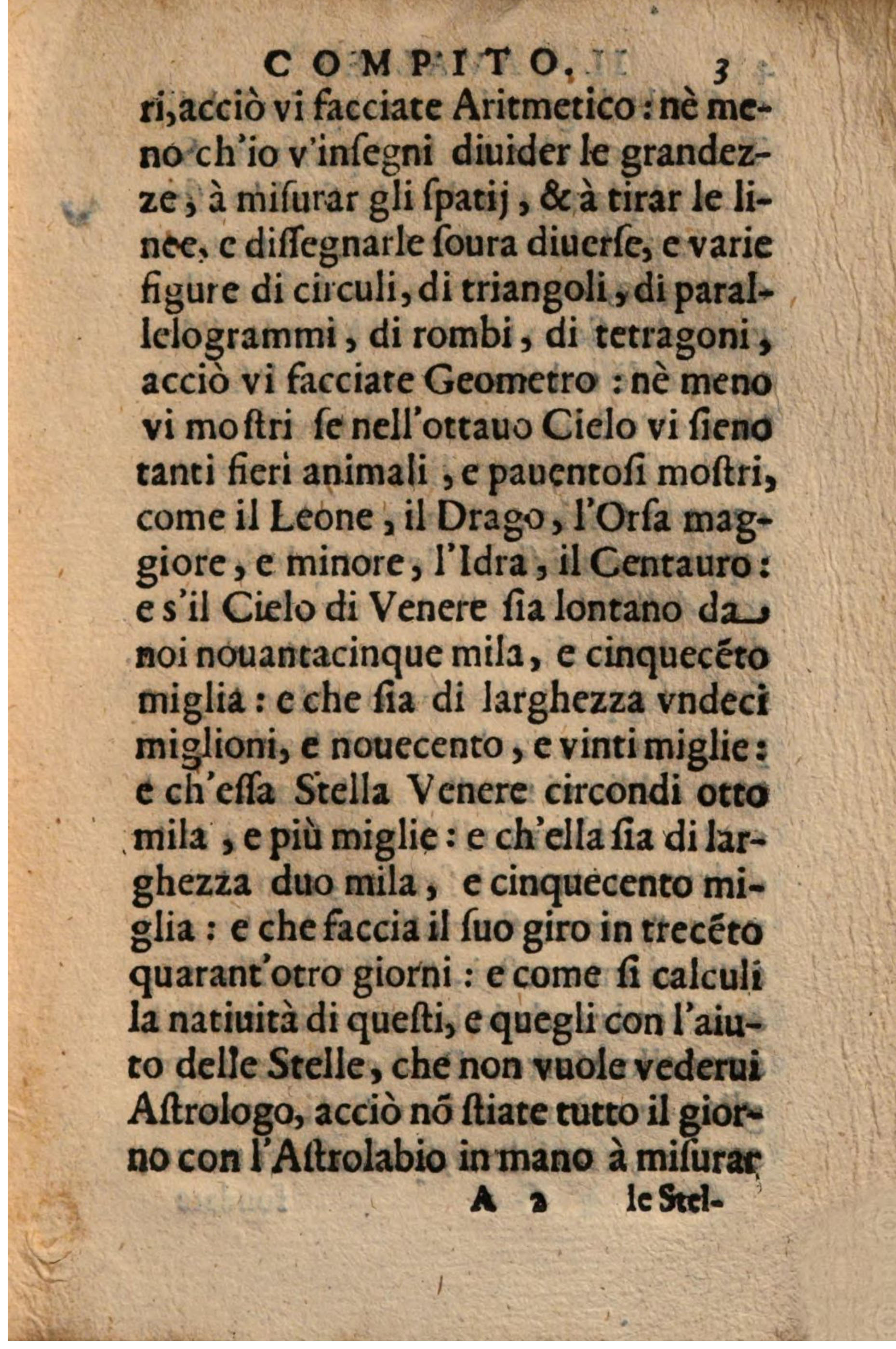
Scan p. 019 | printed p. 3
ri, acciò vi facciate Aritmetico : nè me-
no ch'io v'inſegni diuider le grandez-
ze, à miſurar gli ſpatij , & à tirar le li-
nee, e diſſegnarle ſoura diuerſe, e varie
figure di circuli, di triangoli , di paral-
lelogrammi , di rombi , di tetragoni ,
acciò vi facciate Geometro : nè meno
vi moſtri ſe nell'ottauo Cielo vi ſieno
tanti fieri animali , e pauentoſi moſtri,
come il Leone , il Drago, l'Orſa mag-
giore , e minore, l'Idra , il Centauro :
e s'il Cielo di Venere ſia lontano da
noi nouantacinque mila , e cinquecéto
miglia : e che ſia di larghezza vndeci
miglioni, e nouecento , e vinti miglie :
e ch'eſſa Stella Venere circondi otto
mila , e più miglie : e ch'ella ſia di lar-
ghezza duo mila , e cinquecento mi-
glia : e che faccia il ſuo giro in trecéto
quarant'otto giorni : e come ſi calculi
la natiuità di queſti, e quegli con l'aiu-
to delle Stelle, che non vuole vederui
Aſtrologo, acciò nó ſtiate tutto il gior-
no con l'Aſtrolabio in mano à miſurar
SIGNATURE: A 2
CATCHWORD: le Stel-
Scan p. 020 | printed p. 4
le Stelle di grandezza maggiori della
Terra : non che anche à penſar ſe Sa-
turno è pianeta maleuole, freddo, ſec-
co , e pallido : e che Gioue è tutto al
contrario, beneuole, caldo, & humido :
e che due ſieno i Poli del Mondo, l'Ar-
tico , ch'è nel Settentrione , e l'Antar-
tico, ch'è à lui contrapoſto verſo il me-
zo di, ſoura de' quali ſi volge , e gira
l'ampio Cielo : nè meno , che da me
ſappiate quai ſieno le virtù delle Pie-
tre , dell'Erbe , delle Piante , la natura
de gl'Animali, de' Fonti, e ciò , che s'è
fatto doppo ch'il Mondo è Mondo, che
per hora non vuol vederui Iſtorico , nè
meno ch'io vi maeſtri nel ſuono , e nel
canto, acciò tutto il dì non ſtate à rad-
dolcir vn cuor di ſmalto , non che di
vaga, & amata fanciulla ; mà ſi bene
ch'io vi ammaeſtri , & affini nell'armi ,
& à lui vi renda in breue vn'inuincibil,
e nouello Marte . Però attendete à pi-
gliar da mè maturi conſigli , nuoue
creanze, acuti detti, ſpiritoſe ſentenze,
CATCHWORD: fondate
Scan p. 021 | printed p. 5
Ach. For pity's sake, Master, begin to teach me, for here I am under your discipline, all spirited and courageous, so as to bring you in a short space of time the greatest honour possible, since your valour gives me such daring that, although I am ignorant in arms, I seem to myself to be expert, and to fear no living soul.
B.F. Very willingly I will show you...
fondate facetie , e capriccioſe lettioni
d'armi da mè nuouamente inuentate
con mirabil giudicio, e con forza indi-
cibile, e deſtra del mio robuſto corpo :
lettioni inuero, che quando io ve l'ha-
uerò inſegnate , e che con auantaggio
le ſaprete eſequir in tempo debito , co-
me ſoglio far'io , vengaui pur innanzi
chi vuole, che, benche leſto , prattico ,
e famoſo Maeſtro di Scherma ſia , voi
lo batterete con quella facilità , che
da buon ſcolaro ſi batte , e vince vn
rozzo principiante .
Ach. Per gratia Sig. Maeſtro date prin-
cipio ad inſegnarmi , ch'eccomi ſotto
la diſciplina voſtra tutt'animoſo , e
e coraggioſo , per renderui in poco
ſpatio di tempo quel maggior hono-
re, che poſſibil ſia , poiche il valor vo-
ſtro mi dà vn'ardire, che, benche igno-
rante io ſia nell'armi, eſperto mi par di
eſſere , e di non hauer paura d'alma
viuente .
B. F. Di molta buona voglia vi moſtrarò
SIGNATURE: A 3
CATCHWORD: qué-
Scan p. 022 | printed p. 6
queſta mattina buona parte dell'armi-
gera arte mia , la quale mi hà fatto , e
fa portar in palma di mano da' Prenci-
pi , & in cima delle berette da' Braui ,
& amar come vn nuouo Orlando, riue-
rir come vn alto Rodomonte, e ſeruir
come vn altro Marte . Et prima , che
à queſto molto illuſtre documéto d'ar-
mi io venga , è bene , che molte varie
coſe conuenienti ad vn compito Caua-
liero io vi moſtri, & inſegni ; accioche
in tutto il tempo della vita voſtra ve
ne ſappiate ſeruire, e far honore, & ac-
quiſtarne eterna fama ; e felice voi ſe
vi reſta à memoria vn paro d'hore del
ſciétiato diſcorſo, che voglio farui per
renderui dotto al módo , & immortale.
Hor imparate in prima vna quantità di
dubbi di ragione di Stato più princi-
pali, acciò quando trà Principi vi ritro-
uarete à diſcorrere ſoura tal materia ,
facciate reſtar loro merauigliati , atto-
niti, ſtupidi, e muti inſieme : e da voi
più toſto imparino, che v'inſegnino ,
CATCHWORD: che
Scan p. 023 | printed p. 7
Ach. These problems, yes, I am eager to learn from you, so valiant and rare, so that in occurrences I may know how to avail myself of them, and show that I know how to discourse of such important and lofty matter, not to mention question and leave valiant men in such a profession as if they were so many blockheads and owls; now begin, for most attentively I hear you.
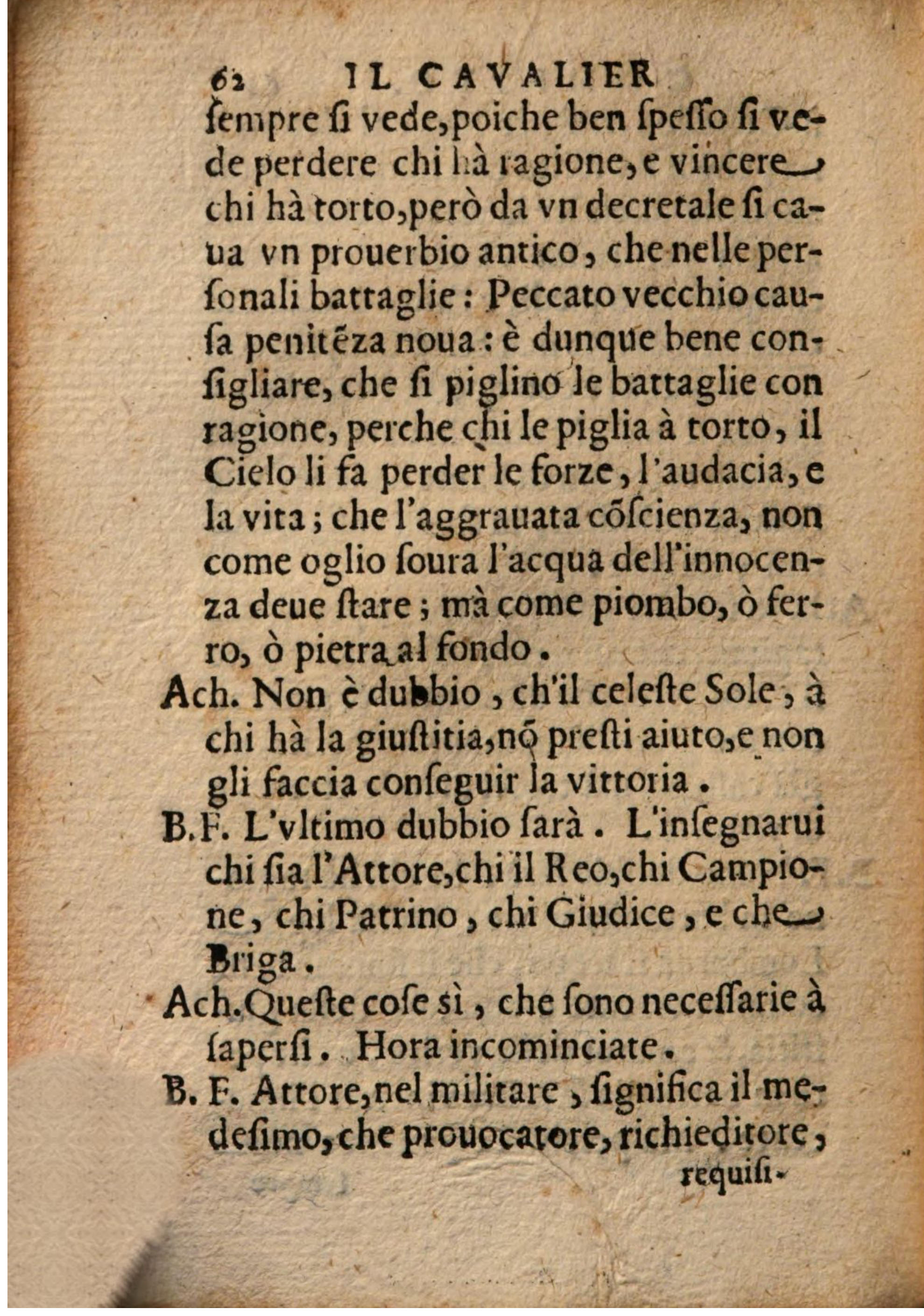
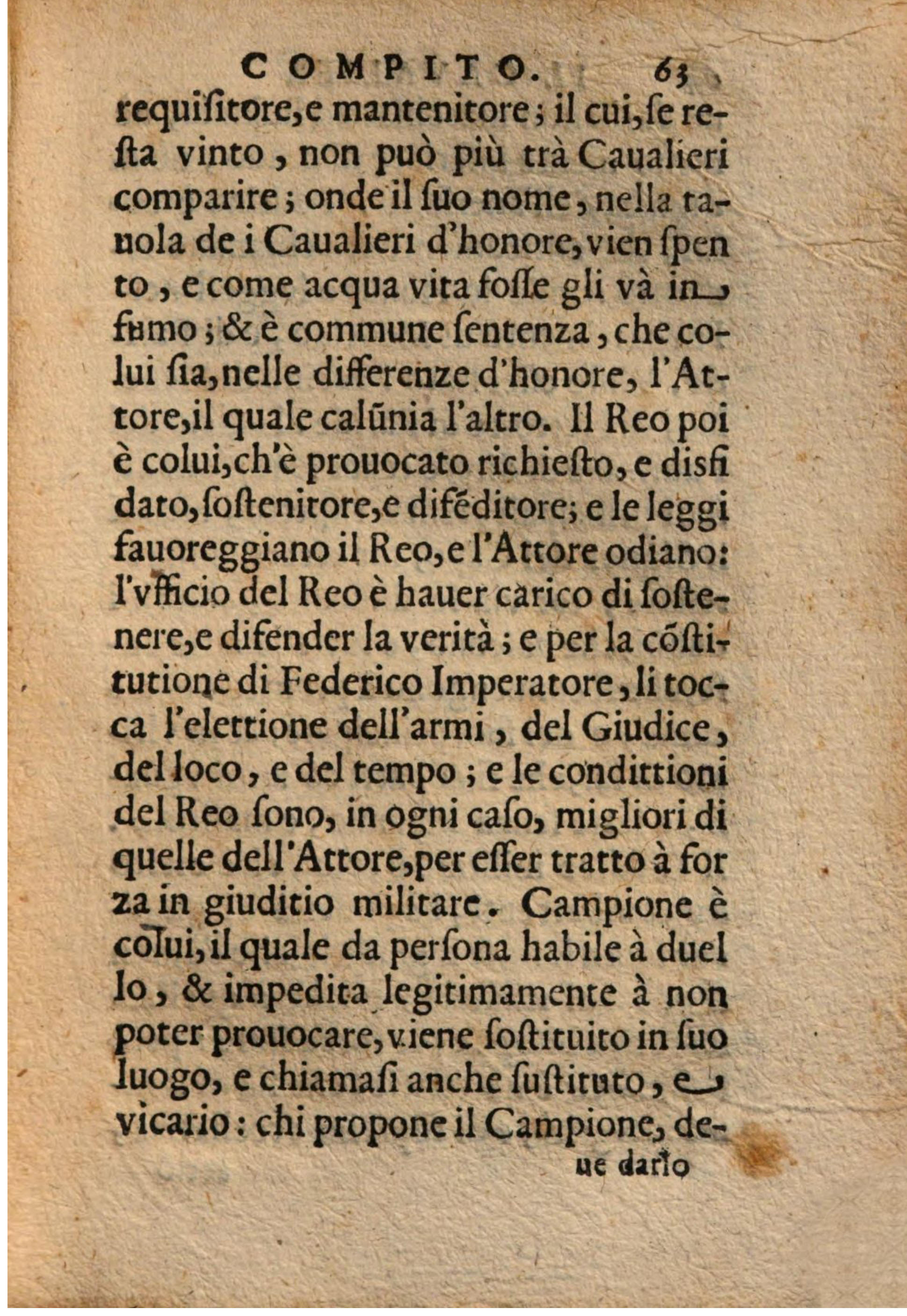
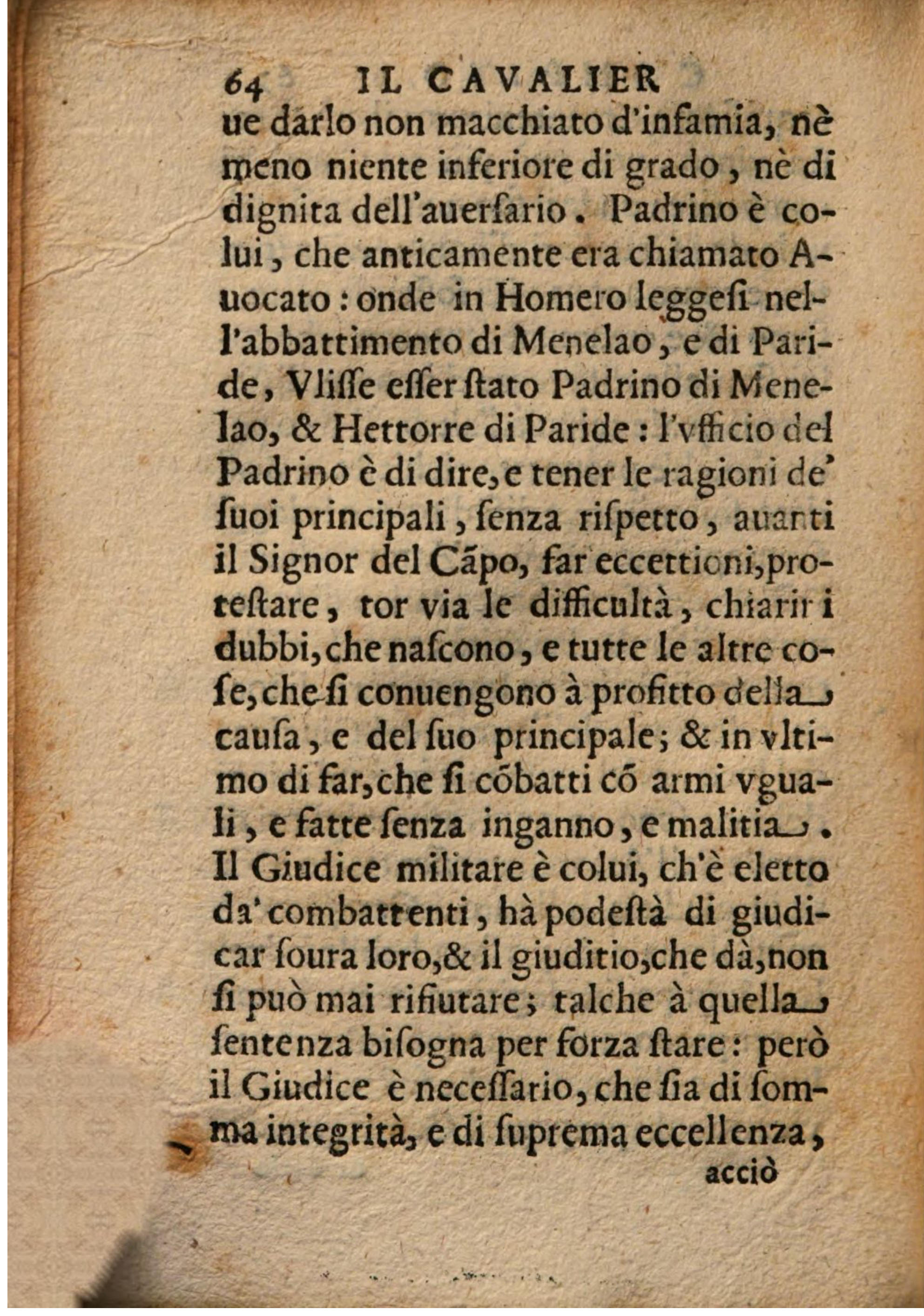
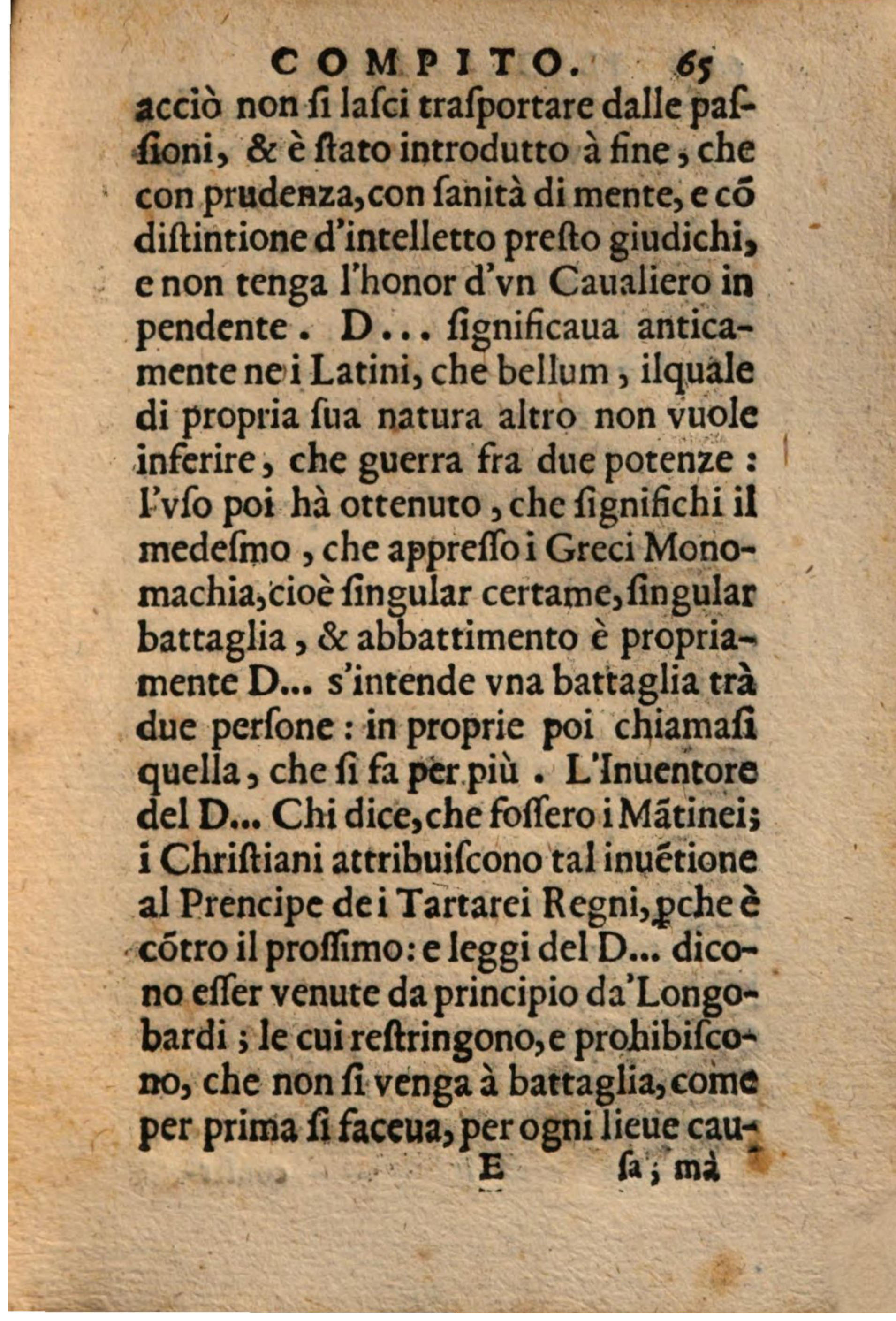
B.F. The first problem, my Achille, will be this. What is the proper charge of the Prince. And that you may know the opinion of many, discordant among themselves, who say the proper operation of the Prince is administering Justice, others in attending that abundance thrives, others in giving ear to the poor and to the rich, and others in studies so as to be able prudently to deliberate. But I, differing from all these, say that the...
che coſì apportarete lode al voſtro no-
me, ſplendor alla voſtra Patria, & ho-
nore al Maeſtro .
Ach. Queſti dubbi ſì, che hò à caro d'im-
parare da voi tanto valente, e raro, ac-
ciò nelle occorrenze io me ne ſappia
preualere , e moſtrare ch'io ſò diſcor-
rere di coſì importante , & alta mate-
ria , non che interrogare , e far reſtar
gli huomini valenti in ſimile profeſ-
ſione come tanti zoccoli , e barba-
gianni ; hor principiate , che attentiſ-
ſimo v'odo .
B. F. Il primiero dubbio, Achille mio, ſa-
rà queſto . Qual ſia il proprio carico
del Prencipe. E perche tù ſappi l'opi-
nione di molti, trà loro diſcordanti, i
quali dicono eſſer la propria operatio-
ne del Prencipe l'amminiſtrar la Giu-
ſtitia, altri in attender , che l'abondan-
za viua, altri in dar orecchie à i poue-
ri, & à i ricchi, & altri in ſtudij per po-
ter prudentemente deliberare . Mà io
differente da tutti coſtoro, dico, ch'il
SIGNATURE: A 4
CATCHWORD: pro-
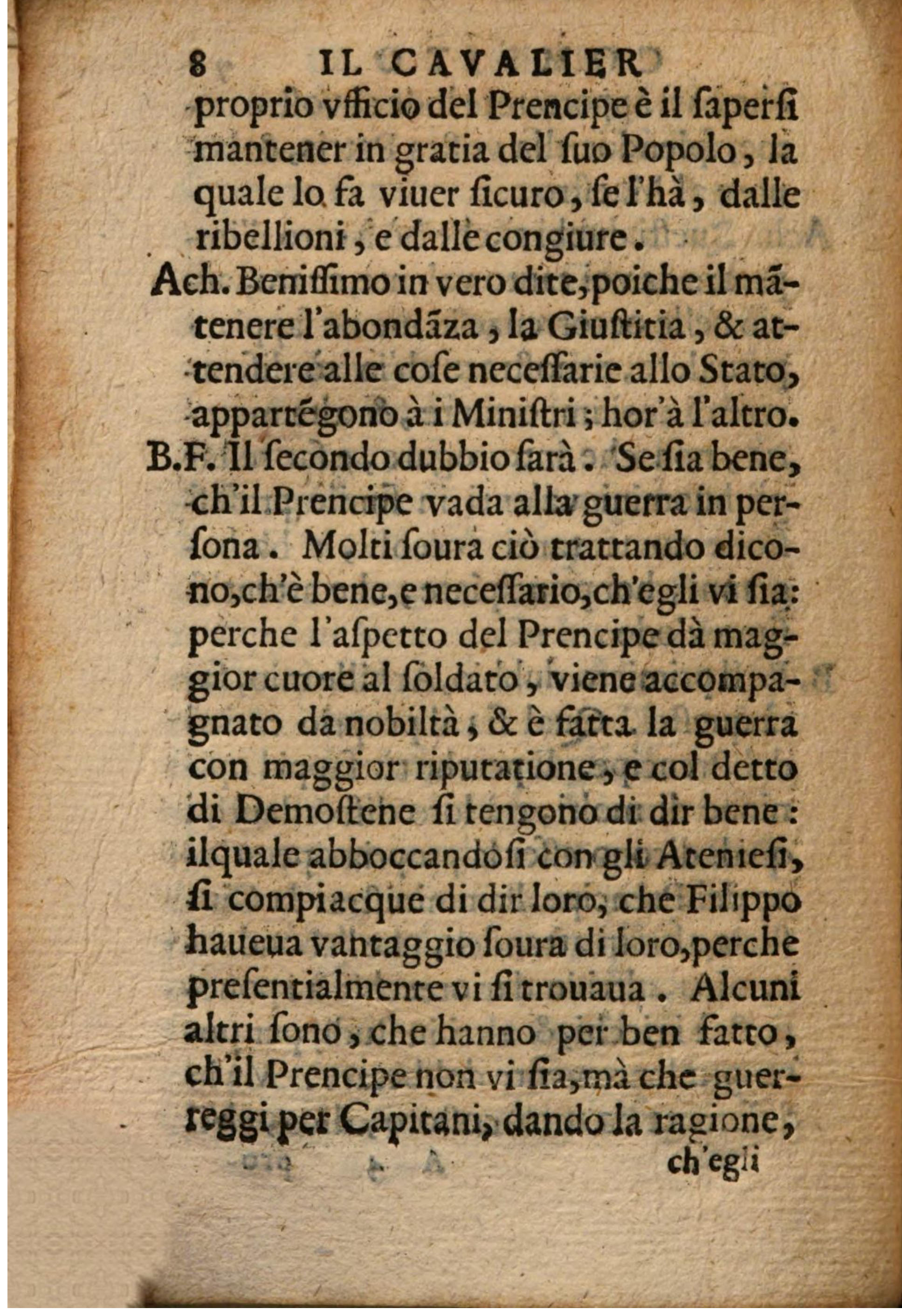
Scan p. 024 | printed p. 8
Ach. Very well indeed you say, since the maintaining of abundance, of Justice, and attending to the things necessary to the State, belong to the Ministers; now to the next.
B.F. The second problem will be. Whether it is well that the Prince go to war in person. Many, treating upon this, say that it is well and necessary that he be there: because the presence of the Prince gives greater heart to the soldier, is accompanied by nobility, and the war is made with greater reputation, and with the saying of Demosthenes they hold themselves to speak well: who, conferring with the Athenians, was pleased to tell them that Philip had advantage over them, because he was present there in person. Some others there are who hold it well done that the Prince not be there, but that he wage war through Captains, giving the reason...
proprio vfficio del Prencipe è il ſaperſi
mantener in gratia del ſuo Popolo , la
quale lo fa viuer ſicuro, ſe l'hà , dalle
ribellioni , e dalle congiure .
Ach. Beniſſimo in vero dite, poiche il má-
tenere l'abondáza , la Giuſtitia , & at-
tendere alle coſe neceſſarie allo Stato,
appartégono à i Miniſtri ; hor'à l'altro.
B. F. Il ſecondo dubbio farà . Se ſia bene,
ch'il Prencipe vada alla guerra in per-
ſona . Molti ſoura ciò trattando dico-
no, ch'è bene, e neceſſario, ch'egli vi ſia :
perche l'aſpetto del Prencipe dà mag-
gior cuore al ſoldato , viene accompa-
gnato da nobiltà , & è fatta la guerra
con maggior riputatione , e col detto
di Demoſtene ſi tengono di dir bene :
ilquale abboccandoſi con gli Ateneſi,
ſi compiacque di dir loro, che Filippo
haueua vantaggio ſoura di loro, perche
preſentialmente vi ſi trouaua . Alcuni
altri ſono , che hanno per ben fatto ,
ch'il Prencipe non vi ſia, mà che guer-
reggi per Capitani, dando la ragione,
CATCHWORD: ch'egli
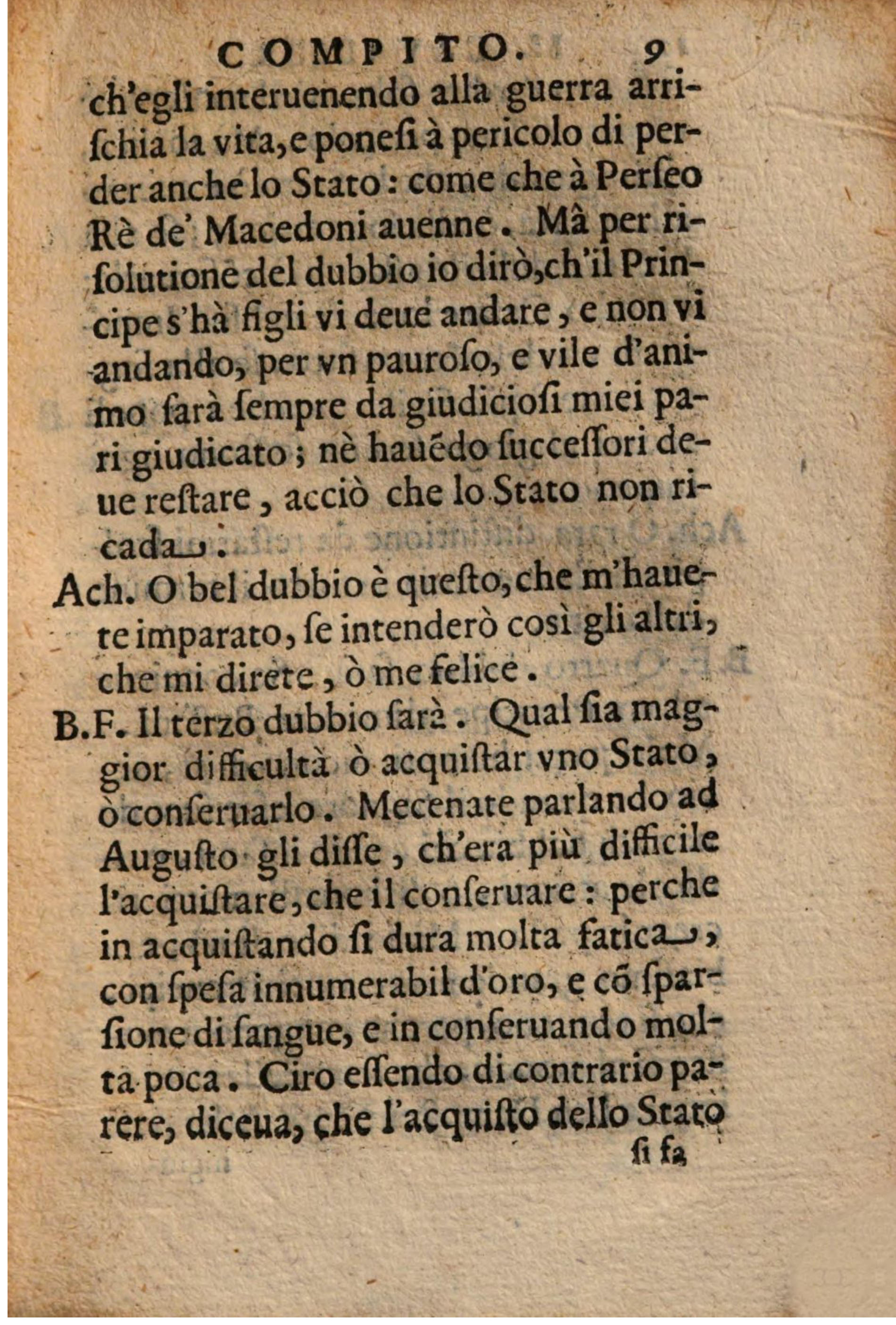
Scan p. 025 | printed p. 9
Ach. Oh, a fine problem is this that you have taught me; if I understand the others you will tell me thus, oh happy me.
B.F. The third problem will be. Which is the greater difficulty, either to acquire a State, or to preserve it. Maecenas, speaking to Augustus, told him that it was more difficult to acquire than to preserve: because in acquiring one endures much toil, with innumerable expense of gold, and with shedding of blood, and in preserving either very little. Cyrus, being of contrary opinion, said that the acquisition of the State...
ch'egli interuenendo alla guerra arri-
ſchia la vita, e poneſi à pericolo di per-
der anche lo Stato : come che à Perſeo
Rè de' Macedoni auenne . Mà per ri-
ſolutione del dubbio io dirò, ch'il Prin-
cipe s'hà figli vi deue andare , e non vi
andando, per vn pauroſo, e vile d'ani-
mo ſarà ſempre da giudicioſi miei pa-
ri giudicato ; nè hauédo ſucceſſori de-
ue reſtare , acciò che lo Stato non ri-
cada .
Ach. O bel dubbio è queſto, che m'haue-
te imparato, ſe intenderò coſì gli altri,
che mi direte , ò me felice .
B. F. Il terzo dubbio farà . Qual ſia mag-
gior difficultà ò acquiſtar vno Stato ,
ò conſeruarlo . Mecenate parlando ad
Auguſto gli diſſe , ch'era più difficile
l'acquiſtare, che il conſeruare : perche
in acquiſtando ſi dura molta fatica ,
con ſpeſa innumerabil d'oro, e có ſpar-
ſione di ſangue, e in conſeruando o mol-
ta poca . Ciro eſſendo di contrario pa-
rere, diceua, che l'acquiſto dello Stato
CATCHWORD: ſi fa
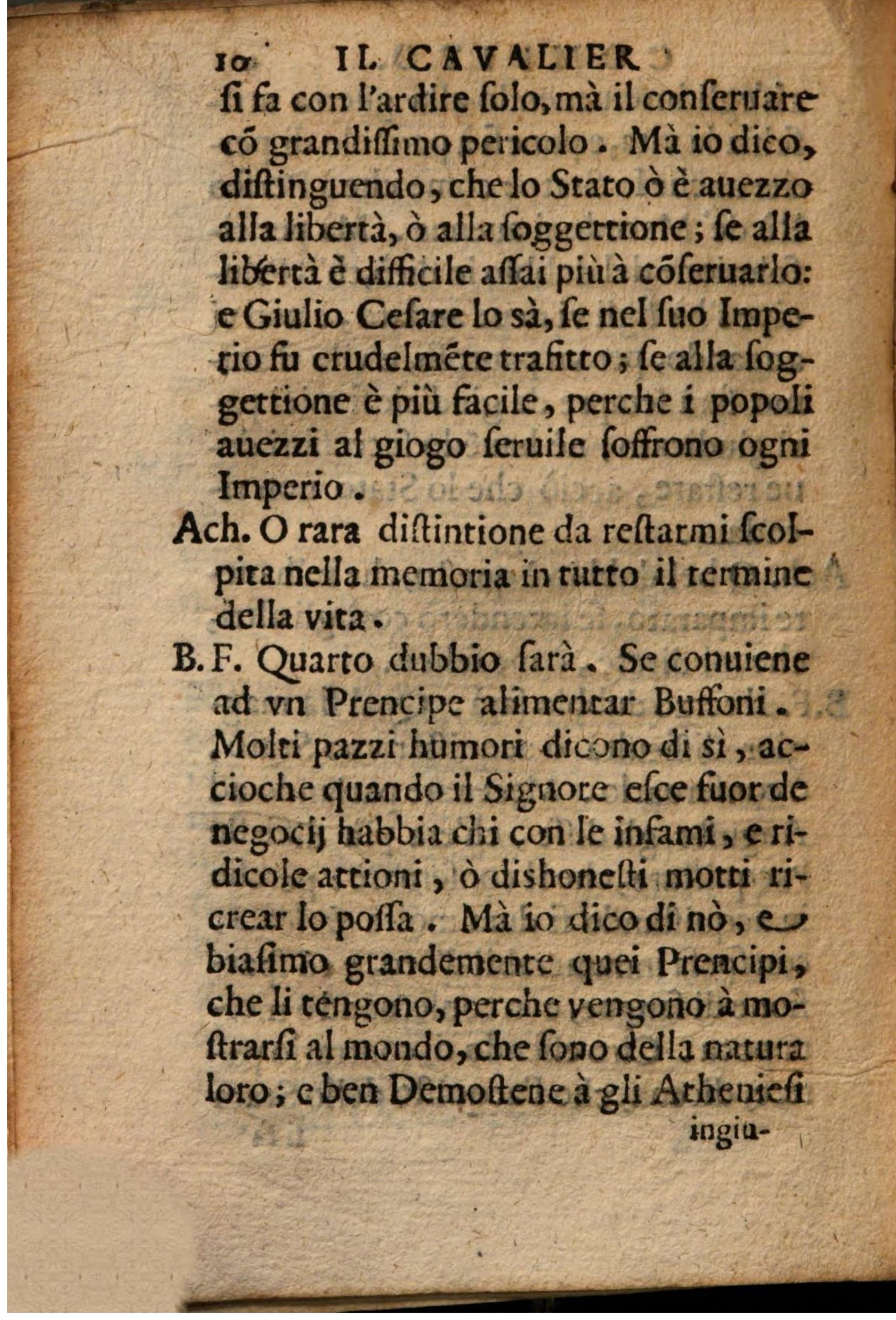
Scan p. 026 | printed p. 10
Ach. Oh, a rare distinction, to remain carved in my memory for the whole term of my life.
B.F. The fourth problem will be. Whether it befits a Prince to maintain Buffoons. Many mad humours say yes, so that when the Lord comes forth from his business he may have someone who with infamous and ridiculous actions, or dishonest jests, can recreate him. But I say no, and I greatly blame those Princes who keep them, because they come to show to the world that they are of their nature; and well did Demosthenes to the Athenians...
ſi fa con l'ardire ſolo, mà il conſeruare
có grandiſſimo pericolo . Mà io dico,
diſtinguendo, che lo Stato ò è auezzo
alla libertà, ò alla ſoggettione ; ſe alla
libertà è difficile aſſai più à cóſeruarlo:
e Giulio Ceſare lo sà, ſe nel ſuo Impe-
rio fu crudelméte trafitto ; ſe alla ſog-
gettione è più facile , perche i popoli
auezzi al giogo ſeruile ſoffrono ogni
Imperio .
Ach. O rara diſtintione da reſtarmi ſcol-
pita nella memoria in tutto il termine
della vita .
B. F. Quarto dubbio farà . Se conuiene
ad vn Prencipe alimentar Buffoni .
Molti pazzi humori dicono di ſì , ac-
cioche quando il Signore eſce fuor de
negocij habbia chi con le infami , e ri-
dicole attioni , ò dishoneſti motti ri-
crear lo poſſa . Mà io dico di nò , e
biaſimo grandemente quei Prencipi ,
che li tengono, perche vengono à mo-
ſtrarſi al mondo, che ſono della natura
loro ; e ben Demoſtene à gli Atenieſi
CATCHWORD: ingiu-
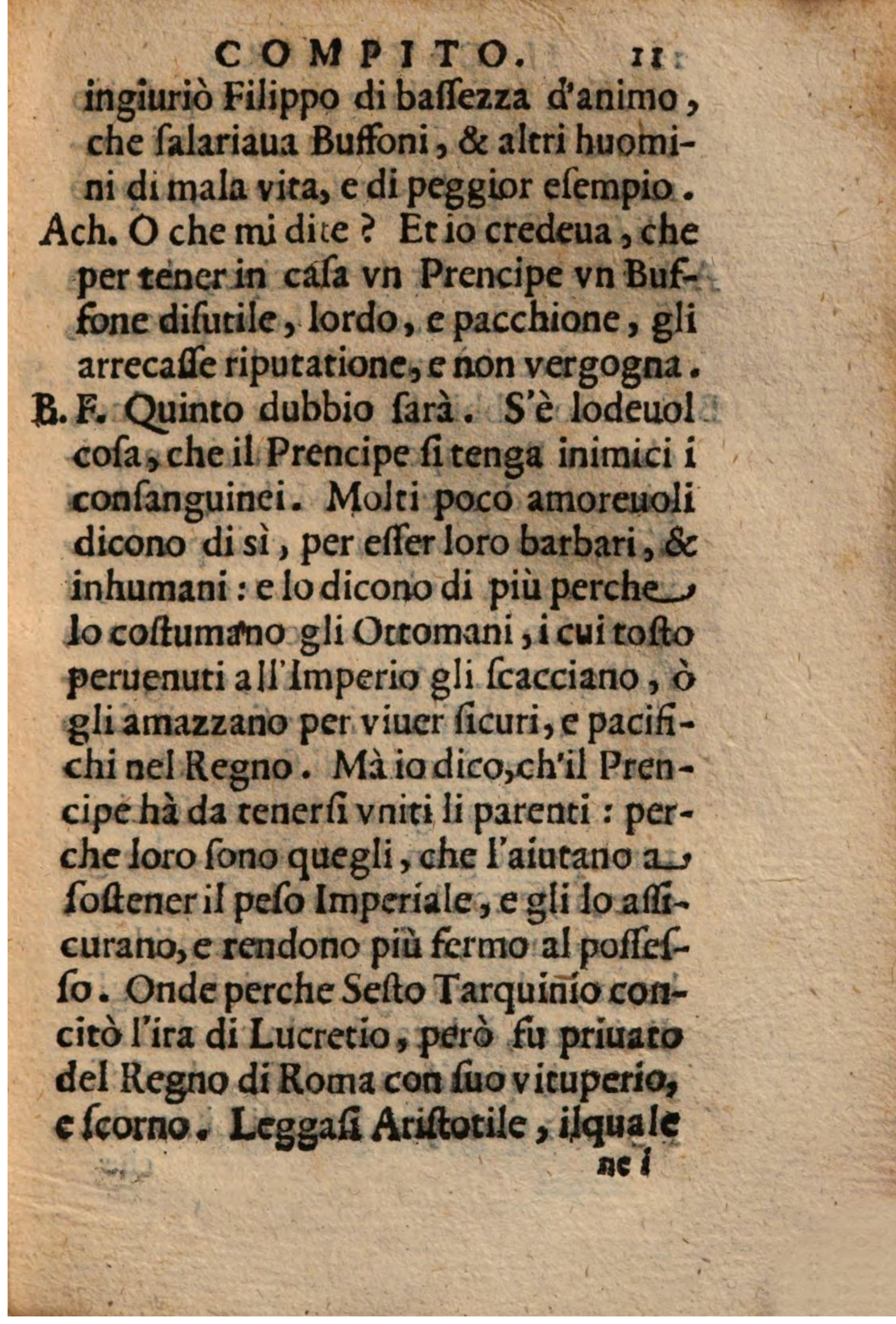
Scan p. 027 | printed p. 11
Ach. Oh, what do you tell me? And I believed that for a Prince to keep in his house a useless, filthy, gluttonous Buffoon brought him reputation, and not shame.
B.F. The fifth problem will be. Whether it is a praiseworthy thing that the Prince hold his blood-relatives as enemies. Many who are little loving say yes, they being barbarous and inhuman: and they say it moreover because the Ottomans practise it, who, as soon as come to the Empire, drive them out, or kill them, to live secure and peaceful in the Kingdom. But I say that the Prince must keep his kinsmen united: because they are the ones who help him to sustain the Imperial weight, and secure it for him, and render it firmer in possession. Whence, because Sextus Tarquinius stirred up the wrath of Lucretius, he was for that reason deprived of the Kingdom of Rome, to his vituperation and scorn. Let Aristotle be read, who...
ingiuriò Filippo di baſſezza d'animo ,
che ſalariaua Buffoni , & altri huomi-
ni di mala vita, e di peggior eſempio .
Ach. O che mi dite ? Et io credeua , che
per tener in caſa vn Prencipe vn Buf-
fone diſutile , lordo, e pacchione , gli
arrecaſſe riputatione, e non vergogna .
B. F. Quinto dubbio ſarà . S'è lodeuol
coſa, che il Prencipe ſi tenga inimici i
conſanguinei . Molti poco amoreuoli
dicono di ſì , per eſſer loro barbari, &
inhumani : e lo dicono di più perche
lo coſtumano gli Ottomani, i cui toſto
peruenuti all'Imperio gli ſcacciano , ò
gli amazzano per viuer ſicuri, e pacifi-
chi nel Regno . Mà io dico, ch'il Pren-
cipe hà da tenerſi vniti li parenti : per-
che loro ſono quegli, che l'aiutano a
ſoſtener il peſo Imperiale, e gli lo aſſi-
curano, e rendono più fermo al poſſeſ-
ſo . Onde perche Seſto Tarquinio con-
citò l'ira di Lucretio , però fu priuato
del Regno di Roma con ſuo vituperio,
e ſcorno . Leggaſi Ariſtotile , ilquale
CATCHWORD: ne i
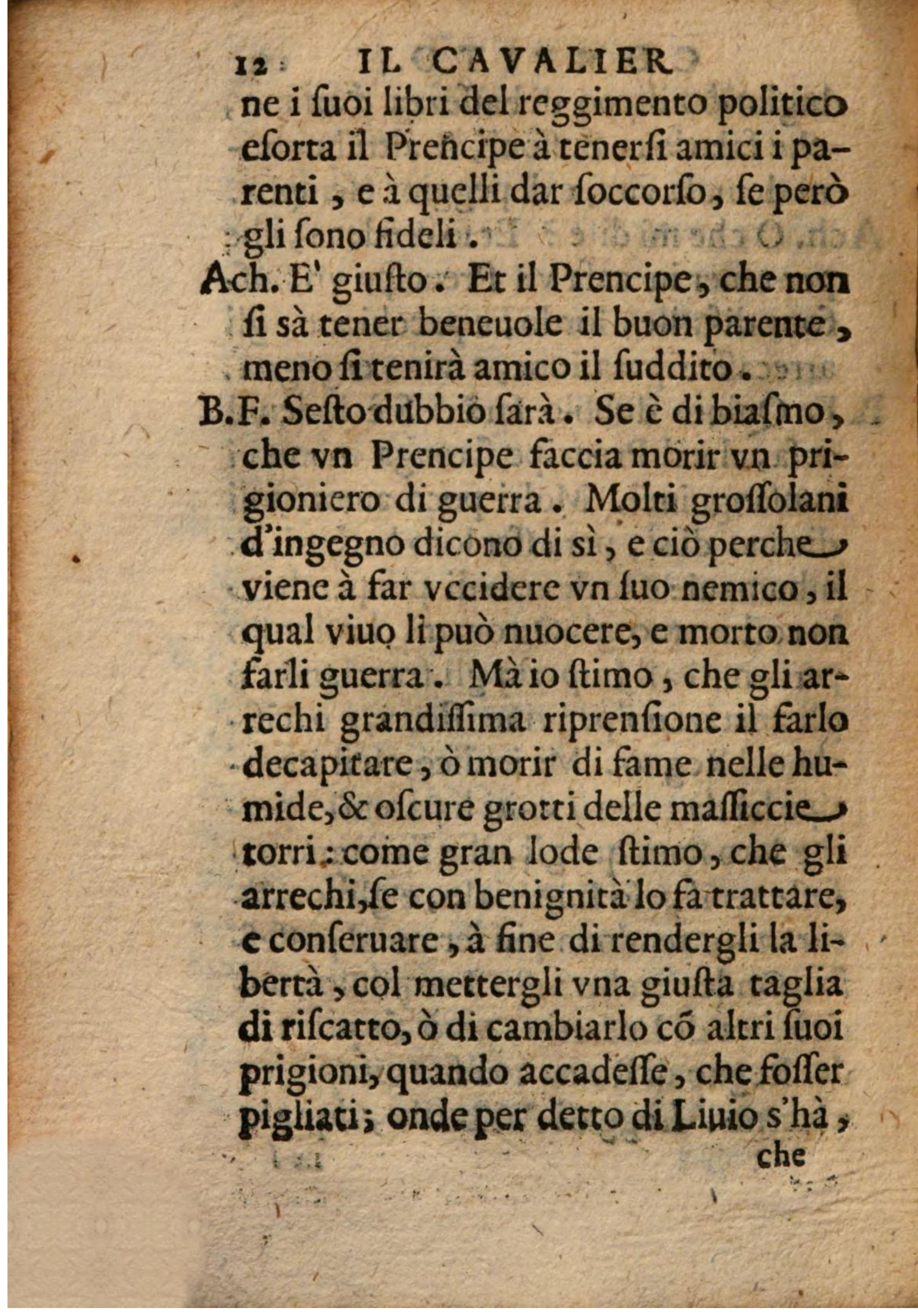
Scan p. 028 | printed p. 12
Ach. It is just. And the Prince who does not know how to keep the good kinsman well-disposed, will keep the subject friendly still less.
B.F. The sixth problem will be. Whether it is blameworthy that a Prince put to death a prisoner of war. Many coarse of wit say yes, and this because he comes to have killed an enemy of his, who alive can harm him, and dead cannot make war on him. But I esteem that it brings him the greatest reprehension to have him beheaded, or die of hunger in the humid and dark grottoes of the massive towers: just as I esteem that it brings him great praise if with kindness he has him treated and preserved, with the aim of restoring his liberty to him, by setting on him a just ransom price, or of exchanging him for other prisoners of his, should it happen that they be taken; whence by the saying of Livy one has...
ne i ſuoi libri del reggimento politico
eſorta il Prencipe à tenerſi amici i pa-
renti , e à quelli dar ſoccorſo, ſe però
gli ſono fideli .
Ach. E' giuſto . Et il Prencipe, che non
ſi sà tener beneuole il buon parente ,
meno ſi tenirà amico il ſuddito .
B. F. Seſto dubbio ſarà . Se è di biaſmo ,
che vn Prencipe faccia morir vn pri-
gioniero di guerra . Molti groſſolani
d'ingegno dicono di ſì , e ciò perche
viene à far vccidere vn ſuo nemico, il
qual viuo li può nuocere, e morto non
farli guerra . Mà io ſtimo, che gli ar-
rechi grandiſſima riprenſione il farlo
decapitare , ò morir di fame nelle hu-
mide, & oſcure grotti delle maſſiccie
torri: come gran lode ſtimo, che gli
arrechi, ſe con benignità lo fa trattare,
e conſeruare , à fine di rendergli la li-
bertà , col mettergli vna giuſta taglia
di riſcatto, ò di cambiarlo có altri ſuoi
prigioni, quando accadeſſe, che foſſer
pigliati ; onde per detto di Liuio s'hà ,
CATCHWORD: che
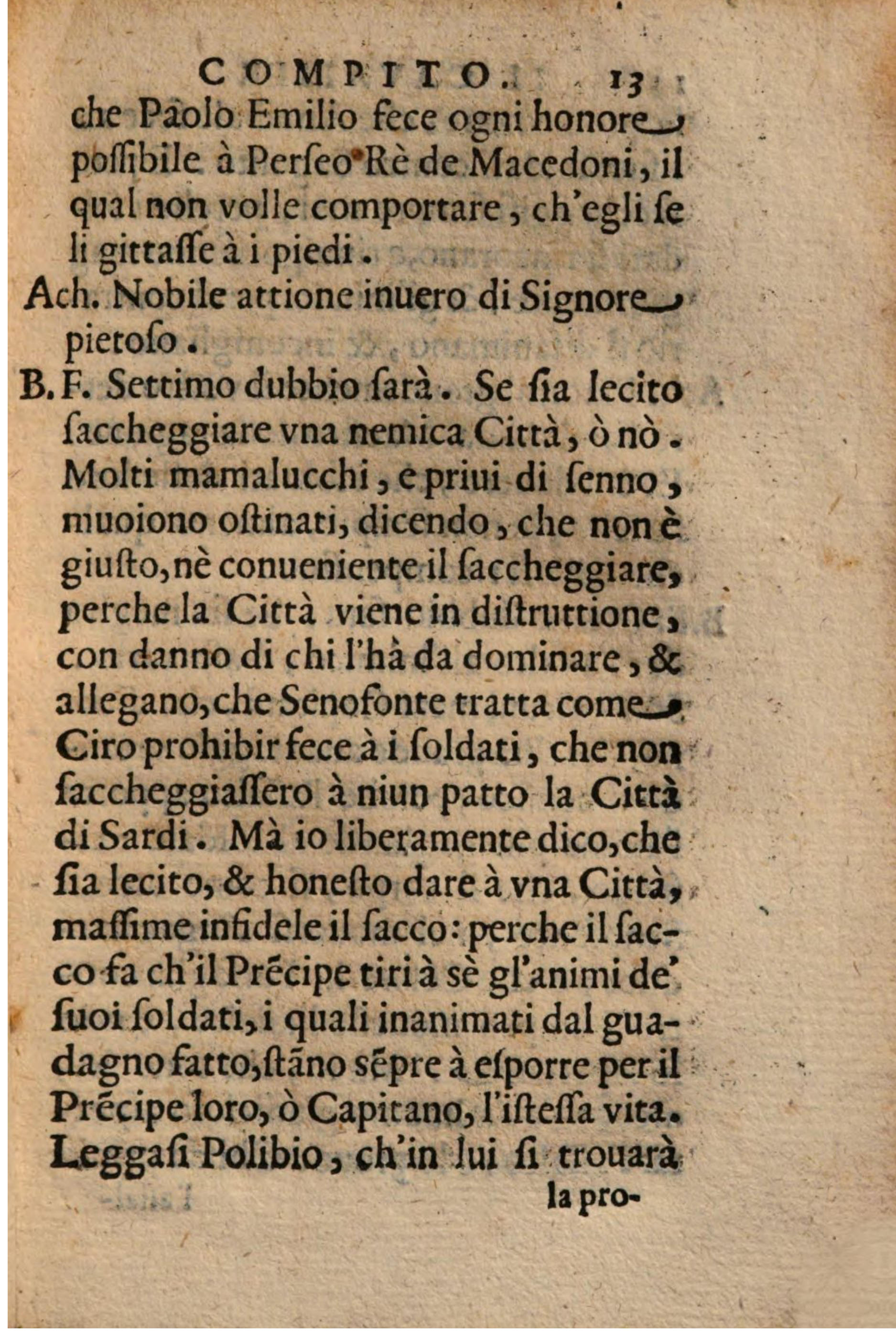
Scan p. 029 | printed p. 13
Ach. A noble action indeed of a compassionate Lord.
B.F. The seventh problem will be. Whether it is lawful to sack an enemy City, or not. Many mamelukes, and deprived of sense, die obstinate, saying that it is not just, nor fitting, to sack, because the City comes into destruction, with damage to him who has to rule it, and they allege that Xenophon treats how Cyrus made prohibit to the soldiers that they not sack on any account the City of Sardis. But I freely say that it is lawful and honest to give a City, especially an infidel one, over to the sack: because the sack makes the Prince draw to himself the spirits of his soldiers, who, animated by the gain made, stand always ready to expose, for their Prince or Captain, their very life. Let Polybius be read, for in him one will find...
che Pàolo Emilio fece ogni honore
poſſibile à Perſeo Rè de Macedoni, il
qual non volle comportare, ch’egli ſe
li gittaſſe à i piedi.
Ach. Nobile attione inuero di Signore
pietoſo.
B. F. Settimo dubbio ſarà. Se ſia lecito
ſaccheggiare vna nemica Città, ò nò.
Molti mamalucchi, e priui di ſenno,
muoiono oſtinati, dicendo, che non è
giuſto, nè conueniente il ſaccheggiare,
perche la Città viene in diſtruttione,
con danno di chi l’hà da dominare, &
allegano, che Senofonte tratta come
Ciro prohibir fece à i ſoldati, che non
ſaccheggiaſſero à niun patto la Città
di Sardi. Mà io liberamente dico, che
ſia lecito, & honeſto dare à vna Città,
maſſime infidele il ſacco: perche il ſac-
co fa ch’il Précipe tiri à ſè gl’animi de’
ſuoi ſoldati, i quali inanimati dal gua-
dagno fatto, ſtáno ſépre à eſporre per il
Précipe loro, ò Capitano, l’iſteſſa vita.
Leggaſi Polibio, ch’in lui ſi trouarà
CATCHWORD: la pro-
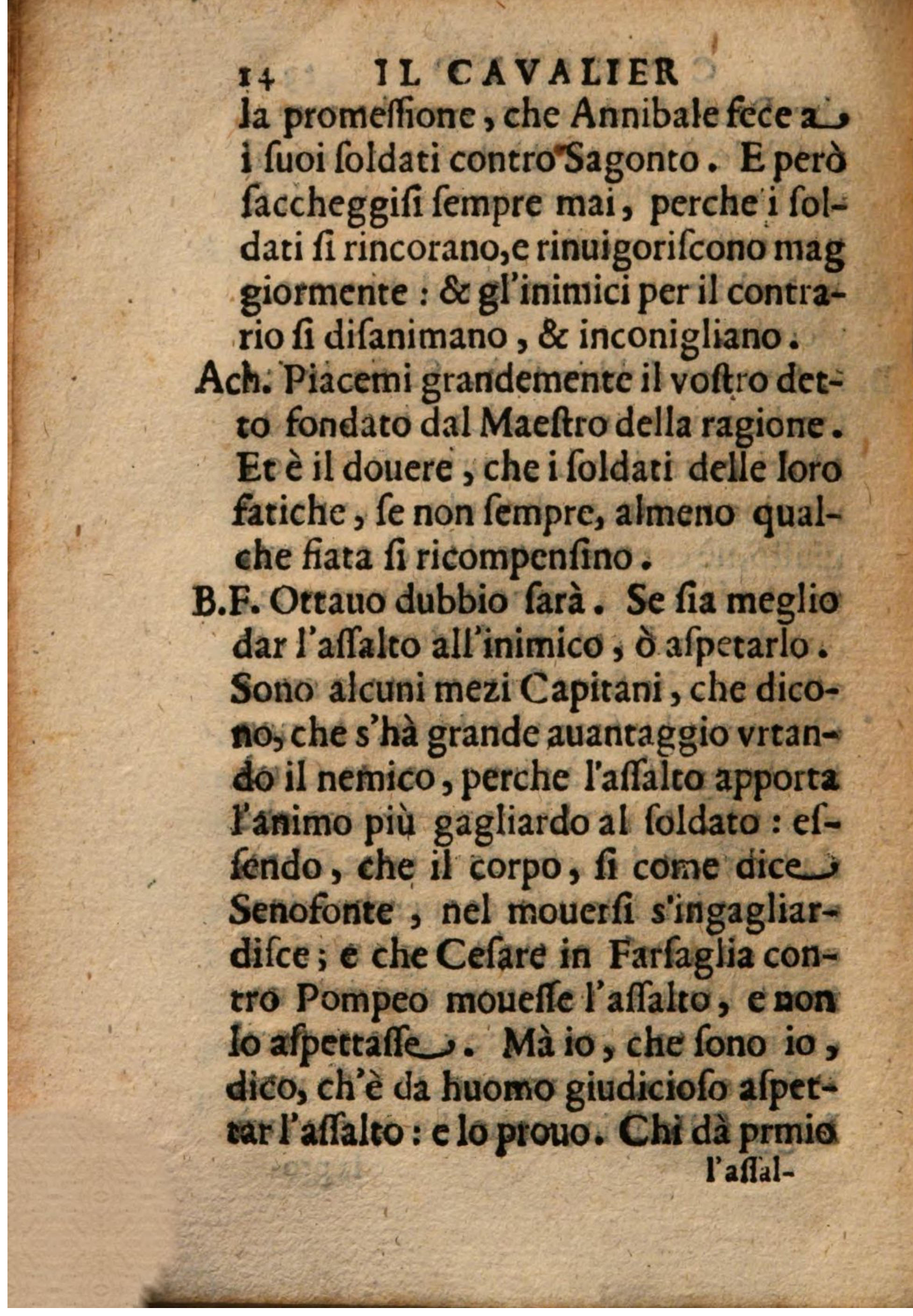
Scan p. 030 | printed p. 14
Ach. Your saying, founded upon the Master of reason, pleases me greatly. And it is right that the soldiers be recompensed for their toils, if not always, at least some time.
B.F. The eighth problem will be. Whether it is better to give the assault to the enemy, or to await it. There are some half-Captains who say that one has great advantage in charging the enemy, because the assault brings the more vigorous spirit to the soldier: it being that the body, as Xenophon says, in moving grows more vigorous; and that Caesar at Pharsalus against Pompey moved the assault, and did not await it. But I, who am who I am, say that it is for a judicious man to await the assault: and I prove it. Whoever gives first...
la promeſſione, che Annibale fece a
i ſuoi ſoldati contro Sagonto. E però
ſaccheggiſi ſempre mai, perche i ſol-
dati ſi rincorano, e rinuigoriſcono mag
giormente : & gl’inimici per il contra-
rio ſi diſanimano, & inconigliano.
Ach. Piacemi grandemente il voſtro det-
to fondato dal Maeſtro della ragione.
Et è il douere, che i ſoldati delle loro
fatiche, ſe non ſempre, almeno qual-
che fiata ſi ricompenſino.
B. F. Ottauo dubbio ſarà. Se ſia meglio
dar l’aſſalto all’inimico, ò aſpetarlo.
Sono alcuni mezi Capitani, che dico-
no, che s’hà grande auantaggio vrtan-
do il nemico, perche l’aſſalto apporta
l’animo più gagliardo al ſoldato : eſ-
ſendo, che il corpo, ſi come dice
Senofonte, nel mouerſi s’ingagliar-
diſce ; e che Ceſare in Farſaglia con-
tro Pompeo moueſſe l’aſſalto, e non
lo aſpettaſſe. Mà io, che ſono io,
dico, ch’è da huomo giudicioſo aſpet-
tar l’aſſalto : e lo prouo. Chi dà prmia
CATCHWORD: l’aſſal-
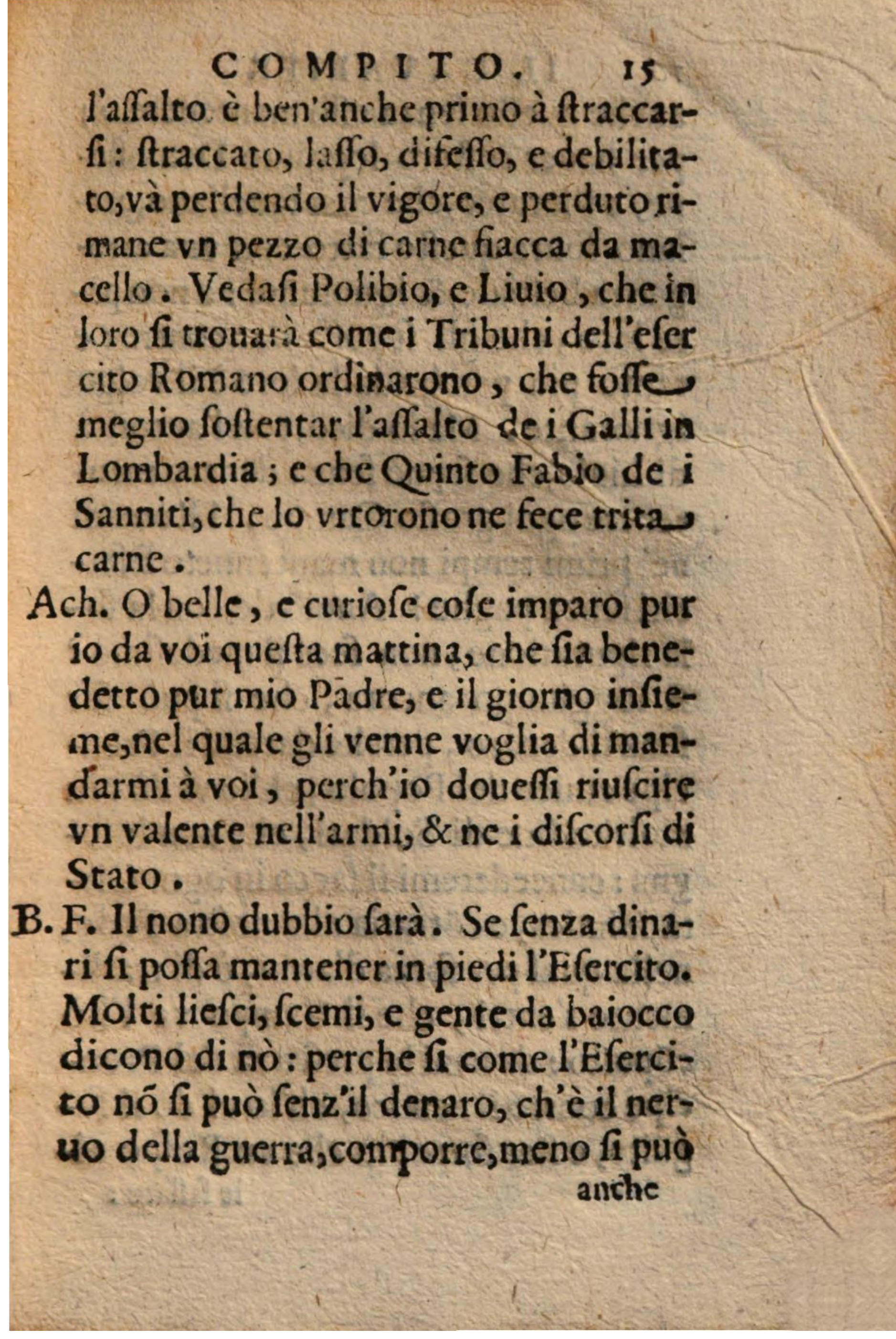
Scan p. 031 | printed p. 15
Ach. Oh, what fine and curious things I do learn from you this morning! Blessed be my father, and blessed too the day on which he took a fancy to send me to you, so that I might turn out a man of valour in arms and in discourses of State.
B.F. The ninth question will be this: whether without money an army can be kept on its feet. Many frivolous, feeble folk, and people not worth a penny, say no; because just as an army cannot be assembled without money, which is the sinew of war, still less can it
l’aſſalto è ben’anche primo à ſtraccar-
ſi : ſtraccato, laſſo, difeſſo, e debilita-
to, và perdendo il vigore, e perduto ri-
mane vn pezzo di carne fiacca da ma-
cello. Vedaſi Polibio, e Liuio, che in
loro ſi trouarà come i Tribuni dell’eſer
cito Romano ordinarono, che foſſe
meglio ſoſtentar l’aſſalto de i Galli in
Lombardia ; e che Quinto Fabio de i
Sanniti, che lo vrtorono ne fece trita
carne.
Ach. O belle, e curioſe coſe imparo pur
io da voi queſta mattina, che ſia bene-
detto pur mio Pàdre, e il giorno inſie-
me, nel quale gli venne voglia di man-
darmi à voi, perch’io doueſſi riuſcire
vn valente nell’armi, & ne i diſcorſi di
Stato.
B. F. Il nono dubbio ſarà. Se ſenza dina-
ri ſi poſſa mantener in piedi l’Eſercito.
Molti lieſci, ſcemi, e gente da baiocco
dicono di nò : perche ſi come l’Eſerci-
to nó ſi può ſenz’il denaro, ch’è il ner-
uo della guerra, comporre, meno ſi può
CATCHWORD: anche
Scan p. 032 | printed p. 16
anche queſto ſenza eſſo mantenere ;
per hauer coſtoro leggiuto Demoſte-
ne, e Plutarco, che coſi fauellano, par-
lano ſoura queſto fatto con vna arro-
ganza beſtiale, & ignorante : e non pa-
re loro, che gli ſi poſſa dar contro : e
tanto più perche dalla loro è il volgo
ignorante. Mà io dico, con l’autorità
di Liuio, che ſi può ſenza denaro man-
tenere ogni groſſo Campo. I Romani
ne’ primi tempi non mantennero Eſer-
citi ſenza paghe? Annibale, con la ſo-
la riputatione, non fece il medeſimo?
E ſoggiungo ancora, che ſi può far
ſenz’il denaro, perche datemi il Pren-
cipe amico del Popolo, ch’io vi dò più
moltitudine di Soldati, che non biſo-
gna : concedetemi il ſacco in ogni Cit-
tà inimica, e cótraria alla noſtra Fede,
nella qual per forza d’armi, ò di tradi-
mento s’entri, che il Campo ve l’hò
cópoſto : datemi la preſenza del Pren-
cipe contro il nemico, ch’io vi dò il ſe-
guito, e ſtar forte più che vn Roſpo al-
CATCHWORD: le ſaſſate :
Scan p. 033 | printed p. 17
Ach. So I believe. Oh, if you were a Prince, I know the Turk's beak, like a mouse's, would ever be waiting to be either killed by the tabby cat of your fury, or driven off by the mere yowling of your dreadful great voice. On to the next question, my Lord Strong-Arm.
B.F. The tenth will be: which is to be valued more, an army composed wholly of Cavalry, or of Infantry alone. Many and many are of the opinion, men who have set their beards to the smoke of the cannon and had them neatly trimmed every week by the razor edge of Turkish scimitars, that an army of Cavalry is of greater worth: proving it by saying that the horse are quicker upon the enemy, and swifter than the Infantry;
le ſaſſate : e concedetemi honori, e ri-
munerationi di poterle io, finita la
guerra, tra ualenti ſoldati diſpenſare,
ch’io di loro ve ne dò in maggior nu-
mero delle ſtelle del Cielo, e delle are-
ne del Mare.
Ach. Coſì credo io : ò ſe voi foſte Pren-
cipe ſò ch’il becco del Turco, à guiſa
di ſorce, ſtaria ſempre aſpettando d’eſ-
ſer ò ammazzato dal gatto ſoriano del
voſtro furore, ò ſcacciato ſol dal gnau-
lar del voſtro ſpauenteuol vocione.
All’altro dubbio Sig. Forte Braccio.
B. F. Il decimo ſarà. Qual ſia da ſtimar
più, vn’eſercito di Caualli tutto com-
poſto, ò di Fanti ſoli. Sono di pare-
re molti, e molti, c’hanno meſſe le
barbe al fumo delle bombarde, e quel-
le ogni ſettimana politamente fatteſe-
le acconciare al radente filo delle ſci-
mitare Turcheſche ; ch’vn’eſercito di
Caualli ſia di maggior ſtima : prouan-
dolo, che i Caualli ſono più preſti adoſ-
ſo a gl’inimici, e più ſpediti delle Fan-
SIGNATURE: B
CATCHWORD: terie:
Scan p. 034 | printed p. 18
terie : e che ſi ponno meglio ſaluar fug
gendo, e vincendo, arriuar l’inimico,
dato, che ſi foſſe alla sbigottita fuga :
& anche ſerrargli i paſſi. Mà io ſono
di contrario parere, e faccio più conto
della Fanteria, che della Caualleria,
e coſì anche gl’intendenti diranno, e
lo prouo con efficaci, e vere ragioni.
Il Turco, cane rabbiatiſſimo, non hà
formatiſſimo eſercito di Caualli ? Et
in ogni modo viene ſempre dalle no-
ſtre Fanterie percoſſo, e poco meno,
che ſpiantato ; e ciò perche nelle ſan-
guinoſe, e mortali battaglie, i pedoni
ſono megliori de i caualieri. Leggaſi
Senofonte, che ciò afferma. E poi i
Fanti non ſono più ſpediti ad armarſi,
e più facili da ponerſi in ordine ? non
fanno gl’eſerciti più fermi del centro
della terra ? e maſſime in tempo, che
all’aſſetata, all’arſa terra rende luce la
cornuta Luna, con le fiſſe Stelle arden-
ti ; e poi non ſono i Caualli ragione-
uoli. Dunque da più di queſte beſtie
CATCHWORD: ſcon-
Scan p. 035 | printed p. 19
Ach. What are you telling me! Before I knew this, I would have esteemed an army of Cavalry of greater force and valour than one of Infantry.
B.F. The eleventh question will be: whether it is fitting
ſconcertate ſono i Fanti ; pongaſi vn
feroce deſtriero in furore, non mette in
confuſione mezo eſercito ? co’ calci
non ſtroppia meza ſquadra ? e ponen-
doſi in ſpauentoſa fuga, quante volte
s’è viſto portar il Caualiero nell’ini-
miche picche, e renderlo ò morto, ò fe-
rito, ò ſchiauo ? ſenta il ribombo delle
artegliarie ſcaricate, non ſi sbigottiſce
tutto ? e tal volta, sbalzando à terra
il Caualiero, non li ſtampa i ferri de’
ſuoi piedi in faccia ? vn ſuono di trom-
ba, vna toccata di tamburo è baſtante à
far, ch’vn’eſercito di Caualli, non cor-
ra à precipitarſi, nò ; mà voli in acquo-
ſi foſſi, ò in correnti fiumicelli, & a
buttarſi da cime altiſſime de’ monti,
per baciarli, có la loro inaueduta mor-
te, li ſpinoſi, e petroſi piedi.
Ach. Che mi dite! Io prima, che ſapeſſi
coteſto, haurei ſtimato di maggior for-
za, e valore vn’eſercito di Caualli, che
di Fanti.
B. F. L’vndecimo dubbio ſarà. S’è con-
SIGNATURE: B 2
CATCHWORD: ueniente,
Scan p. 036 | printed p. 20
ueniente, ch’vn Prencipe alzi vn ſuo
ſeruitore al par ſuo. Quaſi tutti i Cor-
tigiani, per loro intereſſe, dicono di ſì :
& allegano gli honori, le gratie, e li
maneggi, c’hebbero le baſſe genti di
Cleandro, di Plautiano, e Seiano, da
Commodo, da Settimio, e da Tiberio
loro Signori, da’ quali fauoriti al póſſi-
bile, & amati al par delle pupille, ſi te-
neuano in maggior grandezza de i lo-
ro Padroni : nè faceuano ottener gratie
ad alcuno, che per loro mezo non s’ha-
ueſſe. Allegano ancora, che giornal-
mente ſi vede, ch’vn Prencipe gradi-
ſce vn ſuo fauorito, ilqual, tal fiata, non
ſarà buono ad altro, che à renderli bia-
ſimo. Mà io biaſmo quel Prencipe,
ch’inalza ſimili baſſe genti, e tiene
baſſi i braui, e i letterati, e i nati nobili,
noſtri pari, che lo ſeruono. S’ama il
ſeruitore, può ben concederli qualche
giuſta entrata ; mà che lo faccia vgua-
le, e quaſi che ſuperiore, non ſò come
ſe lo faccia.
CATCHWORD: Ach. Er-
Scan p. 037 | printed p. 21
B.F. The twelfth question will be: whether a Prince at war ought to ask aid from an equal or a greater who is an infidel. Many who are warlike only in their dreams say yes; but how much they err they will see in the mirror of the truth, which I shall speak. But it would be better for these mamelukes to set themselves to read Zonaras, so that they may understand how the Emperor Gratian affirms that it is not lawful either to give or to ask aid from infidels. Hence Heraclius, who asked aid from the Mahometans, repented of it and wept bitterly, as it is written. Aid from an enemy Religion often fails in faith, and, what is worse, offends the Ruler of the Heavens.
Ach. It is true: aid from Tyrants, from Barbarians, from Infidels, comes at the wrong hour, at the wrong moment.
Ach. Error grauiſſimo comette quel Si-
gnore, che lo fa ; ò che ſi dia in poter
d’vn ſuo famiglio, facédoſelo proſpet-
tiua de gli occhi ſuoi, non che l’alma
del cuore.
B. F. Il duodecimo dubbio ſarà. S’vn
Prencipe guerreggiante deue doman-
dar aiuto ad vn ſuo pari, ò maggiore,
ch’infidele ſia. Molti bellicoſi ne i ſo-
gni, dicono di ſì ; mà quanto errino,
nello ſpecchio della verità, ch’io dirò,
lo vedranno. Mà ſia meglio, che que-
ſti mamalucchi ſi mettino à leggere
Zonara, che intenderanno come Gra-
tiano Imperatore afferma non eſſer le-
cito nè dare, nè domandar aiuto d’in-
fideli. Onde Heraclio, ilquale doman-
dò aiuto à i Maomettani, ſe ne pentì,
e pianſe amaramente, come è ſcritto.
Aiuto d’inimica Religione, ſpeſſe vol-
te manca di fede, e s’offende, quel ch’è
peggio, il Dominator de’ Cieli.
Ach. E’ vero : aiuto di Tiranni, di Barbari,
d’Infideli, alla malhora, al mal punto.
SIGNATURE: B 3
CATCHWORD: B. F. Il
Scan p. 038 | printed p. 22
But being I of the contrary opinion, I say that the war Counsellor ought to be young, because he has the blood more boiling in his veins, the spirits more ardent, and the mind more ready for heroic deeds than the old man; whence, bold, not indeed through rashness, but through youthful discipline, he resolves, at a turn of the eyes, and counsels whether an army ought to march, or set itself in battle order, to strike, or to besiege, to give the assault, or to await it, to scale
B. F. Il terzodecimo dubbio ſarà. Se i
Cóſiglieri della guerra debbono eſſer
giouani, ò vecchi. Molti, priuilegiati
dal titolo dell’ignoranza, dicono, che
il Conſigliero di guerra deue eſſer vec-
chio ; e lo prouano col detto di Salu-
ſtio, e có altre loro nó vere ragioni, che
ſono queſte. Ch’il vecchio Conſiglie-
ro nel dar conſiglio và peſato ; non pe-
ricoloſo ; và ſauio ; e ſi ſerue della ma-
tura prudenza ; penſa il fine del conſi-
glio ; e sà, per l’età vecchia, dar conſi-
glio, ſenza biſogno di Conſultori.
Mà eſſendo io di contrario parere,
dico, ch’il Conſigliero della guerra
deue eſſer giouane, perche hà più il
ſangue nelle vene bollente, più i ſpiriti
ardenti, e l’animo più pronto ad heroi-
che fattioni del vecchio : onde ardito,
non già per temerità, mà per giouenile
diſciplina, riſolue, à vn volger d’occhi,
e conſiglia s’vn’eſercito deue marchia-
re, ò metterſi in ordinanza, battere, ò
aſſediare, dar l’aſſalto, ò aſpettarlo, ſca-
CATCHWORD: lare,
Scan p. 039 | printed p. 23
Ach. I believe it of you; every mortal who is wise holds you for that great and famous brave Counsellor which you truly are; whence the fame of your valour, arrived at the sphere of heaven, now dances and dwells with it.
B.F. The fourteenth and last question will be: which is better, to wage war on Land or on Sea. A question, in truth, as difficult as it is fine; and to give all my opinions, I leave aside the
lare, ò far mine, dar à fuoco, ò ſaluare,
far tradiméto, ò ritirarſi, far imboſca-
te, ò chiuder i paſſi, ſaccheggiare, ò
far ſchiaui, e finalmente alloggiare, ò
diſalloggiare; nè ciò lo dico, perch'io
ſia giouane, che ſe hò poca età, hauen-
d'io vintidue anni, ben sà hormai tutta
l'Italia, c'hò nell'arbore della mia gio-
uentù, pomi di conſiglio acerbi, e ma-
turi; doue non ſi ſdegnanno i Prencipi
ogni dì, con le lor proprie mani, da
quella ſtaccarne qualch'vno, & aſſag-
giarlo.
Ach. Ve lo credo io; tenendoui ogni mor-
tale, che ſauio ſia, per quel grande, e
famoſo Conſigliero brauo, che vera-
méte ſiete; onde la fama del valor vo-
ſtro arriuata alla sfera del cielo, con
quella hor danza, & alberga.
B.F. Il quartodecimo, & vltimo dubbio
ſarà. Qual ſia meglio, guerreggiar'in
Terra, ò in Mare. Queſtione, in uero,
tanto difficile, quanto bella: e per dir
tutti i pareri miei, laſcio da parte le
SIGNATURE: B 4
CATCHWORD: opi-
Scan p. 040 | printed p. 24
opinioni de i poco guerreggiáti Smar-
giaſsi, e Sfiondatori, miei capitali ne-
mici ; i quali, nel Mare Adriatico di
queſta vaga, e curioſa queſtione,
peſcano non a’ peſci, mà a’ ſpropoſiti,
degni di polmonate, e di berette
tinte. E per cominciar, dico, che par,
che ſia meglio guerreggiar in Terra,
che in Mare, ilquale viene ſignoreg-
giato da i ſoffi impetuoſi d’Eolo, come
afferma Vegetio ; e nó per altro, ſe non
perche inghiotta i miſeri, e male aſſor-
titi. La battaglia nel Mare non è buo-
na per i ſoldati pauroſi, vili, e vigliac-
chi nò, mà per i coraggioſi, & animo-
ſi : e la cagione è, perche i poltroni ſi
poſſono ben sbigottire, & atterrirſi, mà
non già fuggire ; che l’acqua non è ter-
ra, che ſoura di ſè li ſoſteneſſe, ſe non
notando ; e però ſaldi, come inquinta-
ne alle lancie, alle archibugiate i cor-
ſaletti, e i beluardi alle cannonate,
contro lor voglia, ſtanno : doue che in
Terra, alli pericoli, per ſaluarſi la
CATCHWORD: pelle
Scan p. 041 | printed p. 25
pelle ſenza intacco, fuggeriano. La
battaglia di terra è anche meglio, vn
parer par che mi dica, perche il ſolda-
to vedendoſi ferito, & eſſer in mano
de’ porci nemici, gittandoſi in terra, e
fingendo il morto, con quell’inganno
da volpe ſi potria forſe ſaluare : che
piagato, gittandoſi in acqua ſalſa, per
morto finto s’affogaria, e cibo di vora-
ci ſardelle diuentaria. Vn’altro parer
mi dice anche, che in terra guerreg-
giandoſi è migliore ; e ciò, perche il
prattico ſoldato sà voltar la ſchiena à
Febo, acciò con li ſuoi aurati, & ardenti
rai egli acciechi l’inimico : prende an-
co auantaggiato ſito, e li tende aguati
impoſſibili à vitarli. Mà vn’altro pa-
rere hor mi s’accoſta, e dicemi, ch’io
concluda, che ſia meglio guerreggiar
in Mare, che in Terra ; perche la polue-
re non t’accieca : e ſe in Terra ſtracchi
le mani, e i piedi, in Mare ſolo le brac-
cia à tagliar, trinciar, e tritar l’inimico,
& affettarlo come vn citrolo.
CATCHWORD: Ach.
Scan p. 042 | printed p. 26
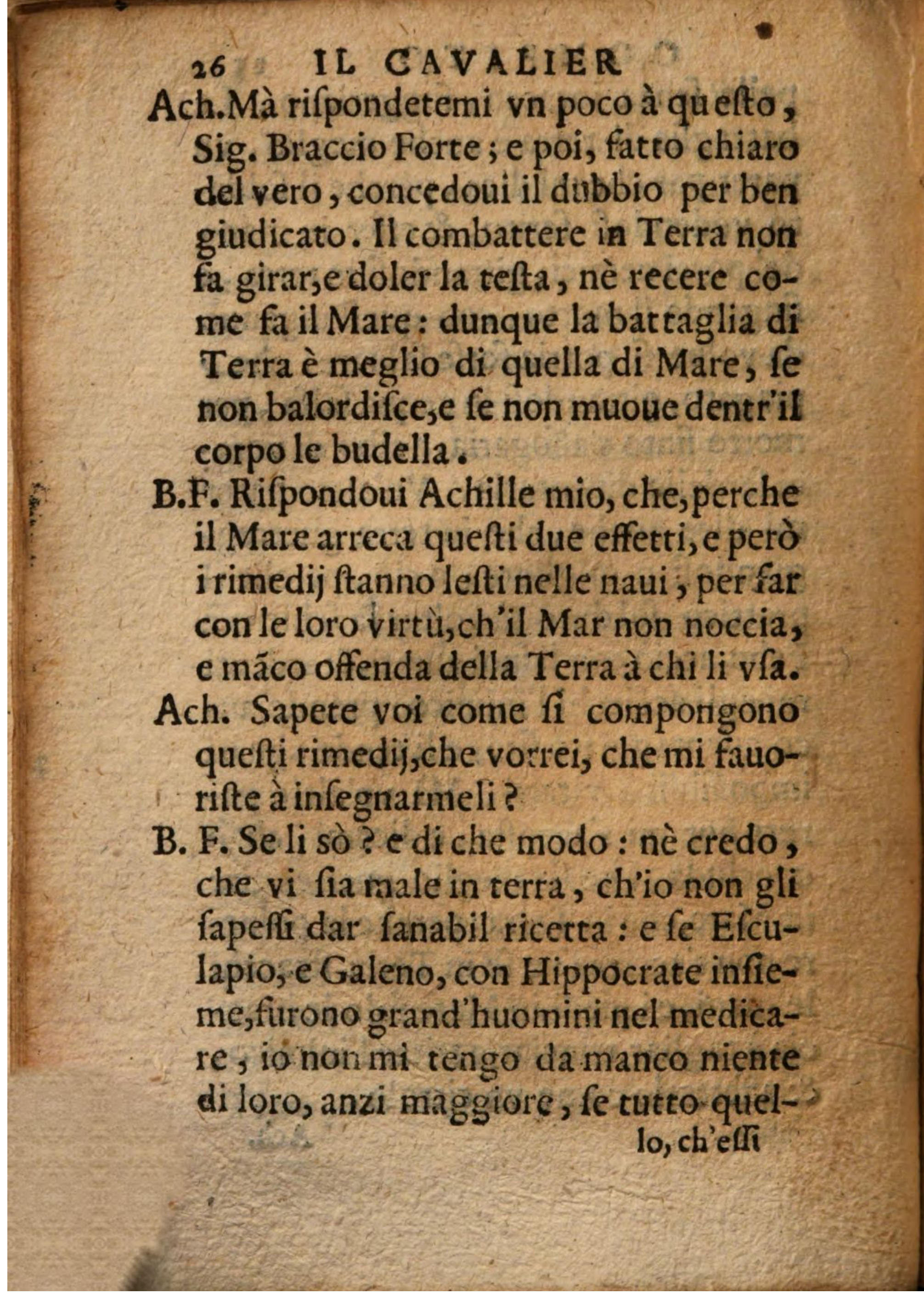
B.F. I answer you, my Achille, that, because the sea brings on these two effects, the remedies are therefore kept ready aboard the ships, so that by their virtues the sea may do no harm, and may the less afflict, on land, whoever uses them.
Ach. Do you know how these remedies are compounded? For I should like you to do me the favour of teaching them to me.
B.F. Whether I know them? And in what manner! Nor do I think there is any ailment on land for which I could not give a healing recipe: and if Aesculapius and Galen, together with Hippocrates, were great men in medicine, I hold myself nothing less than they, indeed greater, if all that they
Ach. Mà riſpondetemi vn poco à queſto,
Sig. Braccio Forte ; e poi, fatto chiaro
del vero, concedoui il dubbio per ben
giudicato. Il combattere in Terra non
fa girar, e doler la teſta, nè recere co-
me fa il Mare : dunque la battaglia di
Terra è meglio di quella di Mare, ſe
non balordiſce, e ſe non muoue dentr'il
corpo le budella .
B.F. Riſpondoui Achille mio, che, perche
il Mare arreca queſti due effetti, e però
i rimedij ſtanno leſti nelle naui ; per far
con le loro virtù, ch'il Mar non noccia,
e mãco offenda della Terra à chi li vſa.
Ach. Sapete voi come ſi compongono
queſti rimedij, che vorrei, che mi fauo-
riſte à inſegnarmeli ?
B. F. Se li sò ? e di che modo : nè credo,
che vi ſia male in terra, ch'io non gli
ſapeſſi dar ſanabil ricetta : e ſe Eſcu-
lapio, e Galeno, con Hippocrate inſie-
me, furono grand'huomini nel medica-
re, io non mi tengo da manco niente
di loro, anzi maggiore, ſe tutto quel-
CATCHWORD: lo, ch'eſſi
Part II · Medicine
Scan p. 043 | printed p. 27
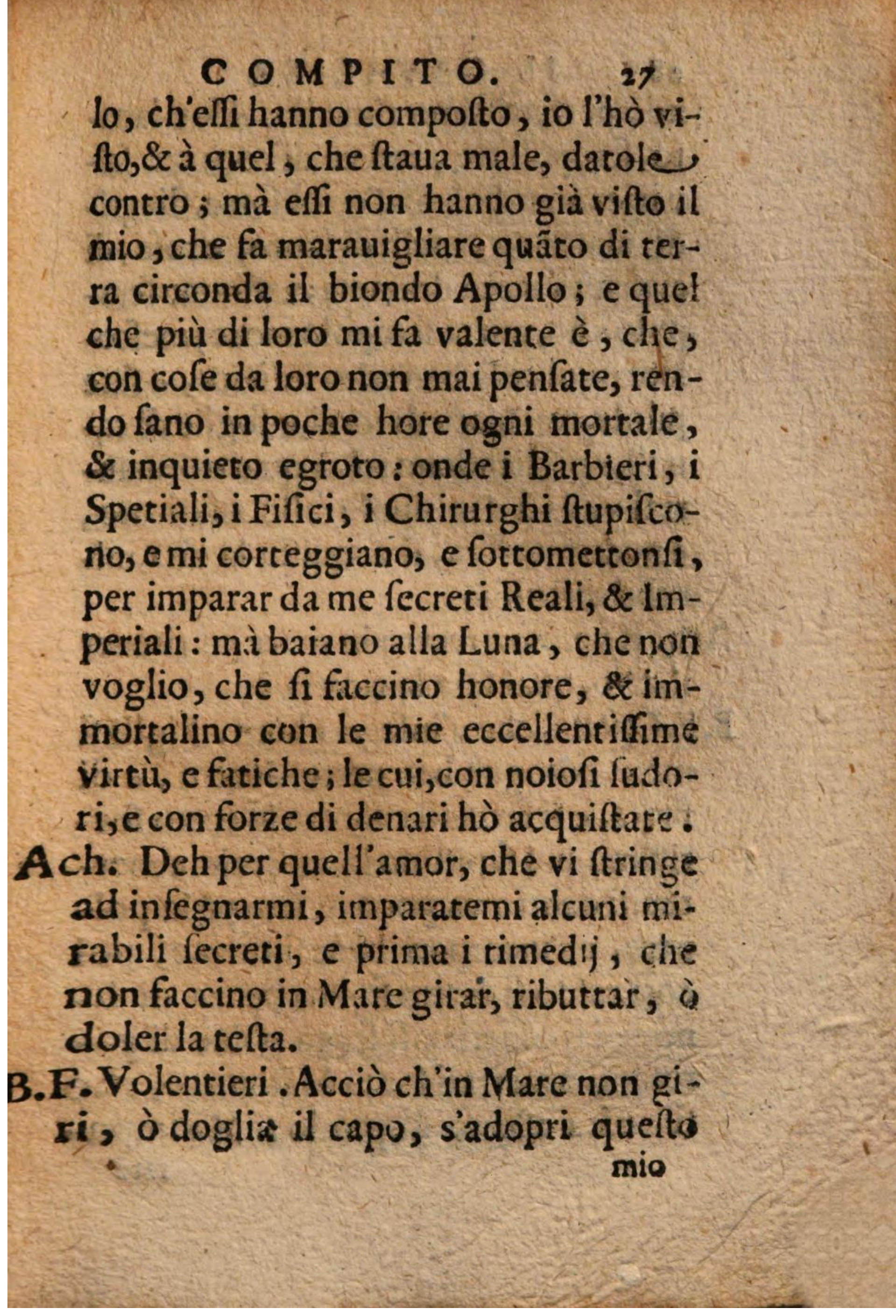
Ach. Ah, for that love which binds you to teach me, teach me some marvellous secrets, and first the remedies that keep the head from spinning, turning queasy, or aching at sea.
B.F. Gladly. So that at sea the head does not spin or ache, let this most perfect remedy of mine be used.
lo, ch'eſſi hanno compoſto, io l'hò vi-
ſto,& à quel, che ſtaua male, datole
contro; mà eſſi non hanno già viſto il
mio, che fa marauigliare quãto di ter-
ra circonda il biondo Apollo; e quel
che più di loro mi fa valente è, che,
con coſe da loro non mai penſate, ren-
do ſano in poche hore ogni mortale,
& inquieto egroto: onde i Barbieri, i
Spetiali, i Fiſici, i Chirurghi ſtupiſco-
no, e mi corteggiano, e ſottomettonſi,
per imparar da me ſecreti Reali, & Im-
periali: mà baiano alla Luna, che non
voglio, che ſi faccino honore, & im-
mortalino con le mie eccellentiſſime
virtù, e fatiche; le cui,con noioſi ſudo-
ri,e con forze di denari hò acquiſtate:
Ach. Deh per quell'amor, che vi ſtringe
ad inſegnarmi, imparatemi alcuni mi-
rabili ſecreti, e prima i rimedij, che
non faccino in Mare girar, ributtar, ò
doler la teſta.
B.F.Volentieri.Acciò ch'in Mare non gi-
ri, ò doglia il capo, s'adopri queſto
CATCHWORD: mio
Scan p. 044 | printed p. 28
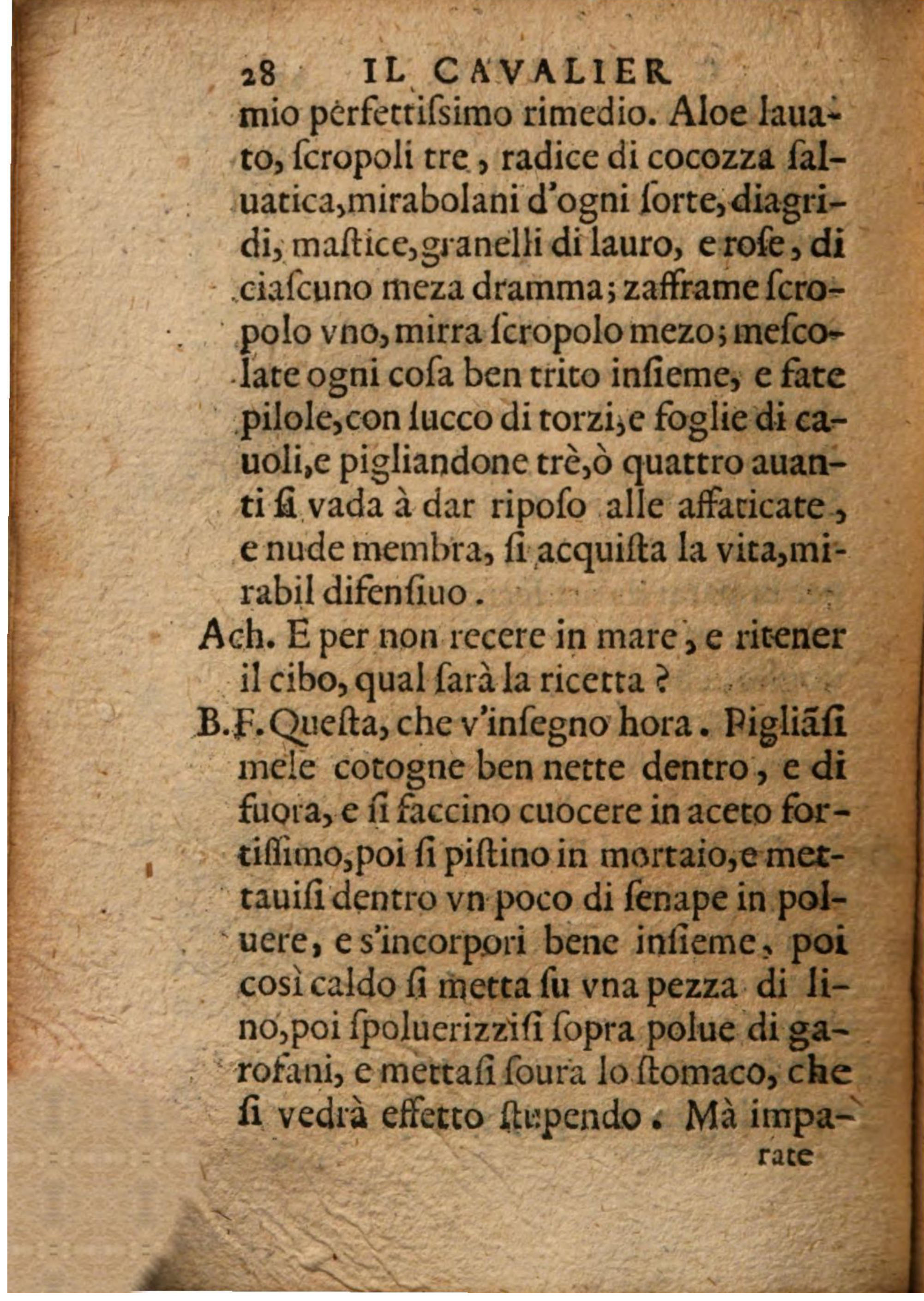
Ach. And to avoid vomiting at sea, and to retain the food, what will the recipe be?
B.F. This, which I now teach you. Take quinces well cleaned inside and out, and let them be cooked in strongest vinegar, then let them be pounded in a mortar, and put therein a little mustard in powder, and let it be well incorporated together; then, thus hot, let it be spread on a piece of linen, then sprinkle over it powder of cloves, and lay it over the stomach, and a stupendous effect will be seen. But learn...
mio perfettiſsimo rimedio. Aloe laua-
to, ſcropoli tre, radice di cocozza ſal-
uatica,mirabolani d'ogni ſorte,diagri-
di, maſtice,granelli di lauro, e roſe, di
ciaſcuno meza dramma; zafframe ſcro-
polo vno, mirra ſcropolo mezo; meſco-
late ogni coſa ben trito inſieme, e fate
pilole,con ſucco di torzi,e foglie di ca-
uoli,e pigliandone trè,ò quattro auan-
ti ſi vada à dar ripoſo alle affaticate,
e nude membra, ſi acquiſta la vita,mi-
rabil difenſiuo.
Ach. E per non recere in mare, e ritener
il cibo, qual ſarà la ricetta?
B.F.Queſta, che v'inſegno hora. Pigliãſi
mele cotogne ben nette dentro, e di
fuora, e ſi faccino cuocere in aceto for-
tiſſimo,poi ſi piſtino in mortaio,e met-
tauiſi dentro vn poco di ſenape in pol-
uere, e s'incorpori bene inſieme, poi
coſì caldo ſi metta ſu vna pezza di li-
no,poi ſpoluerizziſi ſopra polue di ga-
rofani, e mettaſi ſoura lo ſtomaco, che
ſi vedrà effetto ſtupendo. Mà impa-
CATCHWORD: rate
Scan p. 045 | printed p. 29
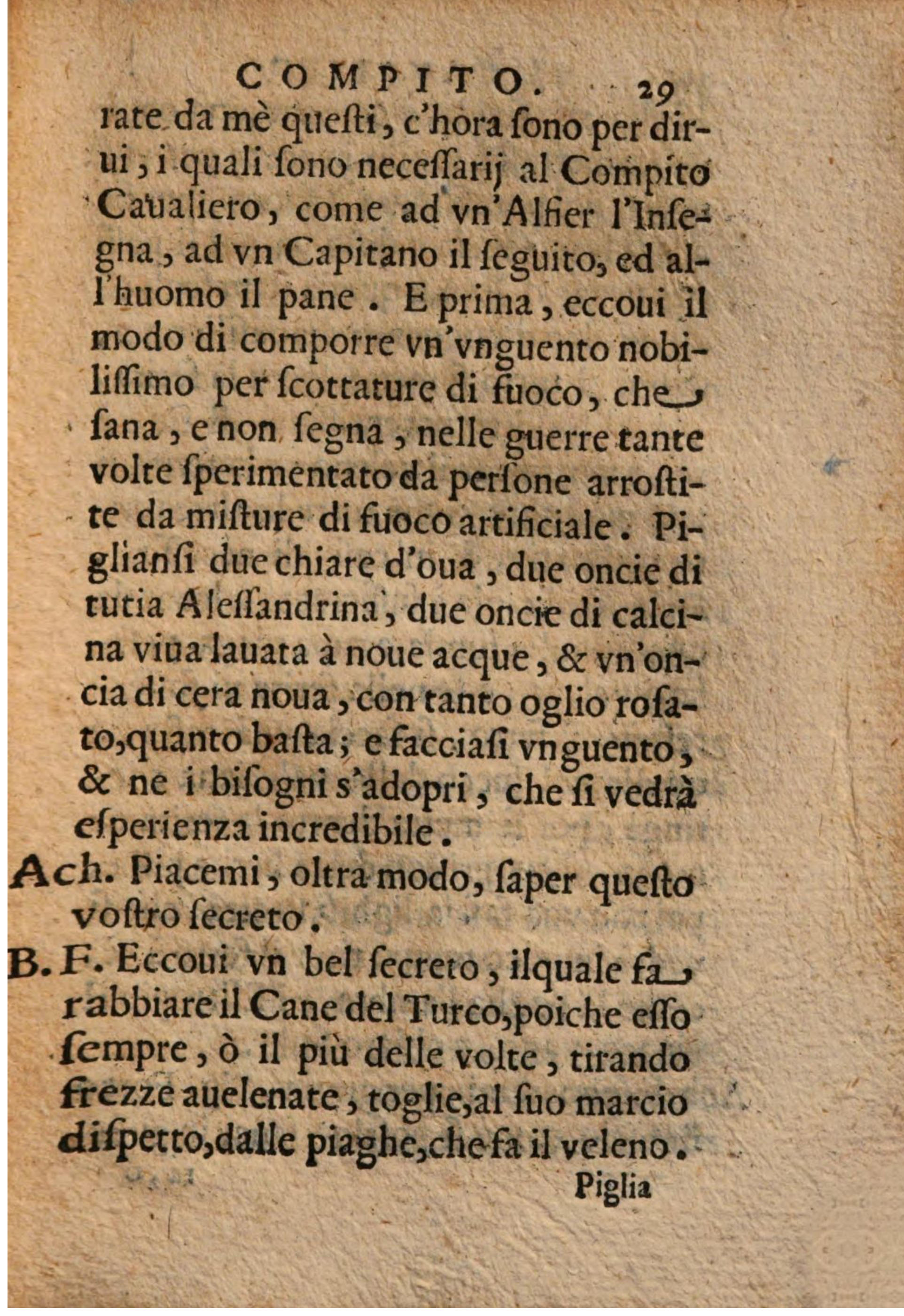
Ach. It pleases me beyond measure to know this secret of yours.
B.F. Here is for you a fine secret, which makes the Turk's Dog rage, since he always, or most of the time, shooting poisoned arrows, removes, to his rotten spite, from the wounds the poison that he makes.
rate da mè queſti, c'hora ſono per dir-
ui, i quali ſono neceſſarij al Compito
Caualiero, come ad vn'Alfier l'Inſe-
gna, ad vn Capitano il ſeguito, ed al-
l'huomo il pane. E prima, eccoui il
modo di comporre vn'vnguento nobi-
liſſimo per ſcottature di fuoco, che
ſana, e non ſegna, nelle guerre tante
volte ſperimentato da perſone arroſti-
te da miſture di fuoco artificiale. Pi-
glianſi due chiare d'oua, due oncie di
tutia Aleſſandrina, due oncie di calci-
na viua lauata à noue acque, & vn'on-
cia di cera noua, con tanto oglio roſa-
to,quanto baſta; e facciaſi vnguento,
& ne i biſogni s'adopri, che ſi vedrà
eſperienza incredibile.
Ach. Piacemi, oltra modo, ſaper queſto
voſtro ſecreto.
B.F. Eccoui vn bel ſecreto, ilquale fa
rabbiare il Cane del Turco,poiche eſſo
ſempre, ò il più delle volte, tirando
frezze auelenate, toglie,al ſuo marcio
diſpetto,dalle piaghe,che fa il veleno.
CATCHWORD: Piglia
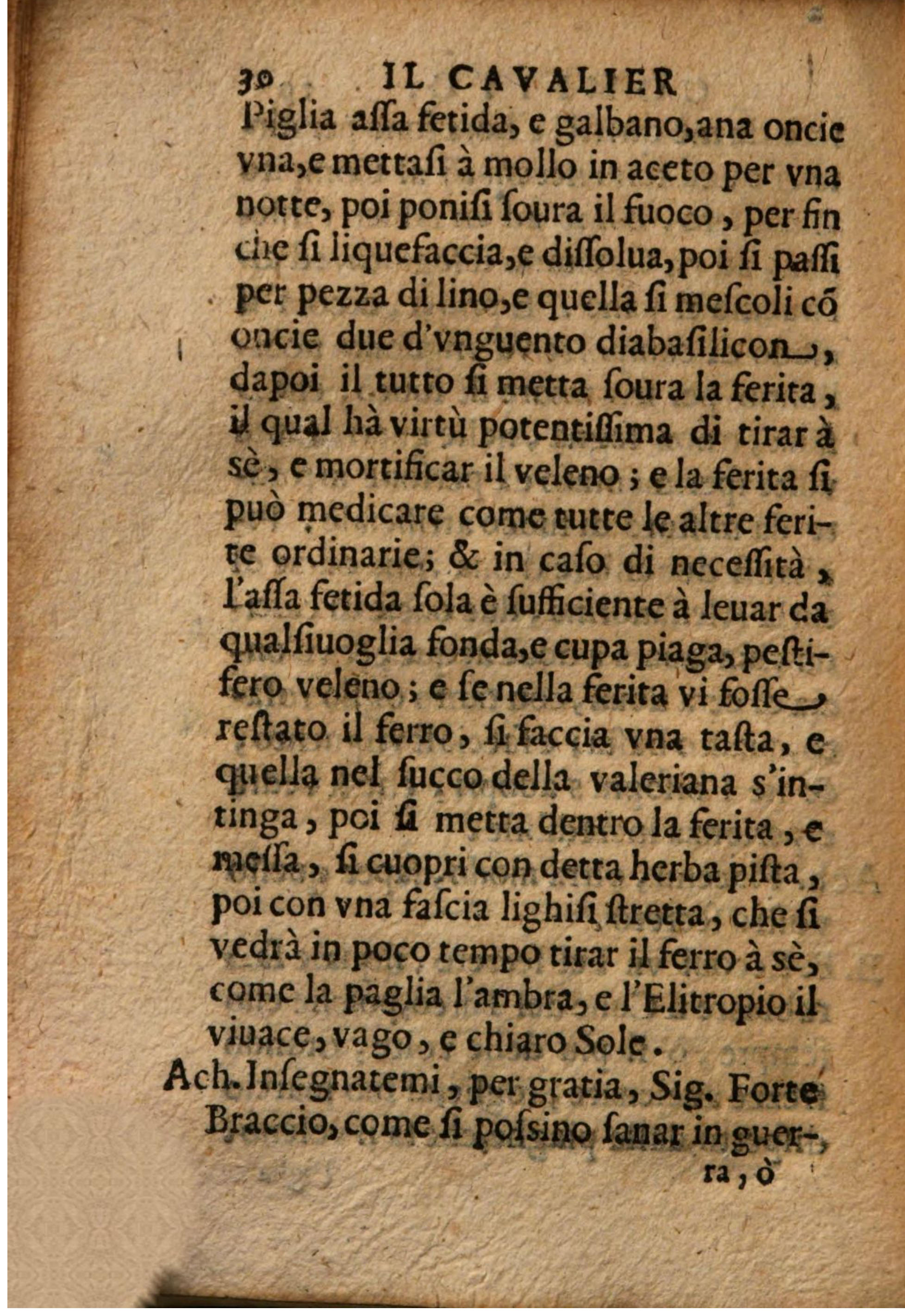
Scan p. 046 | printed p. 30
Ach. Teach me, of your grace, Signor Forte Braccio, how there may be healed, in war...
Piglia aſſa fetida, e galbano,ana oncie
vna,e mettaſi à mollo in aceto per vna
notte, poi poniſi ſoura il fuoco, per fin
che ſi liquefaccia,e diſſolua,poi ſi paſſi
per pezza di lino,e quella ſi meſcoli cõ
oncie due d'vnguento diabaſilicon,
dapoi il tutto ſi metta ſoura la ferita,
il qual hà virtù potentiſſima di tirar à
ſè, e mortificar il veleno; e la ferita ſi
può medicare come tutte le altre feri-
te ordinarie; & in caſo di neceſſità,
l'aſſa fetida ſola è ſufficiente à leuar da
qualſiuoglia fonda,e cupa piaga, peſti-
fero veleno; e ſe nella ferita vi foſſe
reſtato il ferro, ſi faccia vna taſta, e
quella nel ſucco della valeriana s'in-
tinga, poi ſi metta dentro la ferita, e
meſſa, ſi cuopri con detta herba piſta,
poi con vna faſcia lighiſi ſtretta, che ſi
vedrà in poco tempo tirar il ferro à ſè,
come la paglia l'ambra, e l'Elitropio il
viuace, vago, e chiaro Sole.
Ach. Inſegnatemi, per gratia, Sig. Forte
Braccio, come ſi poſsino ſanar in guer-
CATCHWORD: ra, ò
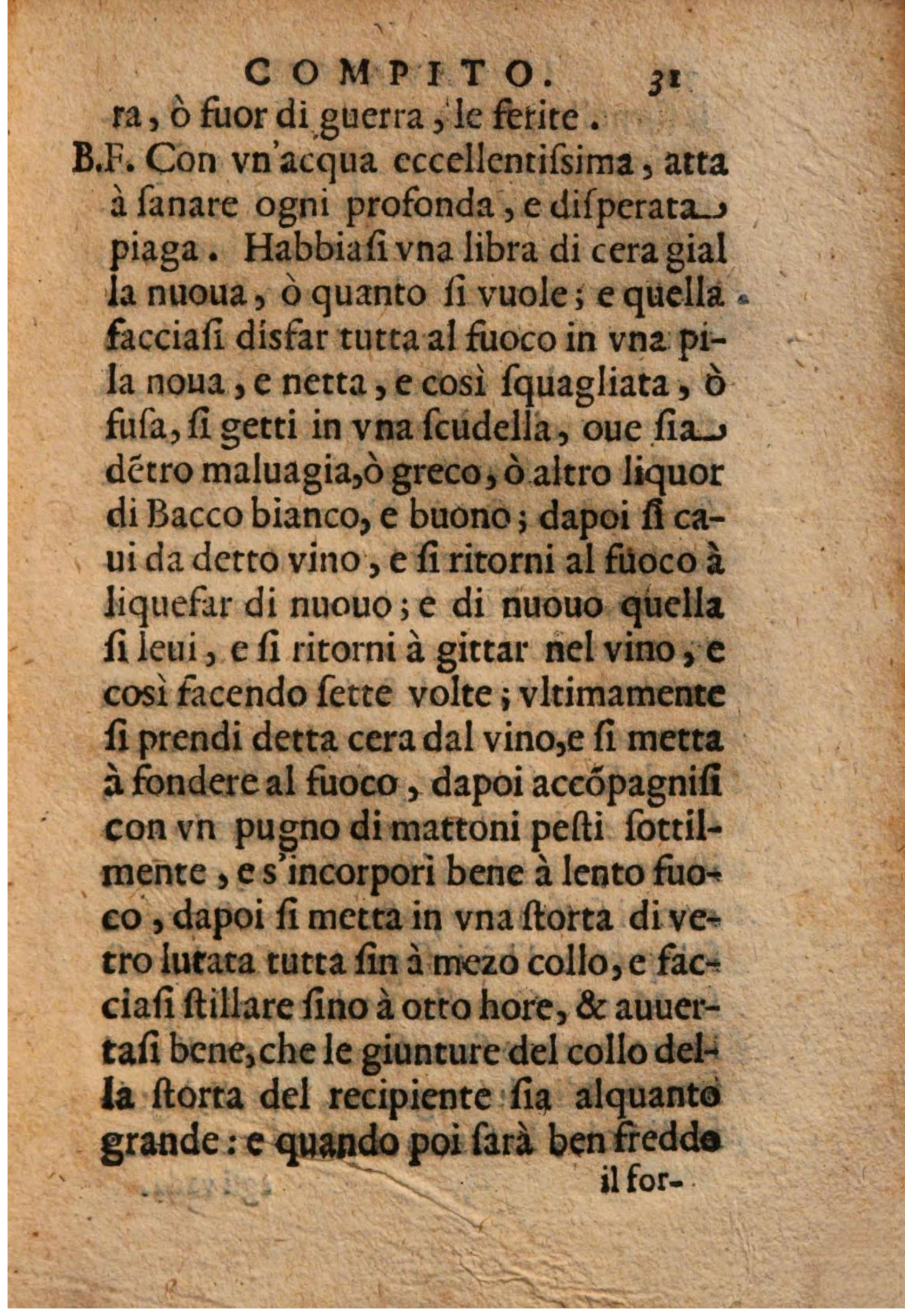
Scan p. 047 | printed p. 31
B.F. With a most excellent water, fit to heal every deep and desperate wound. Have a pound of new yellow wax, or as much as you wish; and let that be undone entirely at the fire in a new and clean pot, and thus melted or fused, let it be cast into a bowl, wherein there is malmsey, or Greek wine, or other liquor of white and good Bacchus; thereafter let it be drawn out from the said wine, and returned to the fire to liquefy anew; and again let that be taken off, and returned to be cast into the wine, and doing thus seven times; lastly let the said wax be taken from the wine, and put to melt at the fire, thereafter let it be accompanied with a fistful of bricks finely ground, and let it be well incorporated at a slow fire, thereafter let it be put into a glass retort luted entirely up to mid-neck, and let it be distilled for up to eight hours, and let good care be taken that the joints of the neck of the retort of the receiver be somewhat large: and when then the...
ra, ò fuor di guerra, le ferite.
B.F. Con vn'acqua eccellentiſsima, atta
à ſanare ogni profonda, e diſperata
piaga. Habbiaſi vna libra di cera gial
la nuoua, ò quanto ſi vuole; e quella
facciaſi disfar tutta al fuoco in vna pi-
la noua, e netta, e coſì ſquagliata, ò
fuſa, ſi getti in vna ſcudella, oue ſia
détro maluagia,ò greco, ò altro liquor
di Bacco bianco, e buono; dapoi ſi ca-
ui da detto vino, e ſi ritorni al fuoco à
liquefar di nuouo; e di nuouo quella
ſi leui, e ſi ritorni à gittar nel vino, e
coſì facendo ſette volte; vltimamente
ſi prendi detta cera dal vino,e ſi metta
à fondere al fuoco, dapoi accõpagniſi
con vn pugno di mattoni peſti ſottil-
mente, e s'incorpori bene à lento fuo-
co, dapoi ſi metta in vna ſtorta di ve-
tro lutata tutta ſin à mezo collo, e fac-
ciaſi ſtillare ſino à otto hore, & auuer-
taſi bene,che le giunture del collo del-
la ſtorta del recipiente ſia alquanto
grande: e quando poi ſarà ben freddo
CATCHWORD: il for-
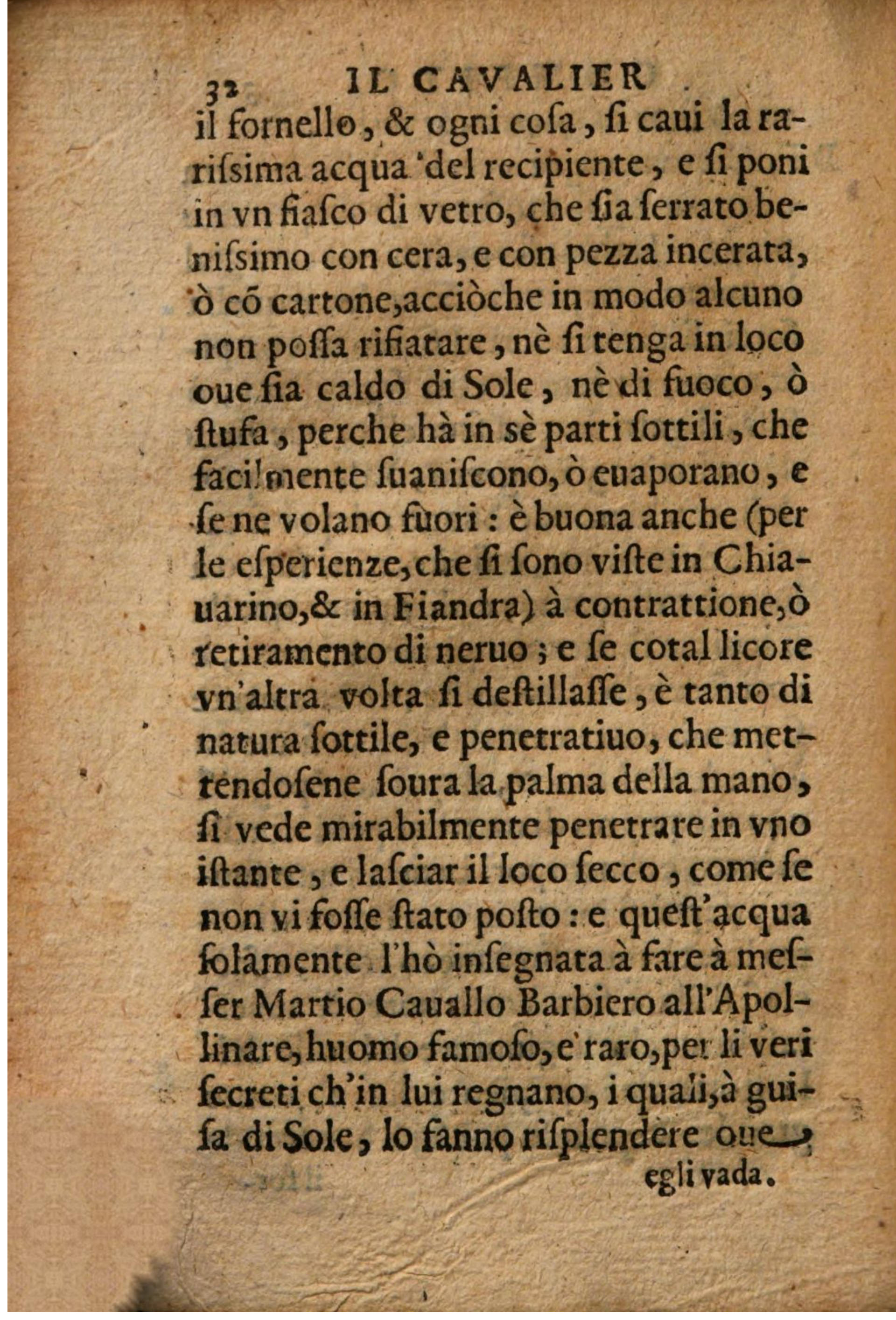
Scan p. 048 | printed p. 32
il fornello, & ogni coſa, ſi caui la ra-
riſsima acqua del recipiente, e ſi poni
in vn fiaſco di vetro, che ſia ſerrato be-
niſsimo con cera, e con pezza incerata,
ò cõ cartone,acciòche in modo alcuno
non poſſa riſiatare, nè ſi tenga in loco
oue ſia caldo di Sole, nè di fuoco, ò
ſtufa, perche hà in ſè parti ſottili, che
facilmente ſuaniſcono, ò euaporano, e
ſe ne volano fuori: è buona anche (per
le eſperienze,che ſi ſono viſte in Chia-
uarino,& in Fiandra) à contrattione,ò
retiramento di neruo; e ſe cotal licore
vn'altra volta ſi deſtillaſſe, è tanto di
natura ſottile, e penetratiuo, che met-
tendoſene ſoura la palma della mano,
ſi vede mirabilmente penetrare in vno
iſtante, e laſciar il loco ſecco, come ſe
non vi foſſe ſtato poſto: e queſt'acqua
ſolamente l'hò inſegnata à fare à meſ-
ſer Martio Cauallo Barbiero all'Apol-
linare, huomo famoſo, e raro,per li veri
ſecreti ch'in lui regnano, i quali,à gui-
ſa di Sole, lo fanno riſplendere oue
CATCHWORD: egli vada.
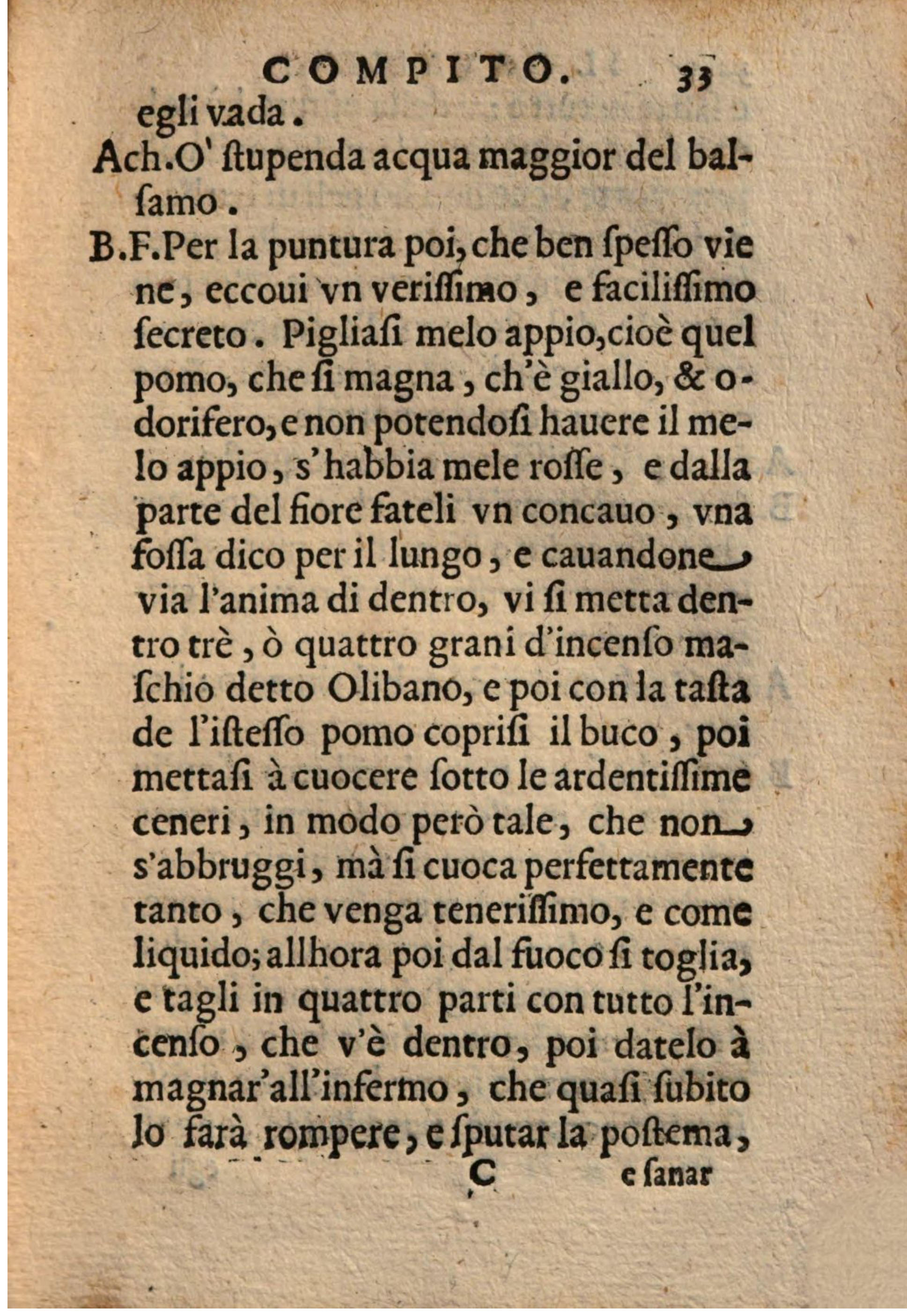
Scan p. 049 | printed p. 33
Ach. O stupendous water, greater than balsam!
B.F. Then for the puncture-wound, which very often comes, here is for you a most true and most easy secret. Take a sweet-apple [melo appio], that is, that apple which is eaten, which is yellow and fragrant, and, not being able to have the sweet-apple, let there be had red apples, and on the side of the flower [blossom-end] make in them a hollow, a pit I mean, lengthwise, and, hollowing out from within the core, put therein three or four grains of male incense called Olibanum, and then with the plug [tasta] of the same apple cover the hole, then set it to cook under the most burning ashes, in such a way however that it does not burn, but cooks perfectly so much that it becomes most tender, and as if liquid; then it is taken off the fire, and cut into four parts, with all the incense that is inside, then give it to the sick man to eat, which almost at once will make him break and spit out the abscess...
egli vada.
Ach.O' ſtupenda acqua maggior del bal-
ſamo.
B.F.Per la puntura poi, che ben ſpeſſo vie
ne, eccoui vn veriſſimo, e faciliſſimo
ſecreto. Pigliaſi melo appio,cioè quel
pomo, che ſi magna, ch'è giallo, & o-
dorifero, e non potendoſi hauere il me-
lo appio, s'habbia mele roſſe, e dalla
parte del fiore fateli vn concauo, vna
foſſa dico per il lungo, e cauandone
via l'anima di dentro, vi ſi metta den-
tro trè, ò quattro grani d'incenſo ma-
ſchio detto Olibano, e poi con la taſta
de l'iſteſſo pomo copriſi il buco, poi
mettaſi à cuocere ſotto le ardentiſſime
ceneri, in modo però tale, che non
s'abbruggi, mà ſi cuoca perfettamente
tanto, che venga teneriſſimo, e come
liquido; allhora poi dal fuoco ſi toglia,
e tagli in quattro parti con tutto l'in-
cenſo, che v'è dentro, poi datelo à
magnar'all'infermo, che quaſi ſubito
lo farà rompere, e ſputar la poſtema,
SIGNATURE: C
CATCHWORD: e ſanar
Scan p. 050 | printed p. 34
Ach. A most excellent secret is this.
B.F. Here is another for you, which is good for one who had fallen from an enemy wall in war, and feared he had broken or cracked something inside.
Ach. This too is a fine remedy: now speak.
B.F. Take half a glass of olive oil, and into it put as much powder of cress seed [nasturtium] as would fit inside half a walnut shell, then let it be given to the patient to drink one or two times; but let the blood first be drawn from him from the common vein, for health first sudden [repente] receives it; and if from the fall he had been bruised, or made livid, let him be anointed...
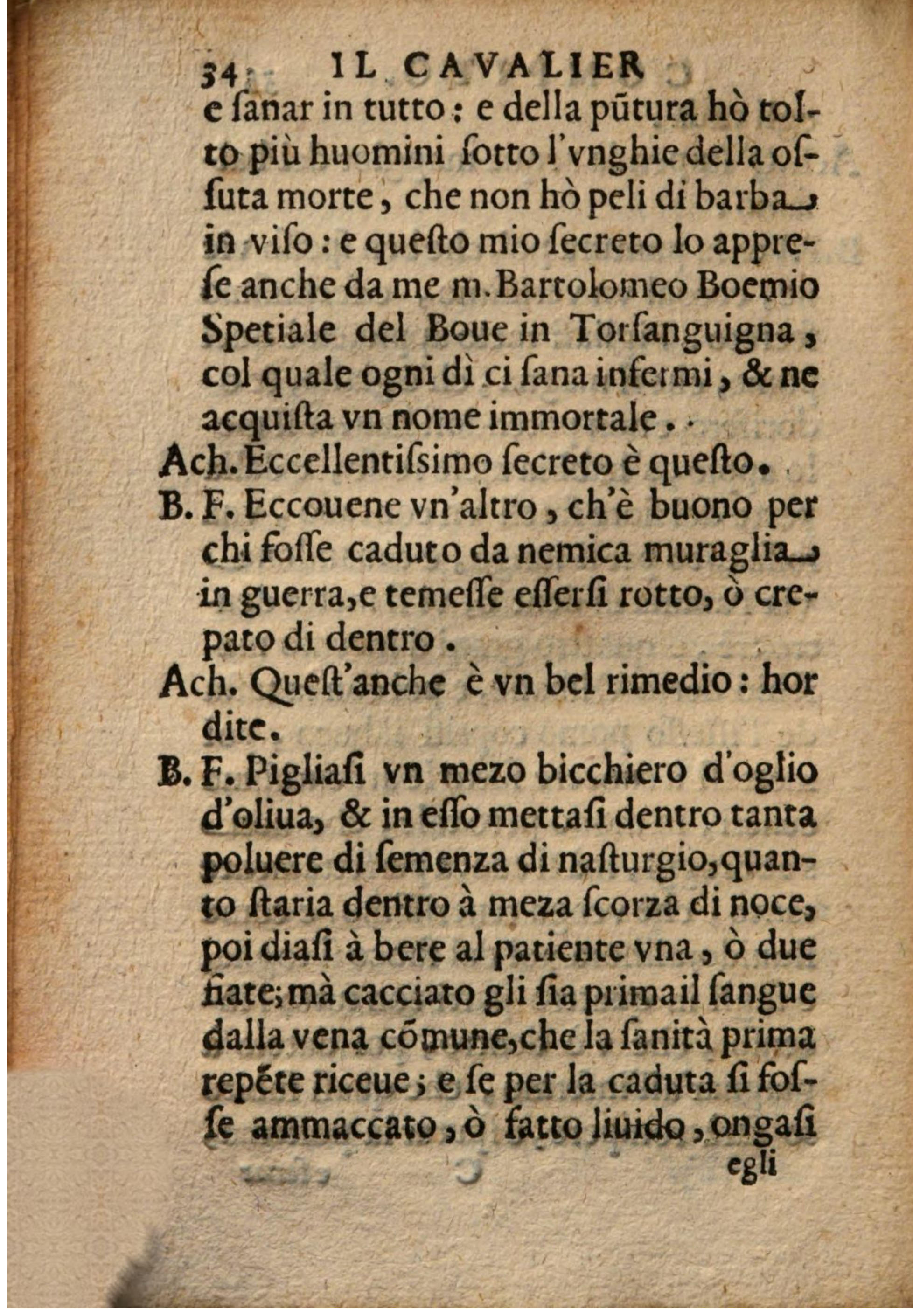
e ſanar in tutto: e della pũtura hò tol-
to più huomini ſotto l'vnghie della oſ-
ſuta morte, che non hò peli di barba
in viſo: e queſto mio ſecreto lo appre-
ſe anche da me m.Bartolomeo Boemio
Spetiale del Boue in Torſanguigna,
col quale ogni dì ci ſana infermi, & ne
acquiſta vn nome immortale.
Ach.Eccellentiſsimo ſecreto è queſto.
B. F. Eccouene vn'altro, ch'è buono per
chi foſſe caduto da nemica muraglia
in guerra,e temeſſe eſſerſi rotto, ò cre-
pato di dentro.
Ach. Queſt'anche è vn bel rimedio: hor
dite.
B. F. Pigliaſi vn mezo bicchiero d'oglio
d'oliua, & in eſſo mettaſi dentro tanta
poluere di ſemenza di naſturgio,quan-
to ſtaria dentro à meza ſcorza di noce,
poi diaſi à bere al patiente vna, ò due
fiate;mà cacciato gli ſia primail ſangue
dalla vena cõmune,che la ſanità prima
repéte riceue; e ſe per la caduta ſi foſ-
ſe ammaccato, ò fatto liuido, ongaſi
CATCHWORD: egli
Scan p. 051 | printed p. 35
Ach. Speak on, for to learn it I open all my hearing to you.
B.F. Take white dittany, round birthwort [aristolochia], carline thistle, vervain, gentian, zedoary, hartshorn, of each two ounces; pound them all together with a handful of rue. Then take a large carafe and put inside it all the aforesaid things, then fill it with the best wine that can be found in the famous Tavern of the Fox at the Rotonda. And in a time of suspicion of plague, take half a glass of such wine every morning before leaving the house, on an empty stomach, having first eaten a walnut, or a fig, or two or three fronds of rue, and the soldier will be safe, so that the plague...
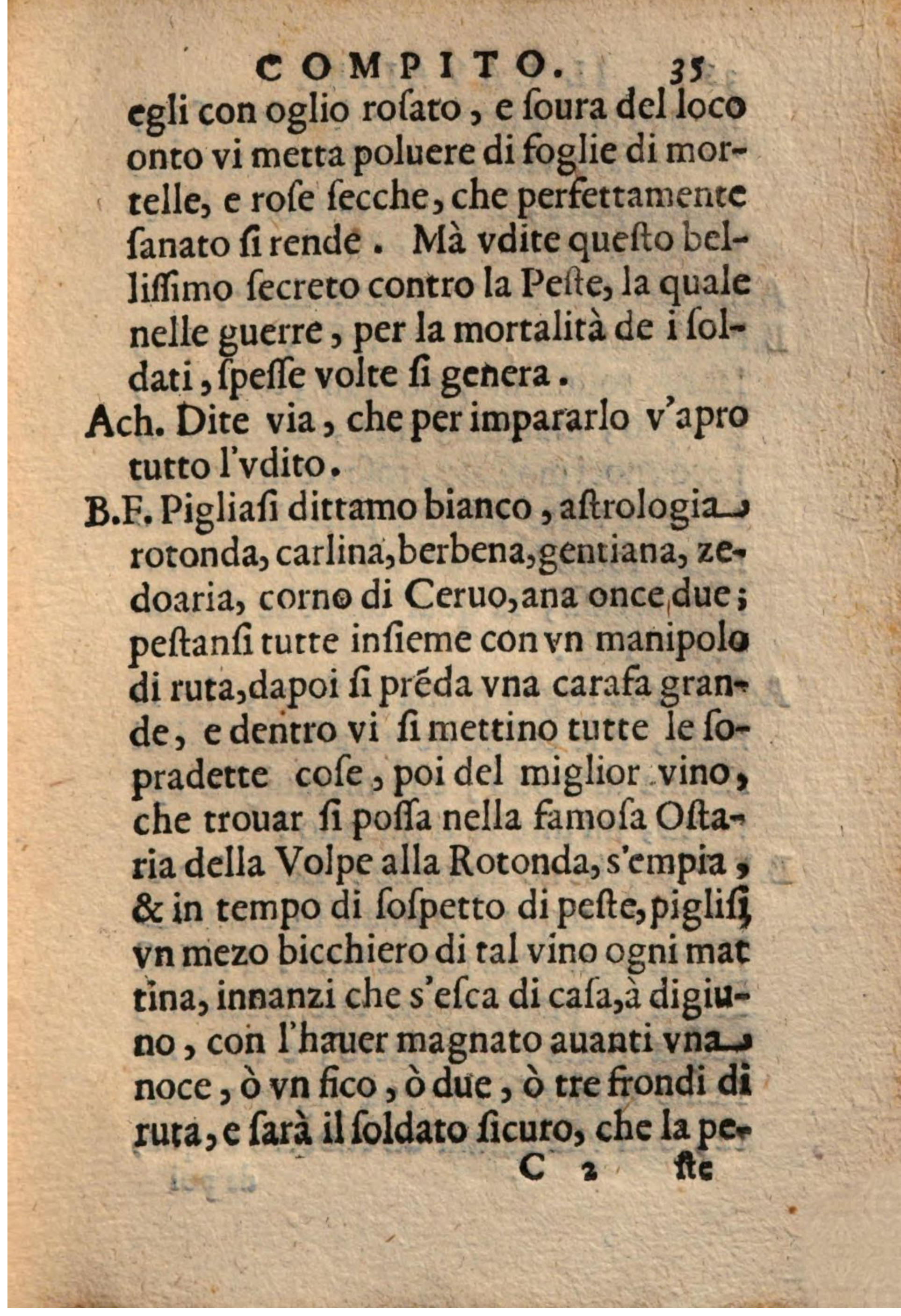
egli con oglio roſato, e ſoura del loco
onto vi metta poluere di foglie di mor-
telle, e roſe ſecche, che perfettamente
ſanato ſi rende. Mà vdite queſto bel-
liſſimo ſecreto contro la Peſte, la quale
nelle guerre, per la mortalità de i ſol-
dati, ſpeſſe volte ſi genera.
Ach. Dite via, che per impararlo v'apro
tutto l'vdito.
B.F. Pigliaſi dittamo bianco, aſtrologia
rotonda, carlina,berbena,gentiana, ze-
doaria, corno di Ceruo,ana once due;
peſtanſi tutte inſieme con vn manipolo
di ruta,dapoi ſi préda vna carafa gran-
de, e dentro vi ſi mettino tutte le ſo-
pradette coſe, poi del miglior vino,
che trouar ſi poſſa nella famoſa Oſta-
ria della Volpe alla Rotonda, s'empia,
& in tempo di ſoſpetto di peſte,pigliſi
vn mezo bicchiero di tal vino ogni mat
tina, innanzi che s'eſca di caſa,à digiu-
no, con l'hauer magnato auanti vna
noce, ò vn fico, ò due, ò tre frondi di
ruta, e ſarà il ſoldato ſicuro, che la pe-
SIGNATURE: C 2
CATCHWORD: ſte
Scan p. 052 | printed p. 36
Ach. I hear more than enough, Sir Braccioforte.
B.F. Take mastic, cypress, incense, laurel, rosemary, cloves, [aromatic] wood, juniper, musk, rue, ambergris, pitch, nutmegs, roses, and myrtle; and all these pounded together are thrown mixed upon the burning coals, and the house is perfumed, which by plague will never be harmed.
Ach. For the scabies, greasy and dry, which embroiders the hands and thighs of the afflicted soldiers in such a way that it brings amazement, would you tell me the remedy?
B.F. And why not, my son? Here is taught to you a water which in five days heals every great scabies. Take two glasses of plantain water, one glass of rose water, and all together let them be put in a clean pot, or in a carafe for cooking water,
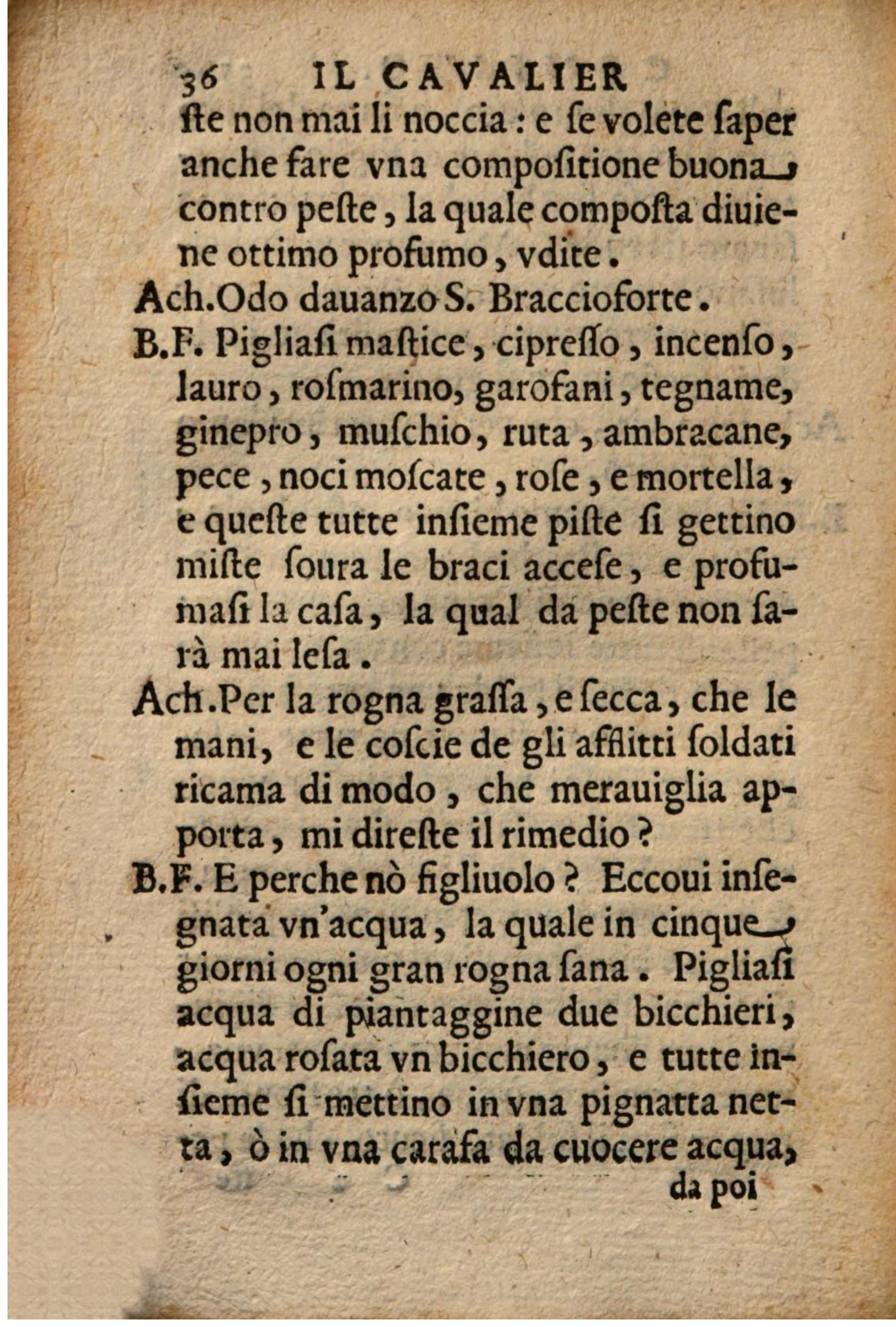
ſte non mai li noccia: e ſe volete ſaper
anche fare vna compoſitione buona
contro peſte, la quale compoſta diuie-
ne ottimo profumo, vdite.
Ach.Odo dauanzo S. Braccioforte.
B.F. Pigliaſi maſtice, cipreſſo, incenſo,
lauro, roſmarino, garofani, tegname,
ginepro, muſchio, ruta, ambracane,
pece, noci moſcate, roſe, e mortella,
e queſte tutte inſieme piſte ſi gettino
miſte ſoura le braci acceſe, e profu-
maſi la caſa, la qual da peſte non ſa-
rà mai leſa.
Ach.Per la rogna graſſa, e ſecca, che le
mani, e le coſcie de gli afflitti ſoldati
ricama di modo, che merauiglia ap-
porta, mi direſte il rimedio?
B.F. E perche nò figliuolo? Eccoui inſe-
gnata vn'acqua, la quale in cinque
giorni ogni gran rogna ſana. Pigliaſi
acqua di piantaggine due bicchieri,
acqua roſata vn bicchiero, e tutte in-
ſieme ſi mettino in vna pignatta net-
ta, ò in vna carafa da cuocere acqua,
CATCHWORD: da poi
Scan p. 053 | printed p. 37
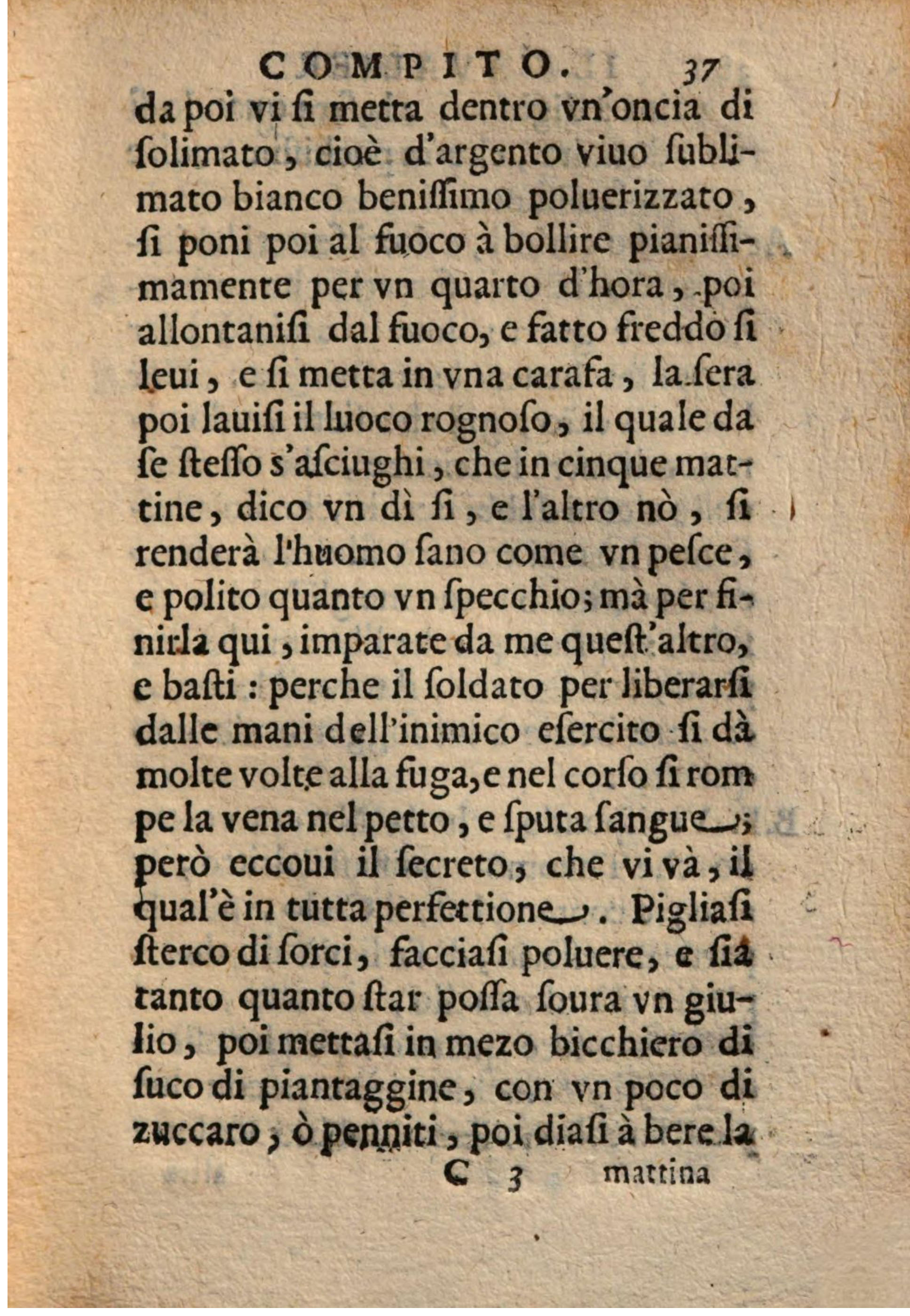
da poi vi ſi metta dentro vn'oncia di
ſolimato, cioè d'argento viuo ſubli-
mato bianco beniſſimo poluerizzato,
ſi poni poi al fuoco à bollire pianiſſi-
mamente per vn quarto d'hora, poi
allontaniſi dal fuoco, e fatto freddo ſi
leui, e ſi metta in vna carafa, la ſera
poi lauiſi il luoco rognoſo, il quale da
ſe ſteſſo s'aſciughi, che in cinque mat-
tine, dico vn dì ſi, e l'altro nò, ſi
renderà l'huomo ſano come vn peſce,
e polito quanto vn ſpecchio; mà per fi-
nirla qui, imparate da me queſt'altro,
e baſti: perche il ſoldato per liberarſi
dalle mani dell'inimico eſercito ſi dà
molte volte alla fuga,e nel corſo ſi rom
pe la vena nel petto, e ſputa ſangue;
però eccoui il ſecreto, che vi và, il
qual'è in tutta perfettione. Pigliaſi
ſterco di ſorci, facciaſi poluere, e ſia
tanto quanto ſtar poſſa ſoura vn giu-
lio, poi mettaſi in mezo bicchiero di
ſuco di piantaggine, con vn poco di
zuccaro, ò penniti, poi diaſi à bere la
SIGNATURE: C 3
CATCHWORD: mattina
Part III · Natural Philosophy & Meteorology
Scan p. 054 | printed p. 38
Ach. Oh what curious and learned secrets I have learned from you! Secrets that will help me gain great goodwill in the wars where I shall go. Now I should be glad, since you are a master of all the sciences, if you would resolve for me certain hidden doubts which until now I have never found a philosopher who, with the truth in hand, has resolved for me. And first: why does man have two feet, while the ass, the bull, the lion, and other beasts subject to him have four?
B.F. I answer you that Nature, wishing man to walk upright and tall and to contemplate the Heaven, did not think it necessary to make him more than two feet; but to the horse, the ox, and the buffalo she made four, because, being prone and inclined to the ground, with two feet they would without doubt have fallen:
mattina à digiuno, e la ſera quando ſi
và à dormire, che in pochiſſime volte
reſtarà ſaniſſimo.
Ach. O che curioſi, e dotti ſecreti hò im-
parato io da voi; ſecreti, che m'han-
no nelle guerre doue io andarò à far
acquiſtar beneuolenza magna. Hor
haurei à caro, già che ſiete vn domi-
nator di tutte le ſcienze, che mi riſol-
ueſte alcuni dubbi occulti,che ſin'adeſ-
ſo non hò mai trouato filoſofo, che
con la verità in mano me gli habbia ri-
ſoluti: e prima perche l'huomo hà due
piedi, & il ſomaro, il toro, il leone,
& altre beſtie à lui ſoggette n'hanno
quattro.
B.F. Vi riſpondo, che la Natura volen-
do che l'huomo caminaſſe dritto, &
alto, e contemplaſſe il Cielo, non le
parue neceſſario, di farli più di due
piedi; mà al cauallo, al boue, & al
bufolo ne fece quattro, perche eſſen-
do proni, & inchinati à terra con due
piedi ſarebbono ſenza dubbio caduti:
CATCHWORD: altra
Scan p. 055 | printed p. 39
Ach. Speak on, my most strong and most warlike Lord.
B.F. Nature gives to each animal the body and the members corresponding to its instinct and habit, and this Galen says: to the horse, so that it may be swift in the course, she gave strong hooves; to the lion, spirited and fierce, the teeth and the claws, so that with one bite or one scratch it can maim any large beast; to the bull the horns, to toss a man up high as if he were made of straw; and to the deer and the hare, being timid and cowardly, in place of weapons the swiftness in fleeing. But to man she gave the hand, an instrument truly necessary to all the arts, and no less suited to peace than to war, and to no other end save that by means of it man may, for his own defence, make use of every...
altra ragione per via filoſofica dar non
vi poſſo; mà imparate da me queſto
dubbio,perche la Natura diede à l'huo
mo la mano.
Ach. Dite via Sig. mio fortiſſimo, e bel-
licoſiſſimo.
B.F. La Natura à ciaſcuno animale dona
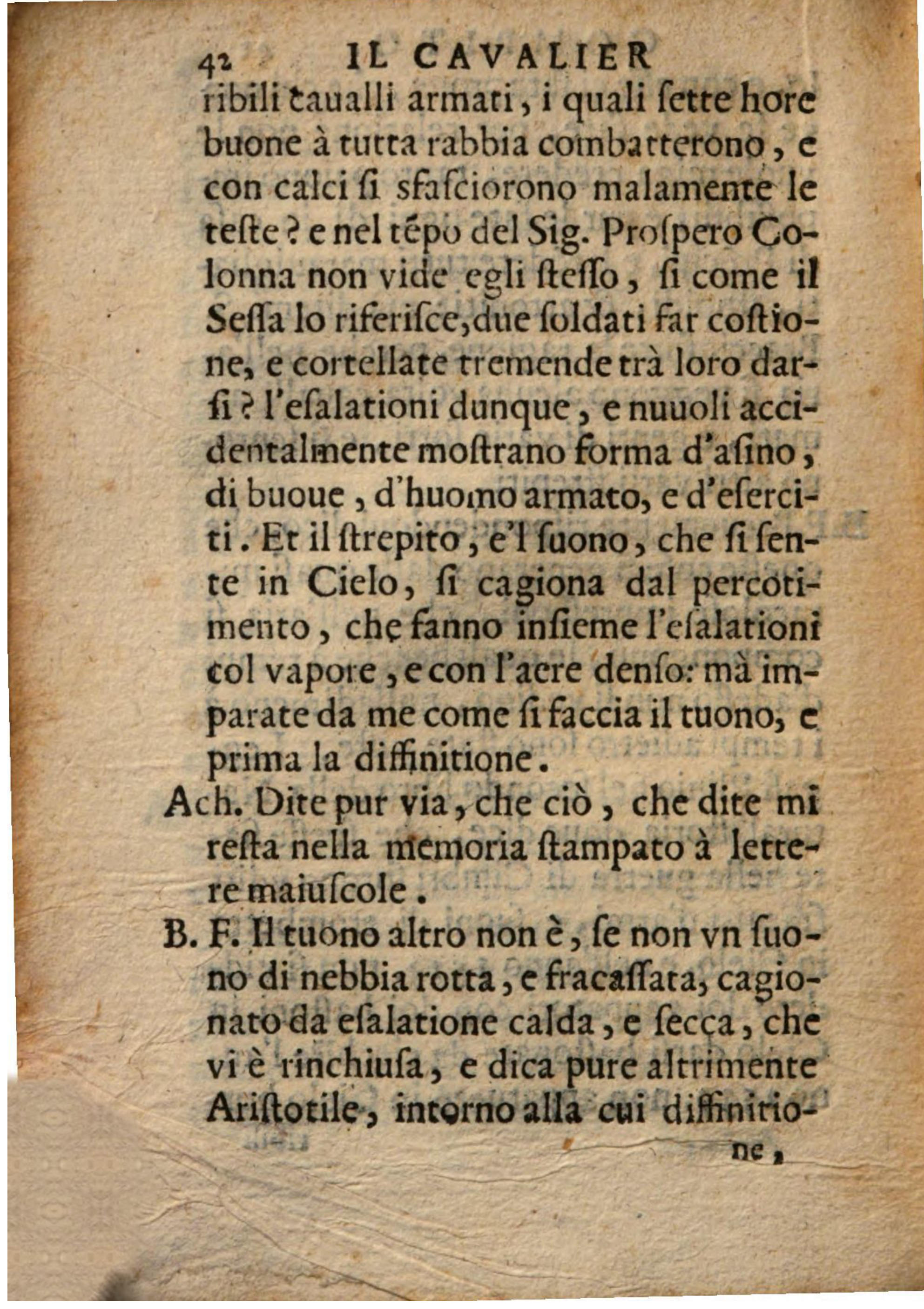
il corpo, e le membra al ſuo inſtinto
coſtume corriſpondenti, e ciò lo dice
Galeno; al cauallo perche ſia veloce
nel corſo diede le forti onghie, al leo-
ne animoſo, e feroce i denti, e l'vn-
ghie, da poter con vn morſo, ò con
vna graffiata ſtroppiar ogni groſſa be-
ſtia; al tauro le corna per ſbalzar'vn
huomo in alto come foſſe di paglia, &
al ceruo, & al lepre per eſſer eglino ti-
midi, e vili in luogo d'arme la veloci-
tà nel fuggire; mà à l'huomo diede la
mano, inſtrumento inuero à tutte le
arti neceſſario, e non meno alla pace,
che alla guerra idoneo, e non ad altro
fine, ſe non che per mezo di lei poſſa
l'huomo per ſua difeſa ſeruirſi d'ogni
SIGNATURE: C 4
CATCHWORD: ſorte
Scan p. 056 | printed p. 40
Ach. I do not believe that in all the universal world a warrior stronger than you can be found: if with your hair you lift a weight of eight hundred pounds, with your teeth you cut iron wire and small cords, and with it you shatter bones hard as travertine, you grind corals, you reduce mountain crystal to finest powder...
ſorte d'arme, e ben diſſe Ariſtotile,
che la mano è organo de gli organi, &
io inuero grand'obligo deuo alla Na-
tura, ſe m'hà dato vna mano, che ſen-
z'armi faccio ciò che voglio, ci rompo
ferri, ci alzo colonne, ci ſpezzo ſaſſi,
ci taglio con le dita le carte, ci tronco
funi di canapa, e ci amazzo fiere, e
ſpauentoſe beſtie; che più? con vn di-
to paſſo vn tondo di ſtagno da banda
à banda, come vna archibugiata, ci
alzo vn rubbio di grano, vna botte di
vino, e faccio le lattuche ad vn bacile;
che più anche? ci fermo il toro, me lo
metto in ſpalla, e poi il getto mezo
morto in terra.
Ach. Non credo, che in tutto l'vniuerſo
mondo ſi troui vn guerrier più forte di
voi: ſe con i capelli alzate vn peſo di
ottocento libre, con i denti tagliate il
filo di ferro, e le cordicelle, e ci ſpez-
zate l'oſſa dure al par del trauertino,ci
macinate i coralli, ci riducete in polue-
re minutiſſima il criſtallo montagnuo-
CATCHWORD: lo,e con
Scan p. 057 | printed p. 41
B.F. Answering you briefly, I say that these things are generated from the almost miraculous impressions [phenomena] that compose themselves in the air, which, although in present times they are not seen, nevertheless in times past have been seen. Let one read Pliny in the second book of the Natural History, where he says that oftentimes in the war of the Cimbri were heard crashings of arms and sounds of trumpets in the Sky; and in the year 1513, were there not seen two ditch-diggers with two staves in the Sky giving each other blows like blind men? In the year 1539, did there not appear in the Sky horr-
lo, e con eſſe ci fate proue, che chi non
ve le vede fare, per relatione non le
vuole miga credere, tanto paiono im-
poſſibili, e pur le fate ogni dì in caſa
di Prècipi, e li rèdete tutti marauiglia-
ti, ſtupidi, & attoniti: mà ditemi S.
Braccioforte la ragione, perche nell'a-
ria ſi veggono alcuna volta caualli ar-
mati, e genti di varie ſorti, e ſi ſento-
no altri varij ſtrepiti.
B.F.Breuemente riſpondendoui dico, che
queſte coſe ſi generano dalle quaſi mi-
racoloſe impreſſioni, che nell'aria ſi
compongono, le quali benche à tempi
d'adeſſo non ſi vedino, nulladimeno à
i tempi adietro ſono ſtate viſte. Leg-
gaſi Plinio nel ſecondo libro della Na-
tural'iſtoria doue dice, che ſpeſſe fia-
te nella guerra di Cimbri furono vditi
fracaſsi d'armi, e ſuoni di trombette
in Cielo, e nell'anno 1513. non ſi vid-
dero doi zappatori con doi baſtoni in
Cielo darſi baſtonate da ciechi? l'an-
no 1539. non apparuero in Cielo hor-
CATCHWORD: ribili
Scan p. 058 | printed p. 42
Ach. Do speak on, for what you say remains stamped in my memory in capital letters.
B.F. Thunder is nothing other than a sound of mist broken and shattered, caused by a hot and dry exhalation that is enclosed within it, whatever Aristotle may say otherwise; concerning whose definition...
42
ribili taualli armati, i quali ſette hore
buone à tutta rabbia combatterono, e
con calci ſi sfaſciorono malamente le
teſte? e nel tèpo del Sig. Proſpero Co-
lonna non vide egli ſteſſo, ſi come il
Seſſa lo riferiſce, due ſoldati far coſtio-
ne, e cortellate tremende trà loro dar-
ſi? l'eſalationi dunque, e nuuoli acci-
dentalmente moſtrano forma d'aſino,
di buoue, d'huomo armato, e d'eſerci-
ti. Et il ſtrepito, e'l ſuono, che ſi ſen-
te in Cielo, ſi cagiona dal percoti-
mento, che fanno inſieme l'eſalationi
col vapore, e con l'aere denſo: mà im-
parate da me come ſi faccia il tuono, e
prima la diffinitione.
Ach. Dite pur via, che ciò, che dite mi
reſta nella memoria ſtampato à lette-
re maiuſcole.
B. F. Il tuono altro non è, ſe non vn ſuo-
no di nebbia rotta, e fracaſſata, cagio-
nato da eſalatione calda, e ſecca, che
vi è rinchiuſa, e dica pure altrimente
Ariſtotile, intorno alla cui diffinitio-
CATCHWORD: ne,
Scan p. 059 | printed p. 43
Ach. O learned Complete Cavalier, indeed you are: the more I converse with you, the more I remain stupefied and beside myself, and I go...
ne, notate bene, che la cauſa formale
è il ſuono, la materiale è la nebbia, e
l'efficiente è l'eſalatione, & il fine ſe-
condo Pitagora è il terrore, e ſpauen-
to, che l'anime de' zirardi, che ſtan-
no ne l'inferno ne riceuono. Hora per
inſegnarui come ſi faccia il tuono, vdi-
te bene. Quella eſalatione, la quale
dal caldo del ſole, e delle ſtelle leuaſi
da terra, peruenuta ch'è alla ſeconda
regione dell'aria ſi diuide: percioche
la parte ſottile d'eſſa ſe ne paſſa in ſù
laſciando i nuuoli, e la parte craſſa, e
greue reſta chiuſa nella nebbia, & eſ-
ſendo circondata dalla freddezza di
quella s'vniſce in ſe ſteſſa per antiperi-
ſteſi, come i filoſofi dicono,& in queſto
modo vnita è fatta forte, rompe,ſpez-
za, e fracaſſa la nebbia, e rompendo-
la, ſpezzandola, e fracaſſandola ſuo-
na, e cotal ſuono è il tuono.
Ach. O ſcientiato Caualier Compito voi
pur ſiete: più che con voi diſcorro, più
reſto ſtupefatto, e fuor di me, e vado
CATCHWORD: trà di
Scan p. 060 | printed p. 44
B.F. The winds compose themselves in the air, and their material cause is the terrestrial exhalation, subtle, dry, and without any moisture or greasiness: I say without any greasiness, because if it were gross, enclosing itself in the hollows of the earth, it would rather make an earthquake than wind; and if it were oily, that is, apt to catch fire, it would rather make falling stars and other effects of fire; and if it were moist and watery, it would make lightning flashes. But, if you will grasp this doubt from me: why does the sea move with the ebb and flow?
Ach. The cause of this doubt is indeed beautiful and curious to know.
B.F. Hear first the opinions of the others, who have gone quite mad for not finding the true cause. Parmen-
44
trà di me penſando come, e doue mai
hauete potuto imparar tanto, che ſap-
piate ogni ſcienza: mà ditemi il modo
come ſi fanno i venti, acciò quando
nauigo il mare mi ſia noto.
B. F. I venti nell'aria ſi compongono, e
la cauſa loro materiale è l'eſalatione
terreſtre, ſottile, ſecca, e ſenza humi-
dità, e graſſezza alcuna: dico ſenza
graſſezza alcuna, perche s'ella foſſe
craſſa rinchiudendoſi nelle concauità
della terra farebbe più toſto terremo-
to, che vento, e ſe foſſe ontuoſa, cioè
atta ad infiammarſi farebbe più toſto
ſtelle cadenti, & altri effetti di fuoco,
e s'ella foſſe humida, & acquea fareb-
be lampi: mà ſe apprenderete queſto
dubbio da me, perche il mare ſi muo-
ue col fluſſo, e refluſſo?
Ach. La cagione di queſto dubbio ſi ch'è
bella, e curioſa à ſaperſi.
B. F. Vdite in prima l'opinioni de gli al-
tri, i quali ſi ſono impazziti à fatto per
non trouar la cagione vera. Parmen-
CATCHWORD: ſi di-
Scan p. 061 | printed p. 45
ſi dicea,che la Luna con la ſua influen-
za gonfiaua, & accreſceua ſei hore il
mare, quanto potea accreſcerſi,e gon-
fiarſi: e che poi ſei altre hore lo gonfia-
ua, e ſgonfiaua, e volea queſto effetto
non farſi per virtù del lume della luna,
perche, quando ella ſi ritrouaua ſotto
terra, il ſuo lume era impedito; ſi che
non potea far cotal'effetto; nè anche
farſi p vigor del ſuo mouimèto,perche
quando era ſotto terra non toccaua il
mare di ſopra con il mouer ſuo: talche
con l'influenza voleua, che la Luna
cauſaſſe il fluſſo, e refluſſo. Alcuni al-
tri magna pani, dicono, ch'il Sole n'è
cauſa, ilquale fa bollir'il Mare; e ſe ciò
foſſe vero, ne ſeguirebbe, che quando
naſce il Sole, il Mar bolliſſe; ilche al-
l'eſperienza non corriſponde. Alpe-
tragio l'attribuiſce al firmamento, vo-
lendo, ch'il mouimento di quel Cielo
foſſe ſtato cauſa del fluſſo,rifluſſo: e coſi
tal parere è ſciocco;pche ne ſeguirebbe
che foſſe ordinatamente ſempre da le-
CATCHWORD: uante
Scan p. 062 | printed p. 46
Ach. It gives me more satisfaction to have learned this doubt than if I had won a thousand gold scudi of the coinage at sbaraglini or scarca l'asino [dice/board games]. But tell me, for what cause were the celestial signs called by the names of animals?
B.F. I answer you that it was to distinguish the property of the season by some likeness, in this way. The Image that is in the Zodiac and is proper to the tropic of summer is called Cancer, because, just as the Crab walks forwards and...
46
uante à ponente. Hor per conclude-
re, e non taſſar'Auerroe, ch'anche eſſo
nella ſua parafraſi hà detto,ſoura que-
ſto dubbio, ſpropoſito grande; dico, e
riſoluo, con la verità del fatto, ch'eſ-
ſendo vero, che i corpi miſti habbino
due virtù, vna da gli Elementi, l'altra
dal Cielo, non deue eſſer merauiglia,
ſe per virtù de gl'Elementi ſi muoue in
giù, per eſſer graue,e per virtù del Cie-
lo ſi muoue, col fluſſo, e refluſſo, ogni
ſei hore.
Ach.M'è più di ſodisfattione hauer ſapu-
to queſto dubbio,che s'io haueſſi mille
ſcudi d'oro delle ſtampe, guadagnato
à sbaraglini, ò à ſcarca l'aſino. Mà di-
temi perche cauſa i ſegni celeſti furono
chiamati per nome d'animali?
B. F. Riſpondoui, che per diſtinguere la
proprietà del tempo con qualche ſimi-
litudine, in queſto modo. La Imagine
ch'è nel Zodiaco, è proprio del tropico
dell'eſtate: ſi chiama Cancro,perche,
ſi come il Cancro camina innanzi, e
CATCHWORD: indietro,
Scan p. 063 | printed p. 47
indietro, coſì il Sole, arriuato in quel-
la parte, torna indietro à guiſa proprio
del Cancro. E la Imagine, che viene
appreſſo, ſi domanda Leone, perch'il
Sole in quel tempo tiene quella poten-
za fra le Stelle, che tiene il Leone frà
gli Animali, & io fra gli Huomini: e
chiamaſi Vergine quella, che ſegue
dapoi, perche, ſi come la Vergine non
partoriſce coſa veruna, coſì la terra,
quando il Sole in quel ſegno ſi ritroua,
abbruſciata dal ſouerchio caldo, non
produce frutto alcuno: diceſi Libra la
ſeguente, perche, ſi come lo librare fa,
che ſia vguale l'vna, e l'altra bilancia,
coſì il Sole,arriuando à cotal ſegno,fa,
ch'il giorno ſia vguale alla notte. Ne
per altro i ſeguenti ſegni ſi chiamoro-
no Sagittario,Acquario,e Peſce,ſe non
perche in quel tempo, ch'il Sole con
eſſi alberga, ſpeſſe volte pioue, lampa,
tuona: e per concluderla con queſt'al-
tro dubbio, vdite perche cauſa alcuna
volta pioue pezzi di carne, di mattoni,
CATCHWORD: latte,
Scan p. 064 | printed p. 48
Ach. Is this possible?
B.F. Is it possible? Why not? Does one not read that in the time when L. Volumnius and Servius Sulpitius were Consuls, pieces of flesh fell with the rain, which neither rotted nor were the less pecked at by the songbirds? And in the time of the Consulate of L. Paulus and C. Marcellus, did not wool and sponges descend with the rain? And the year before Marcus Crassus was killed by the Parthians, did not baked bricks and iron fall? And at other times, as Pliny says, has one not seen it rain milk and blood? And at other times fish, frogs and worms? And other animals? Not to mention waters sweet, fetid and bitter, and of other tastes? And this happens, regarding the raining of animals, because in the matter of the water there are hot and cold parts, and when the heat that is in the mist divides and separates itself from it, it draws with itself the subtle moisture that is found in that same mist, which...
48
latte, ſangue, ranocchie, & altre coſe.
Ach.E poſsibile queſto?
B.F. S'è poſſibile? perche nò? non ſi leg-
ge nel tempo, che furono Conſoli L.
Volunnio, e Seruio Sulpitio, che cad-
dero con la pioggia i pezzi di carne, i
quali non ſi corromperono, ne dalli
canori augelli furono meno beccati? e
nel tempo del Conſolato di L. Paolo,
e C.Marcello non ſceſero con la piog-
gia lane, e ſpongie? e l'anno innanzi
che Marco Craſſo foſſe ſtato da Parti
vcciſo, non caddero mattoni cotti, e
ferri? & altre fiate, come Plinio dice,
non ſi è viſto piouer latte, e ſangue?&
altre volte peſci, ranocchie, e vermi?
& altri animali? non che acque dolci,
fetide, & amare? e d'altri ſapori? e ciò
naſce circa il piouer animali, perche
nella materia dell'acqua ſono parti cal-
de, e fredde, e quand'il caldo, ch'è
nella nebbia ſi diuide,e ſeparà da quel-
la, tira ſeco l'humido ſottile, che nel-
la medeſima nebbia ſi ritroua, il qual
CATCHWORD: miſchian-
Scan p. 065 | printed p. 49
Ach. Oh what lovely and curious doubts, concerning hidden and much-desired matters in philosophy, I have learned to resolve from you. Now it remains that you teach me the Scrima [fencing].
B.F. Gently with the Scherma [fencing]; it is necessary first that you know many other doubts necessary to everyone who adorns his flank with piercing and cutting steel...
miſchiandoſi poi con alcuna terreſtre
eſalatione, diuenta alquanto viſcoſo,
e tenace; e coſì viſcoſo, dalla freddez-
za dell'aria, ſi congela, e condenſa;
onde, coſì condenſato, diuiene come
vna pellicella, dètro della quale il me-
deſimo caldo auiluppandoſi è cagione,
ch'in eſſa ſi ſerri lo ſpirito, al quale
aggiungendoſi, ſi generano varie le
miſchianze, e gli aſpetti delle ſtelle:
e quando queſte coſe piouono, prono-
ſtico,che guerre, liti, diſcordie trà pa-
renti,morte di Prencipi,aſſaſſinamenti,
careſtie, ribellioni, e morbi inſanabili,
con fluſſi à ſangue naſcono.
Ach. O che vaghi, e curioſi dubbi,intor-
no alle coſe occulte, e deſiderate nella
filoſofia, da voi hò imparato à riſolue-
re. Hor reſta, che mi inſegnate la
Scrima.
B.F. Piano con la Scherma; è neceſſario
prima, che ſappiate molti altri dubbi
neceſſarij à ciaſcheduno, che di pun-
gente, e tagliente ferro s'adorna il fian-
SIGNATURE: D
CATCHWORD: co: &
Part IV · Chivalric Questions & the Duel
Scan p. 066 | printed p. 50
Ach. Oh fine question; it seems to me a thousand years until you begin it.
B.F. Upon this doubt there are read in the world various and discordant opinions, which I do not state so as not to be too long. I will say indeed, by way of conclusion, that the Cavalier who lives for honour also dies for honour, and once dead cannot another time be resurrected to honour. And those ignorant men who say that a Prince can restore to the life of honour one dead to honour speak wrongly. Therefore let the Cavalier take care not to say, in scorn of others, uncivil and discourteous words, which bring dishonour and infamy; let him show on every occasion that presents itself, with unconquered spirit, his valour; let him not violate his faith, nor fail his word, let him honour justice, for in this manner he will live by the law of honour, and not by the penalty of eternal infamy.
50
co: & in prima, ſe l'honore perduto ſi
poſſa ricouerare.
Ach. O bella queſtione; parmi mill'anni,
che la incominciate.
B. F. Soura queſto dubbio leggonſi del
mondo variè, e diſcordanti opinioni,
le quali non dico per non eſſer troppo
lungo: dirò bene per conchiuſione,che
il Caualiero, che viue all'honore,all'ho
nore anche muore, e morto non puote
vn'altra volta riſuſcitar all'honore;
e quelli ignoranti, che dicono, che vn
Prècipe poſſa reſtituir alla vita dell'ho-
nore vn morto all'honore,dicono male;
però il Caualiero guardiſi di dire, in
diſpregio d'altri, parole inciuili, e di-
ſcorteſi, le cui arrecano diſhonore, e
infamia, moſtri in ogni occaſione, che
gli ſi appreſenta, con animo inuitto, il
ſuo valore, non violi la fede,non man-
chi di ſua parola, honori la giuſtitia,
che à queſto modo viuerà alla legge
dell'honore, e non alla pena dell'infa-
mia eterna.
CATCHWORD: Ach.
Scan p. 067 | printed p. 51
B.F. The second doubt shall be: whether two Cavaliers who challenge each other in the midst of the armies, going to fight outside of them, are deserving of punishment. It is to be concluded that they merit punishment; the reason is this, that they fail in their honour, being obliged to the service of the army, which, while it lasts, they cannot, without the licence of their superiors, fight; and by fighting they offend the republic or their Lord. And so the Jurists have made laws against such combatants that punish them gravely.
Ach. These laws are very well made, since they avoid, by the rigour of the penalty, many troubles.
B.F. The third doubt shall be: if two enemy Cavaliers who make peace, coming to a new enmity, are to be understood to have broken the peace. It is said no, according to Bartolus; and if they maim each other, it is attributed to the new quarrel, and not to the first...
Ach.O bene inuero Sig. Braccioforte, &
horrendo.
B. F. Secondo dubbio ſarà. Se due Ca-
ualieri, che ſi disfidano in mezo à gli
eſerciti, di douer andar à combattere
fuor di quelli, ſiano degni di caſtigo.
E' da concluderſi, che meritano puni-
tione: la ragione è queſta, ch'eſſi man-
cano all'honor loro, eſſendoſi obligati
al ſeruitio dell'eſercito,il quale mentre
dura non ponno,ſenza licenza de i loro
ſuperiori,còbattere, e còbattèdo offen-
dono la republica, ò il lor Signore:e pe-
rò i Iuriſcòſulti, ſoura tali pugnatori, hà
fatto leggi, che grauemète puniſcono.
Ach.Stanno molto ben fatte queſte leggi,
poiche euitano,col rigor della pena,
molti inconuenienti.
B.F.Terzo dubbio ſarà. Se due Caualie-
ri inimici,che faccino pace, ſe à nuoua
inimicitia venendo, s'intenda c'habbi-
no rotta la pace. Si dice di nò,ſecon-
do Bartolo; e ſe ſi ſtroppiano,alla nuo-
ua briga s'attribuiſce,e non alla prima,
SIGNATURE: D 2
CATCHWORD: per
Scan p. 068 | printed p. 52
Ach. I too am of your Bartolist opinion; and if they promised not to harm each other, and were obliged to this, it is understood for the enmities made before the peace, not to trouble each other any more, and not for future ones.
B.F. The fourth doubt shall be: if a Philosopher or Jurist, being challenged to battle by a Cavalier, is left dishonoured by not going. Many of little wisdom, and clothed in the habit of ignorance, believe that when someone, though he be not a professor of arms, is challenged by a professor, by not answering him he is left stained with perpetual infamy. But I...
52
per la cui ſi ſono pacificati, e giurato
hanno non più mai douerſi ricordare
delle inimicitie paſſate: talche quei ta-
li, che ſono contrari alla mia opinione,
ſono aſini in forma d'huomini, ſe non
hanno tanto giuditio, quanto vna for-
mica, i quali farebbono meglio à tener
la teſta nell'arca del pane,che metterſi
à parlar di coſe, che non ſanno.
Ach. Del voſtro Bartoleſco parere ſono
anch'io; e ſe ſi ſono promeſſi di non
offenderſi, & à ciò obligati, s'intende
ciò per l'inimicitie innanzi la pace fat-
te, non più moleſtarſi, e non per le
future.
B. F.Quarto dubbio ſarà. S'vn Filoſofo,
ò Leggiſta, che disfidato foſſe à batta-
glia da vn Caualiero, non v'andando
reſti infamato. Molti poco ſauij, e ve-
ſtiti dell'habito dell'ignoranza, credo-
no, che come vno, ancorche profeſſore
non ſia dell'armi, viene disfidato da
profeſſore,nò riſpondendoli, reſti mac-
chiato di perpetua infamia. Mà io,
CATCHWORD: che
Scan p. 069 | printed p. 53
Ach. So I hold too.
B.F. The fifth doubt shall be: whether the ancients used single combats. In Homer one reads of many single battles: of Menelaus with Paris, of Aeneas with Diomedes, of Hector with Ajax and with Achilles. Virgil, Prince of the Latin Poets, sets down the noble battle of Turnus. One reads in Diodorus Siculus of the combat of Pyrrhus with Pantauchus, of Alexander...
che ſò tutto quello, che può ſaper vn
nobile, e dotto Caualiero, dico, ch'il
Filoſofo,e Leggiſta non v'andando, nò
vi rimette d'honore. Lo decide anche
queſto dubbio Ariſtotile, con queſto
prouerbio, trattano i fabri coſe fabri-
cate; e che ciaſcuno adopra il ſuo me-
ſtiero: e ſi come il Caualiero,disfidato
à combattere con i libri in mano, non è
obligato à riſpondere al Dottore, per
non hauer mai ſtudiato; coſì anche il
Dottore non è in obligo di riſpondere
al Caualiero, per non eſſerſi mai nel-
l'armi eſercitato.
Ach.Coſì tengo io.
B.F. Quinto dubbio ſarà. Se gli antichi
vſauano abbattimenti. Appreſſo Ho-
mero ſi leggono molte ſingolari bat-
taglie di Menelao con Paride, d'Enea
cò Diomede, d'Ettorre con Aiace,e cò
Achille. Virgilio, Prencipe de' Poeti
Latini,mette la nobil battaglia di Tur-
no.Leggeſi in Diodoro Siculo l'abbat-
timèto di Pirro cò Pàtaco, d'Aleſſàdro
SIGNATURE: D 3
CATCHWORD: Mace-
Scan p. 070 | printed p. 54
54
Macedonio con Spitrobate Perſiano,
Prefetto della Ioia, e con Poro Rè de
gli Indi. Nelle Romane Iſtorie vedeſi
ancora come Marcello, Torquato,Cor-
uino, Scipione maggior Africano, e
molti altri duellorono,non più per de-
ſiderio di vendetta,che di lode, e glo-
ria. E Dario Perſiano, per hauer in
ſingular contela fatto quarti da ſalare
del nemico, non fu eletto, per premio
della ſua vittoria, Rè de' Perſi? Et à
noſtri tempi, non habbiamo hauuto vn
Scanderbegh, ch'in preſenza d'Amu-
ratte gran Turco,ignudo,con la ſua pe-
ſante ſcimitarra, fece,contro molti ar-
mati,proue di braccio terribiliſſime, ſe
tagliaua l'armature adoſſo à i ſuoi ne-
mici,come foſſero di ſottili laſagne cò-
poſte:onde,preſo nome,s'inſignorì del-
l'Albania, della Macedonia, e d'altre
parti; fece guerra col Turco, e come
vnto lo piſtò col ſuo forte ferro; e di-
ſtrutto l'haueria in tutto, come che in
buona parte fece, ſe gli anni, al viuer
CATCHWORD: ſuo va-
Scan p. 071 | printed p. 55
B.F. The sixth question will be this. If between two combatants one were to strike out his enemy's eye, and that enemy were to cut off his nose, which would be the better and more honourable blow? The claim is that the knight who has deprived his enemy of an eye is the winner, and they give as their reason that to be deprived of sight is a great misery, since a man deprived of it is useless for all things. What is more, since the eye is set in the head to govern all the other human members, once it is lost the man loses the noblest member he has. But the nose, cut off by the knight, being the member that channels mucus and other refuse of the brain, is less honourable. They then add that
ſuo valoroſo , non gli fuſſero mancati
sì preſto .
Ach.Grand'huomo in uero diceſi, che ſia
ſtato Scanderbegh ; & in ſua loda n'hò
letto vn Poema,nuouaméte compoſto,
ilquale,per eſſer ſtato fatto da Donna ,
non mi diſpiace . Mà ſeguite innanzi .
B.F. Seſto dubbio farà . Se tra due com-
battenti , vno cacciaſſe l'oechio al ne-
mico , e quello à lui tagliaſſe il naſo ,
qual ſarà meglior colpo , e più hono-
rato . Talche il Caualiero, c'hà priuo
il nemico dell'occhio, reſta vincitore ;
e danno la ragione, che l'eſſer priuo
della viſta è gran miſeria ; ſe l'huomo,
priuo di quella , reſta inutile à tutte le
coſe : che più ? Che l'occhio,per eſſer
collocato in teſta à gouernar tutti gli
altri mébri humani,perduto ch'è, l'huo
mo perde il più nobil membro c'hab-
bia : mà il naſo,tagliato dal Caualiero,
per eſſer membro conduttore di moc-
cico, e d'altre feccie del cerebro,è má-
co honorato : ſoggiungono poi , che
SIGNATURE: D 4
CATCHWORD: quanto
Scan p. 072 | printed p. 56
quanto è più eccellente il mébro, táto
è più honorata , e maggiore l'offeſa ; e
che,per queſte ragioni,il Caualiero del
naſo tagliato , vince l'altro dell'occhio
cacciato . Mà io dico, ch'è maggior
perdita perder il naſo , che vn'occhio ;
e lo prouo . Il naſo è membro vnico ,
& neceſſario al corpo humano , è orna-
mento della faccia , la quale , priuo di
quello,diuiene vn moſtro da ſpauentar
cornacchie,e fantaſme : e che maggior
vergogna può riceuer vn delinquente,
che perder il naſo ? e ſi come vna na-
ue ſenza timone è imperfetta,coſì vn'-
huomo, priuo di naſo , vale meno d'vn
zero . Leggaſi Federico nella ſua con-
ſtitutione , oue dice , che la pena della
priuatione del naſo, è punitione atroce,
e ſeuera,eſſendo deriſione della gente:
e però Maino ſbirro , c'haueua il naſo
magnato dal mal Franceſe,era beffato,
ſchernito , e ſmaccato, ouunque anda-
ua ; talche il poueretto , per non eſſer
più traſtullo di bricconi , e di belli hu-
CATCHWORD: mori,
Scan p. 073 | printed p. 57
mori, fece vn memoriale alla Morte ,
pregandola, che, per non poter più vi-
uere in queſto ſecolo , per non hauer
quaſi niente di naſo , gli falciaſſe , nel
campo della ſua vita,il fieno de gli an-
ni ſuoi mal graditi al mondo : mà chi
perde vn'occhio, non reſta priuo del
lume,perche gli reſta l'altro,il quale he
redita la virtù viſiua dell'occhio per-
duto, del ſuo compagno ; talche viene
à veder con vno quel, che con due oc-
chi per innanzi vedeua : e queſto io lo
dico per proua ; poiche eſſendomi per
diſgratia , da vn bambino , allhora par
mio, offeſo con vna cannuccia l'occhio
manco, col deſtro vedo quanto có due
vedeua per innázi; nè mi toglie l'ardire,
la fortezza,nè meno mi fa parer brutto,
anzi par che mi dia gratia nel volto , e
ſpauento apporti à gl'inimici miei. Non
ſi legge d'Anibalé Cartagineſe,ilquale
per violenza di freddo,nell'Alpi di Bo-
logna pdédo vn'occhio,fece có vn ſolo,
contro Romani, Eroiche fattioni ? in
CATCHWORD: modo,
Scan p. 074 | printed p. 58
Ach. Thus I too conclude, with the example of Heaven, which lacks neither virtue, nor beauty, nor strength, although it has no more than one eye, which is the Sun. And how many times has it been seen that you alone were surrounded by an immense multitude of swords and halberds, both by day and by night, and with one eye you defended yourself and struck out, as if you were an Argus?
B.F. The seventh question will be this. If four knights challenged to battle, one fleeing, the two may go to strike a single one. Upon this question there would be
modo , che di molte vittorie famoſiſſi-
mo è rimaſto : che più ? la legge non
prohibiſce, à quel c'hà ſolo vn'occhio,
lo adminiſtrar officij , perche lo tiene
per huomo perfetto , e ſpeſſe fiate gli
fa dar ogni honorato carico : mà ad vn
naſo tagliato ? ad vn priuo di quello
non ſoccorre la legge, nè gli huomini :
e però ſi deue concludere,che perder il
naſo ſia di maggior infamia , dishono-
re, e vituperio .
Ach.Coſì concludo anch'io , con l'eſem-
pio del Cielo, che non li manca nè vir-
tù,nè bellezza,nè fortezza,benche non
habbi più d'vn'occhio, ch'è il Sole .
E quante volte s'è viſto , voi ſolo eſſer
circondato da immenſa moltitudine di
ſpade, e libarde,tanto di giorno, quan-
to di notte,e con vn'occhio difenderui,
& offendere , come s'vn'Argo foſte ?
B. F. Settimo dubbio ſarà . Se quattro
Caualieri disfidati à battaglia,vno fug
gendo , i due poſſino andar à ferire vn
ſolo . Soura queſta queſtione ci ſaria
CATCHWORD: da dire
Scan p. 075 | printed p. 59
Ach. Your opinion pleases me, true and royal. Whence it is no wonder if the other evening, when you came with other friends of yours to a knife-fight, against a greater number of enemy
da dire vn pezzo,tante varie, e capric-
cioſe opinioni ci ſono, e ſtrauaganti ;
mà io dirò la mia , fondata nella ragio-
ne . Hor' io dico di sì ; e ciò, perche
il fuggitore ſi rende per vinto , onde la
fuga dà l'auantaggio,e cócede,che due
poſſino offendere vn ſolo : e s'il fuggi-
tore reſtaſſe morto , non deueria il ſuo
compagno finir la battaglia con i due ?
Signor sì ; leggaſi Liuio, ilquale riferi-
ſce,che i trè Romani,i quali combatte-
rono có gli Albaneſi,due reſtando mor
ti,il Romano ſolo all'vltimo rimaſe vit
torioſo. Dico ben queſto,che ſuccedé-
do all'huomo la morte naturale,in quel
l'iſtáte, che vuol moſtrar quáta forza hà
nel braccio,e cuor nel petto,il Caualier
ſolo non è tenuto à combattere contra
due , perche il caſo viene dal Cielo , e
però è degno di pietade, e ſcuſa .
Ach. Mi piace il parer voſtro vero, e rea-
le : onde non è merauiglia,ſe l'altra ſe-
ra venendo voi, con altri voſtri amici,
à far à coltellate,có più numero di gen-
CATCHWORD: ti inimi-
Scan p. 076 | printed p. 60
B.F. The eighth will be this. Whether a knight who challenges on horseback to fight an equal of his ought to remain the victor if he dismounts and kills the enemy. Many of Tinca's soldiers say that he cannot do so, because the agreement is to fight on horseback, and this must be observed if one wishes to win; and if he does otherwise, he breaks the covenants, betrays the enemy, and fights not as a knight but as a foot-soldier. But I, being contrary to these men, say that the knight who has begun the battle on horseback may dismount from it, and with his weapon skewer him like a starling, for he does not violate the pacts, if at the outset he stands
ti inimiche,che non eran dal canto vo-
ſtro ; i compagni voſtri meſſiſi in fuga ,
voi ſolo reſtaſte à menar le mani con-
tra tutti ; nè dal fatto dell'armi mai vi
partiſte , ſin che non vedeſte ſtincati
caderui innanzi à i piedi la metà di
quelli , e gli altri darſi à gambe ſcome
porci . Hor qual ſarà l'altro dubbio ?
B.F. L'ottauo ſarà . S'vn Caualiero, che
disfida à Cauallo à combattere vn par
ſuo , reſtar debba vincitore , perche
ſmonta,& vccide l'inimico . Molti ſol-
dati del tinca , dicono, che non lo puo-
te fare,perche la cónentione è di cóm-
battere à Cauallo , e queſta ſi deue oſ-
ſeruare per voler vincere,e s'altrimen-
te fa,rompe le conuentioni , tradiſce
l'inimico,e combatte non come Caua-
liero,mà come Fante . Mà io , eſſendo
à coſtoro contrario,dico,ch'il Caualie-
ro , c'hà principiata la battaglia à Ca-
uallo , può da quello diſmontare, e con
la ſua arme infilzarlo come vn ſtorno ,
che non viola i patti, ſe in principio ſtà
CATCHWORD: à Cauallo;
Scan p. 077 | printed p. 61
Ach. I am of your opinion; and for one reason that presents itself to me, I say that the knight who dismounts and kills, at his own great disadvantage, deserves not punishment but trophies of eternal praise and of victory.
B.F. The ninth question will be this. Whether he who has right in battle wins. In the Lombard law it is found that the supreme good is commonly the helper of justice and the lover of truth, and that therefore in battle it makes the innocent one remain victorious. But because experience is not
à Cauallo ; anzi per legge ſi determi-
na , che li ſia lecito con honeſtà , ò di-
shoneſtà difender la vita,e cercar ogni
aſtutia per reſtar vincitore : e quan-
tunque vno à piedi, e l'altro à Cauallo
combatti,dico,e manterrò ſempre, con
queſta ſpada, e con queſta vita, che le-
gitima ſi può chiamar la battaglia , di
Caualiero,e non di Fante à piede , che
l'aſtuta induſtria , in ſimili caſi, non
mai s'eſclude .
Ach. Io ſon del parer voſtro ; e per vna
ragione,che mi ſi rappreſenta,dico,che
il Caualiero, che diſmonta , & amazza
con ſuo gran diſauantaggio,merita, nó
già caſtigo , mà trofei di lode eterna, e
di vittoria .
B.F. Nono dubbio ſarà . Se chi hà ragio-
ne in battaglia vince . Nella legge
Lombarda ſi troua , che il ſommo bene
communemente è adiutore della giu-
ſtitia,& amator della verità , e che pe-
rò in battaglia fa reſtar vincitor l'inno-
cente . Mà perche l'eſperienza non
CATCHWORD: ſempre
Scan p. 078 | printed p. 62
Ach. There is no doubt that the celestial Sun does not lend aid to him who has justice, and does not make him obtain the victory.
B.F. The last question will be this. To teach you who is the Plaintiff, who the Defendant, who the Champion, who the Second, who the Judge, and what a Quarrel is.
Ach. These things, yes, are necessary to be known. Now begin.
B.F. Plaintiff, in military matters, signifies the same as provoker, challenger,
ſempre ſi vede,poiche ben ſpeſſo ſi ve-
de perdere chi hà ragione, e vincere
chi hà torto,però da vn decretale ſi ca-
ua vn prouerbio antico , che nelle per-
ſonali battaglie : Peccato vecchio cau-
ſa penitéza noua : è dunque bene con-
ſigliare, che ſi piglino le battaglie con
ragione, perche chi le piglia à torto , il
Cielo li fa perder le forze , l'audacia, e
la vita ; che l'aggrauata cóſcienza, non
come oglio ſoura l'acqua dell'innocen-
za deue ſtare ; mà come piombo, ò fer-
ro, ò pietra al fondo .
Ach. Non è dubbio , ch'il celeſte Sole , à
chi hà la giuſtitia,nó preſti aiuto,e non
gli faccia conſeguir la vittoria .
B.F. L'vltimo dubbio ſarà . L'inſegnarui
chi ſia l'Attore,chi il Reo,chi Campio-
ne, chi Patrino , chi Giudice , e che
Briga .
Ach.Queſte coſe sì , che ſono neceſſarie à
ſaperſi . Hora incominciate .
B. F. Attore,nel militare , ſignifica il me-
deſimo,che prouocatore, richieditore,
CATCHWORD: requiſi-
Scan p. 079 | printed p. 63
requiſitore,e mantenitore ; il cui,ſe re-
ſta vinto , non può più trà Caualieri
comparire ; onde il ſuo nome, nella ta-
uola de i Caualieri d'honore,vien ſpen
to , e come acqua vita foſſe gli và in
fumo ; & è commune ſentenza , che co-
lui ſia,nelle differenze d'honore, l'At-
tore,il quale calúnia l'altro. Il Reo poi
è colui,ch'è prouocato richieſto, e disfi
dato,ſoſtenitore,e diféditore ; e le leggi
fauoreggiano il Reo,e l'Attore odiano:
l'vfficio del Reo è hauer carico di ſoſte-
nere,e difender la verità ; e per la cóſti-
tutione di Federico Imperatore ,li toc-
ca l'elettione dell'armi , del Giudice ,
del loco , e del tempo ; e le condittioni
del Reo ſono, in ogni caſo, migliori di
quelle dell'Attore,per eſſer tratto à for
za in giuditio militare . Campione è
cólui,il quale da perſona habile à duel
lo , & impedita legitimamente à non
poter prouocare,viene ſoſtituito in ſuo
luogo, e chiamaſi anche ſuſtituto , e
vicario : chi propone il Campione, de-
CATCHWORD: ue darlo
Scan p. 080 | printed p. 64
ue darlo non macchiato d'infamia, nè
meno niente inferiore di grado , nè di
dignita dell'auerſario . Padrino è co-
lui, che anticamente era chiamato A-
uocato : onde in Homero leggeſi nel-
l'abbattimento di Menelao , e di Pari-
de , Vliſſe eſſer ſtato Padrino di Mene-
lao, & Hettorre di Paride : l'vfficio del
Padrino è di dire, e tener le ragioni de'
ſuoi principali , ſenza riſpetto , auarti
il Signor del Cápo, far eccettioni,pro-
teſtare , tor via le difficultà , chiarir i
dubbi,che naſcono , e tutte le altre co-
ſe,che ſi conuengono à profitto della
cauſa , e del ſuo principale ; & in vlti-
mo di far,che ſi cóbatti có armi vgua-
li , e fatte ſenza inganno , e malitia .
Il Giudice militare è colui, ch'è eletto
da' combattenti , hà podeſtà di giudi-
car ſoura loro,& il giuditio,che dà,non
ſi può mai rifiutare ; talche à quella
ſentenza biſogna per forza ſtare : però
il Giudice è neceſſario, che ſia di ſom-
ma integrità, e di ſuprema eccellenza,
CATCHWORD: acciò
Scan p. 081 | printed p. 65
acciò non ſi laſci traſportare dalle paſ-
ſioni , & è ſtato introdutto à fine , che
con prudenza,con ſanità di mente, e có
diſtintione d'intelletto preſto giudichi,
e non tenga l'honor d'vn Caualiero in
pendente . D... ſignificaua antica-
mente ne i Latini, che bellum , ilquale
di propria ſua natura altro non vuole
inferire , che guerra fra due potenze :
l'vſo poi hà ottenuto , che ſignifichi il
medeſmo , che appreſſo i Greci Mono-
machia,cioè ſingular certame,ſingular
battaglia , & abbattimento è propria-
mente D... s'intende vna battaglia trà
due perſone : in proprie poi chiamaſi
quella, che ſi fa per più . L'Inuentore
del D... Chi dice,che foſſero i Mátinei;
i Chriſtiani attribuiſcono tal inuétione
al Prencipe de i Tartarei Regni,pche è
cótro il proſſimo : e leggi del D... dico-
no eſſer venute da principio da'Longo-
bardi ; le cui reſtringono, e prohibiſco-
no, che non ſi venga à battaglia,come
per prima ſi faceua, per ogni lieue cau-
SIGNATURE: E
CATCHWORD: ſa; mà
Scan p. 082 | printed p. 66
ſa ; mà ſi bene per caſi importantiſſimi
d'honore, verbi gratia, per eſſer vn ga-
lant'huomo taſſato per traditore , per
falſario , per figlio di padre incerto , e
per padre delle capre , e per altre ſimi-
li infamie ; ilqual D... non è permeſſo
dalla legge Diuina , perche è contro la
carità direttaméte ; nè meno dalla leg-
ge della Natura, ſe diſtrugge la ſpetie ;
nè dalle leggi delle Città , per non re-
ſtar'elle de' ſuoi habitatori priue, e po-
uere : e chi hoggi combatteſſe in D...
oltre che incorreria in ſcommunica,ca-
deria anche in pena delle leggi Ciuili ,
che puniſce i commettitori d'homici-
dij . E queſto D... fu , alcuni dicono,
trouato perche in eſſo ſi moſtri il ſuo
valore, e ſi ſcopri la verità , non che
purghi la calunnia oppoſta , e ſi faccia
vendetta,e ſi termini ogni differenza .
Mà io dico,che fu introdutto il D... dà
Caualieri per deprimere , e punir'il vi-
tio, per inalzar la virtù, e darle i debiti
premij, che ſono il mantenimento, e la
CATCHWORD: conſer-
Part V · The Art of Fencing
Scan p. 083 | printed p. 67
Ach. Do you mean to teach me to fence with an edged sword [spada di filo, sharp sword], Signor Braccioforte, and not with the blunt one [spada di marra, foil/blunt sword], with which one learns in all the schools of the world?
B.F. With this one, which has point and edge, do I teach; and the reason is that the scholar accustoms his sight to the wounding enemy sword, and takes over it such courage that it seems he esteems it not a fi[g]...
cóſeruatione dell'honore . Reſtami fi-
nalméte, ch'io v'inſegni hora à maneg-
giar l'armi,le quali p impararle da me,
vi ſiete partito dalla voſtra patria,e ve-
nutomi in caſa nel maggior caldo del-
l'anno,doue io,con quella più facilità ,
che potrò, e breuità,vi réderò có l'aiu-
to del Padre Eterno, e dell'Auocato Sá
Giorgio , queſta mattina ſchermitor
perfetto ; poiche v'inſegnarò à fare , e
parare tutt'i colpi più importanti .
Hor cacciate mano alla voſtra ſpada ,
che anch'io , ecco che cauo la mia : à
che tardate? mettete mano dico,& im-
bracciate il ferraiolo con preſtezza .
Ach. Con la ſpada di filo mi volete inſe-
gnar à ſchermir Sig.Braccioforte? e nó
con quella di marra, con la quale s'im-
para per tutte le ſcuole del Mondo ?
B.F. Con queſta, c'hà punta,e taglia,am-
maeſtro io ; e la ragione è , che lo ſco-
laro auezza la viſta nella feritrice ſpa-
da nemica , e prende ſoura quella tal
animo, che par, che non la ſtimi vn fi-
SIGNATURE: E 2
CATCHWORD: co,anzi
Scan p. 084 | printed p. 68
Ach. A most beautiful comparison indeed. Now behold, I lay hand.
co,anzi la ſprezzi come ſe canna foſſe .
E ſe i Maeſtri d'Italia inſegnaſſero al
nuouo modo mio, i loro ſcolari, quan-
do fanno à coſtione , non ſi ſmarrireb-
bono come fanno , non ſarebbono bat-
tuti come aſini , nè fuggirebbono co-
me conigli ; e ciò ſia detto ſenz'offeſa
de gli animoſi , e coraggioſi ſcolari ;
poiche la ſpada tagliente fa in loro
quell'iſteſſo, che fa in vn putto vn ſpa-
uentoſo ſerpe , ilquale preſentádogliſi
inanzi,lo fa correre piangendo,ò cader
per paura tramortito : mà s'auiene ,
ch'il putto il fiero ſerpente veda pinto,
non lo teme,nè lo ſtima,perche sà,ch'è
colore,ch'è carta,e che non morde , nè
àuelena : coſì à punto coſtoro , la ſpa-
da di marra è il ſerpe in carta, che ſe lo
traggono ſotto i piedi,la ſpada di ferro
poi filato è il ſerpente viuo, che toglie
loro la forza, l'ardire , e il cuore di me-
nar le mani, e d'acquiſtarſi honore .
Ach.Belliſſima comparatione inuero : hor
ecco ch'io caccio mano .
CATCHWORD: B.F. Non
Scan p. 085 | printed p. 69
Ach. Here it is in the scabbard, and moreover hung at my side. But before you teach me that, tell me, generous Signor Braccio, why the sword that one keeps at the side you say comes to stand in first imperfect defensive guard?
B.F. I answer you. It comes into guard because it is in position; it is called defensive because it stands ready to defend; and it is called imperfect because, being within the scabbard, it terrifies without performing any perfect action. Now let this right foot of yours come forward of the left two palms' [breadth].
Ach. Have I placed it well?
B.F. Very well: now set your hand, and let the drawing [cavata, draw] and the delivery of a riverso [riverso, backhand cut] toward my face be done by you in one continuous motion.
B.F. Non è buona la cacciata : rimettete
la ſpada, che viene à ſtare in prima
guardia difenſiua imperfetta,ch'io vo-
glio inſegnarui come far debbiate à ca-
uarla con tutti i buoni termini .
Ach.Eccola nel fodro, & appeſa di più al
fianco . Mà prima, che ciò m'inſegna-
te,ditemi Sig. Braccio generoſo,perche
la ſpada,che ſi tiene al fianco,voi dite,
che viene à ſtare in prima guardia di-
fenſiua imperfetta ?
B.F. Riſpondoui . Viene in guardia, per-
che è in ſito,chiamaſi difenſiua,perche
ſta pronta per difendere , e diceſi im-
perfetta , perche ſtando ella dentro il
fodero atteriſce ſenza,che faccia attio-
ne alcuna perfetta . Hor queſto voſtro
piede dritto venga innanzi al ſiniſtro
due palmi .
Ach.L'hò meſſo bene ?
B.F. Beniſſimo : hor mettete mano, e la
cauata,e la tirata d'vn rouerſo alla vol-
ta del mio viſo , ſia da voi fatto ſegui-
tamente .
SIGNATURE: E 3
CATCHWORD: Ach.
Scan p. 086 | printed p. 70
B.F. Draw and deliver away without any fear of hurting me, for you will find me in every blow that I show you always at the defence, whether with the cloak or with the sword.
Ach. Before I draw it and deliver, I should like you to teach me to buckle on the cloak with that ease you have done.
B.F. So that you may learn it, let the cloak now fall down from your shoulder, and taking it from one side once or twice, wind it about your arm.
Ach. Now I try it: have I done well?
B.F. Yes indeed: and here is another way, easier, of buckling on the cloak; take the cloak by the collar, and once around the arm wheel it about.
Ach. See whether I buckle it well.
B.F. Excellently: now unsheathe it, and deliver a vigorous riverscio [riverscio, backhand cut] toward my face.
Ach. So I shall do: now go to the parry, for behold, I obey you. Have I delivered the blow well?
Ach.Guardateui il naſo,ch'io cauo,e tiro .
B.F. Cauate , e tirate via pur ſenza paura
d'offendermi, che mi trouarete in ogni
colpo, che vi moſtro ſempre mai alla
difeſa, ò con la cappa, ò con la ſpada .
Ach. Prima, ch'io la cacci,e meni, vorrei ,
che m'inſegnaſte ad imbracciar la cap-
pa có quella facilità,c'hauete fatto voi.
B. F. Perche l'impariate , laſciateui hora
cader la cappa giù dalla ſpalla , e da
vna parte pigliandola vna,ò due volte,
voltateuela intorno al braccio .
Ach. Hora mi ci prouo : hò fatto bene ?
B. F. Si bene : & eccoui vn'altro modo più
facile ad imbracciar la cappa ; pigliate
la cappa per il bauero , & vna volta in-
torno al braccio volteggiatela .
Ach. Vedete ſe la imbraccio bene .
B. F. Per eccellenza : hor sfoderatela , &
vn rouerſcio gagliardo alla volta della
mia faccia tirate .
Ach.Coſì farò : hor andate alla riparata,
ch'ecco ch'io v'obediſco . Hò tirato
bene il colpo?
CATCHWORD: B.F. Se
Scan p. 087 | printed p. 71
Ach. What usefulness does the buckling-on of the cloak bring, Signor Braccioforte?
B.F. It defends life, if it is of good cloth that resists the cut, as are mine, which I wear, which are of finest draped serge, of plush, and of cloth of Spain; and of these three cloths every man who carries a sword ought to have his cloaks made, since they are light and handy for their fineness, and not of coarse Roman cloth fit to dress stone-throwers, or of dark "monachino" fit to dress grooms, or of "Castello" cloth fit to dress gluttonous parish priests. What else does the buckling-on do? It beats back the enemy sword, as one does with the gauntlet or with the dag[ger]...
B.F. Se non v'allongauate tanto di gam-
be, veniua bene il rouerſcio ; mà auer-
tite per vn'altra volta, che il giocar di
ſpada , e cappa richiede il piede vicino
all'altro, acciò non ſi cada per troppo
longarſi, ò impicciarſi nel ferraiolo, il
quale per la ſua grauezza fa,che l'huo-
mo delle volte cada à bocca innanzi ,
per eſſerſi troppo allargato .
Ach.Che vtilità arreca l'imbracciamento
di cappa Sig.Braccioforte ?
B.F. Difende la vita , s'è di buon panno,
che reſiſta al taglio, come ſono le mie,
che porto,quali ſono di finiſſima ſaia
drappata,di pelluzzo,e di páno di Spa-
gna ; e di queſti tre panni,ogni huomo,
che ſpada porti,ſi doueria far i ferraio-
li,poiche ſono leggieri, e maneſchi per
la finezza loro , e non di panni Roma-
neſchi da veſtir ſaſſaioli,ò di Monachi-
ni da veſtir ſtaffieri , ò di panno di Ca-
ſtello da veſtir Piouani arlotti . Che
anche fa l'imbracciamento ? ribatte l'i-
nimica ſpada, come ſi fa col guanto, ò
SIGNATURE: E 4
CATCHWORD: col pu-
Scan p. 088 | printed p. 72
Ach. How does one cast this cloak upon the enemy's head?
B.F. One takes both parts of the cloak more toward the hood, and with all possible quickness, drawing it over one's own head, one throws it onto the enemy's head; in whose cloak, being wrapped up, with a kick in the stomach he can be beaten to the ground, his weapons taken from him, and with vigorous stoccate [stoccate, thrusts] and imbroccate [imbroccate, descending thrusts] he can be pierced all over like a sieve, and thence one can carry off a triumphant victory. One can also hurl the cloak with the edge of the sword, in feigning [ink blot] to want to deliver a riverscio [riverscio, backhand cut] at the enemy, and wrap it upon him; and these tricks of the cloak, whoever...
col pugnale ; e chi ſà la cappa all'im-
prouiſo auentar all'inimico,li cuopre la
teſta, e lo fa reſtar orbato, e tagliar lo
può in pezzi come vn ciocco,ò sbuſciar
come vna padella di caldaroſtaro,ò re-
ſtar com'vn Trofeo di Cápidoglio ſéza
gambe,ſenza braccia,e ſenza teſta;per-
che viene , l'huomo orbato, à rimaner
com'vn ſacco dritto di carbone .
Ach. Come ſi lancia in capo dell'inimico
queſta cappa ?
B.F. Si piglia ambe le parti della cappa
più verſo il capuccio,e có ogni preſtez-
za poſſibile , per ſopra il capo trahen-
doſila , ſi getta in teſta all'inimico,nel-
la cui cappa inuolto, con vn calcio nel-
lo ſtomaco ſi può battere in terra,torli
l'arme , & à gagliarde ſtoccate, & im-
broccate bucarlo tutto come vn criuel-
lo, e riportarne trionfante vittoria : ſi
può amche ſlanciar la cappa col taglio
della ſpada, nel finger [ink blot]voler trar vn
rouerſcio all'inimico,& inuilupparglie-
la adoſſo ; e queſti inganni di cappa ,
CATCHWORD: chi li
Scan p. 089 | printed p. 73
Ach. When I have delivered the riverscio [riverscio, backhand cut] at you, and the pommel of the sword comes beside my ear, in what guard shall I then be?
B.F. In the second high guard [seconda guardia alta, second high guard], offensive, perfect, you will be, the sword being on the right side, which uncovers the enemy more than any other guard whatsoever; and therefore it is called perfect, because it can make a perfect blow in offending. But if the sword were, with the right foot forward, on the left side, it would be called guar[d]...
chi li ſà far bene, arrecano vtile, & ho-
nore . Molti altri modi d'imbrogliar
l'inimico con la cappa v'inſegnarei,mà
il tempo non mi lo concede . Hor ri-
tornate nel voſtro fodero la ſpada, e ti-
randomi vn rouerſo verſo il viſo, come
che prima faceſte,rimanete con la ſpa-
da alta , che ſia vicina al voſtro dritto
orecchio,e facédo,che la punta guardi
verſo di me , ſtenderemila verſo il ven-
tre,come che ſe con eſſa voleſte paſſar-
mi da vn lato all'altro .
Ach.Quando io v'hauerò tirato il rouer-
ſcio , e che il pomo della ſpada mi ver-
rà à canto all'orecchia , in che guardia
ſarò io allhora?
B.F. Nella ſecóda guardia alta, offenſiua,
perfetta ſarete voi , eſſendo la ſpada
nella deſtra parte , laquale ſcuopre più
l'inimico, che qualſiuoglia altra guar-
dia,e però chiamaſi perfetta perche
può far colpo perfetto offendédo ; mà
ſe la ſpada foſſe col piede dritto inan-
zi nelle ſiniſtre parti,ſi chiamerà guar-
CATCHWORD: dia di
Scan p. 090 | printed p. 74
Ach. Tell me, spirited Signor Braccio, if in that moment when I lay hand and deliver a riverscio [riverscio, backhand cut], the enemy should thrust at me with the point, what ought I to do?
B.F. You will beat back his blow toward the air with a riverscio, then, having placed yourself in the aforesaid high guard, perfect, offensive, hurl at him an imbroccata [imbroccata, descending thrust] toward the navel, so that it disembowels him.
Ach. Would it not be better that I delivered a mandritto [mandritto, forehand cut] at him, to split his head in the middle, as if it were a little cooked kid's head?
B.F. No, my son, because the point goes more swift and mortal toward the vital parts, and therefore is held by every judicious man to be more perfect and offensive than the cut; yet if from a riverscio you wished to form a mandritto, one can, and it is used; and this mandritto ought to plunge down upon the enemy's head.
dia difenſiua,perche ſtà per difeſa del-
l'huomo,come ſtà il Baſtione di S. Spi-
rito p difenſione del Caſtel S.Angelo.
Ach. Ditemi Sig. Braccio animoſo , ſe in
quel tempo,ch'io caccio mano,e che
vn rouerſcio tiro,il nemico mi tiraſſe di
punta, che far debb'io ?
B.F. Ribatterete il ſuo colpo verſo l'aria
có vn rouerſcio,poi meſſoui nella ſopra
detta guardia alta, perfetta,offenſiua ,
auétategli vna imbroccata verſo il bel-
lico, che lo sbudelli .
Ach.Non ſaria meglio, ch'io gli tiraſſi vn
mandritto , che gli ſpaccaſſe la teſta in
mezo, come ſe foſſe vna teſticciola
cotta di capretto ?
B.F. Nó figliuolo,perche la punta và più
veloce,e mortale verſo le parti cordia-
li , e però vien tenuta da ogni huomo
giuditioſo per più perfetta,& offenſiua
del taglio;pure ſe da vn rouerſcio vole-
ſte formar vn mandritto,ſi può, e s'uſa ;
e queſto mandritto deue precipitarſi
ſoura il nemico capo .
CATCHWORD: Ach.
Scan p. 091 | printed p. 75
B.F. You would be in the third offensive imperfect guard. I call it imperfect because such a blow strikes imperfectly, if indeed it ever kills, since the head is protected by the cranium, a very strong and double bone, which is the half of the head that houses the brain.
Ach. Once I have delivered the mandritto, which will descend for me near the ground and towards the left side of the foot, in which guard will I be?
B.F. In the fourth guard, wide, defensive, imperfect, formed from the sopramano [overhand], from which a round riverso is generated. It is called a wide guard because the sword has moved away and widened from the enemy in such a way that it no longer points towards his body.
Ach. If I now found myself in this guard, what blow ought I to throw at the enemy?
B.F. A blow that had its beginning as a ri-
Ach.Se da rouerſcio aſcendente,io ne for-
maſſi mandritto deſcendente, in che
guardia ſarò io ?
B. F.Sarete voi nella terza guardia offen-
ſiua imperfetta : chiamola imperfetta,
perche tal colpo offende imperfetta-
mente , ſe non mai vccide , eſſendo il
capo difeſo dal craneo,oſſo fortiſſimo ,
e doppio , il quale è la meza teſta del
ceruello .
Ach.Come hauerò tirato il mandritto, il
quale mi calerà vicino à terra, & alla
parte ſiniſtra del piede, in che guardia
ſarò ?
B.F. Nella quarta guardia larga , difenſi-
ſiua,imperfetta , formata dal ſoprama-
no,dal quale ſi genera vn rouerſcio ro-
tondo ; diceſi guardia larga,per eſſerſi
la ſpada allontanata , & allargata dal-
l'inimico in modo, che più non guarda
verſo il ſuo corpo .
Ach.S'hora io mi trouaſſi in queſta guar-
dia,che colpo douerei tirar all'inimico?
B.F. Vn colpo, c'haueſſe principio di ro-
CATCHWORD: uerſcio,
Scan p. 092 | printed p. 76
Ach. What then will that guard be called?
B.F. The sixth guard, wide, offensive, imperfect, which, once thrown, returns into the seventh guard, close, offensive, perfect. Nor is there need for me to tell you why it is called a close guard, why offensive, and why perfect, because I have already told you.
Ach. Do not be displeased to tell me again,
uerſcio,e finiſſe in ſtoccata,e l'arriuaſſe
nella parte manca del petto,doue le fe-
rite ſono inſanabili, e mortali , e vene-
reſte ad offendere con la quinta guar-
dia,ſtretta,difenſiua,perfetta;chiamola
ſtretta perche ſtà vicina al nemico, e
gli guarda l'albergo del cuore ; e que-
ſta guardia è difficile ad eſſer'offeſa,per
riſpetto della punta,che ſpauentoſa ſtà
inanzi alla caſſa del cuore dell'inimi-
co per ſcaſſarla,e romperle la ſerratura
della vita , e trà le difenſiue guardie
queſta forſe è delle migliori ; e queſta
guardia, auentata c'hà alla punta, può
far calarla à terra, e rientrar in nuoua
guardia .
Ach.Che guardia chiameraſſi poi coteſta?
B.F. Seſta guardia larga,offenſiua,imper-
fetta, laquale tirata, torna in ſettima
guardia ſtretta, offenſiua,perfetta , nè
occorre , ch'io vi dica perche ſi chiami
guardia ſtretta,perche offenſiua, e per-
che perfetta, perche già ve l'hò detto .
Ach. Non vi diſpiaccia ridirmi di nuouo ,
CATCHWORD: perche
Scan p. 093 | printed p. 77
B.F. Gladly. Indeed, I will recapitulate for you what I have taught you in all these seven guards. Now attend. A guard is called offensive because it guards you while striking; a guard is called defensive because in guarding it defends you; it is called wide because it widens away from the enemy in order to give him a mortal closing; now a guard is imperfect, now perfect; it is called perfect if it strikes with a straight point, it is called imperfect if it strikes with the edge; the guard is now high, now low; it is called high because, like a tower at sea, it discovers the enemy; low because it lowers, terrifies and frightens the spirit of the enemy.
Ach. What does rising and descending riverso [backhand cut] mean?
B.F. A rising riverso is that which springs up from the ground towards the face, or towards any other limb of the enemy; descending then, when from
perche ſi dica guardia ſtretta,offenſiua,
perfetta ; e ciò perche meglio mi reſti
à memoria .
B.F.Volentieri , anzi vi repilogo quanto
v'hò inſegnato in tutte queſte ſette
guardie : hora attédete . Diceſi guar-
dia offenſiua,pche ti guarda offendédo,
diceſi guardia diféſiua,pche guardádo
ti diféde,chiamaſi larga,pche s'allarga
dall'inimico per darli mortal ſtretta ;
hor vna guardia è imperfetta,hor per-
fetta ; diceſi perfetta ſe colpiſce di pun
ta dritta , diceſi imperfetta ſe colpiſce
di taglio ; la guardia hor è alta , hor è
baſſa ; alta diceſi perche,à guiſa di tor-
re in mare,ſcuopre l'inimico,baſſa per-
che abbaſſa,atterriſce , ſpauenta l'ani-
mo del nemico .
Ach. Che vuol dir rouerſcio aſcendente ,
e diſcendente ?
B.F. Rouerſcio aſcendente è quello, che
dalla terra ſi ſpicca alla volta del mo-
ſtaccio, ò verſo ogn'altro membro del-
l'inimico ; diſcendente poi, quando da
CATCHWORD: alto ca-
Scan p. 094 | printed p. 78
Ach. Are there many other guards, Sir Braccioforte?
B.F. There are too many, if with every movement of the foot a guard is generated; but with these that I have taught you, you must serve yourself in feats of arms. Now I am about to have you exercise in these seven guards; but I judge it would be better to teach you many very beautiful blows by word of mouth, and then to have you put them into practice.
Ach. If you do so, it will be easier for me to learn them.
B.F. That is just how I dispose myself to do. But first I will return my sword into the scabbard.
Ach. This of yours does not seem a sword to me, but a most fearsome greatsword, even if you wield it with one hand.
B.F. It is a sword, and indeed one of those ancient perfect ones, for it cuts marble and iron with more ease than the knife cuts the pith
alto cala à baſſo verſo la gamba del
nemico, per renderlo alla terra ſenza
gambe .
Ach. Vi ſono più altre guardie Sig. Brac-
cioforte ?
B.F. Vi ſono troppo , ſe ad ogni moto di
piede ſi genera vna guardia;mà di que-
ſte, che v'hò inſegnate douete ſeruirui
ne' fatti dell'armi : hora ſtò per farui
eſercitare in queſte ſette guardie ; mà
lodo , che ſia meglio inſegnarui molti
belliſſimi colpi in voce , e poi far che
voi li mettiate in prattica .
Ach.Se coſì farete, mi ſarà più facile ad
apprenderli .
B.F. Coſì proprio mi diſpongo à fare :
mà prima ritornerò nel foderò la mia
ſpada .
Ach.Non mi par ſpada queſta voſtra,mà
ſpadone ſpauentoſiſſimo , ſe ben voi la
menate con vna mano .
B.F. E' ſpada,e ben di quelle antiche per-
fette, ſe taglia il marmo,e il ferro, con
più facilità, che non fa il coltello l'ani-
CATCHWORD: ma di
Scan p. 095 | printed p. 79
Ach. I have not seen in my days a finer iron, shining and cutting, than this of yours; but how much does it weigh?
B.F. Around eleven pounds.
Ach. I do not know how a shoulder does not pull you to the ground when you use it, if it weighs so much.
B.F. On the contrary, on account of the boundless strength I have in this arm of mine, it seems to me a feather; and if it were ten pounds heavier, I would wield it in time of need with more satisfaction, because I would feel it in my hand, which abhors light things, having accustomed myself to lift half-columns and to place them, with incredible nimbleness, upon my shoulders, and to have myself carry them for miles, without the weight wearying me; not to mention lifting the thickest iron bars from the ground
mà di ſambuco, e nó reſta punto intac-
cata ; e ſi và dubitando , che queſta
ſpada non habbia anticamente ſeruito
à qualche Gigáte, ò forte Paladino ce-
lebrato nell'Arioſto, per il merço c'hà ,
ch'è il Mondo .
Ach. Io non hò viſto à miei dì il più bel
ferro lucente, e tagliente di queſto vo-
ſtro : mà quanto peſa ?
B.F. Dà vndeci libre in circa .
Ach.Non ſò come non vi tiri à terra vna
ſpalla quando che l'adoperate , ſe peſa
tanto .
B.F. Anzi , per la ſmiſurata forza, c'hò in
queſto mio braccio,mi pare vna penna,
e ſe foſſe dieci libre più peſante,con più
mia ſodisfattione ne i biſogni la ma-
neggerei , perche me la ſentirei in ma-
no,laquale abborriſce coſe leggieri,per
hauerla io auezza ad alzar meze coló-
ne,e pormele,con leſtezza incredibile,
ſu le ſpalle, e farmele portar le miglia,
ſenza che mi ſtracchi il peſo,non che à
leuar pali di ferro groſſiſſimi da terra
CATCHWORD: con due
Scan p. 096 | printed p. 80
Ach. Happy you, who have the strength of Atlas; but which are these blows that you want to teach me?
B.F. They are many, and almost all most cruel and most deadly, because whoever knows how to do them well, I say quickly and in time, they are irreparable; therefore see that they be stamped in your intellect, so that you may serve yourself with them, and do me honour by them. Now attend.
Ach. Speak on, for this morning not a syllable, let alone a word, escapes from your mouth, nor a sigh, that, like fine gold, I do not seize it and lock it away in the purse of memory.
B.F. If you found yourself in the lists with your enemy, and he, standing in the fifth close guard, held the point near your chest, I would want you to place yourself against him in the same guard, and, beating aside his sword with yours, at one stroke the left foot
con due dita, e quelli,con tutta la for-
za della vita mia,gli hò láciati ſei buo-
ni paſſi , e vinto chi ſcommettendo nol
credea .
Ach. Felice voi,c'hauete la forza d'Atlan-
te; mà quali ſono queſti colpi, che mi
volete inſegnare ?
B.F.Sono molti , e quaſi tutti crudeliſſi-
mi , e mortaliſſimi , perche chi li ſà far
bene, dico preſto, e à tempo ſono irre-
parabili , però fate che vi ſi ſtampino
nell'intelletto , acciò ve ne ſeruiate , e
me ne facciate honore,hora attendete.
Ach.Dite via,che non v'eſce queſta mat-
tina ſillaba, non che parola fuor di
bocca , ò ſoſpiro , che à guiſa di fin'oro
io non la pigli,e riſerri nella borſa del-
la memoria .
B.F.Se vi ritrouaſte in ſteccato col voſtro
inimico , & egli ſtando in quinta guar-
dia ſtretta vi teneſte la punta vicino al
petto,vorrei,che ve li metteſte incótro
nell'iſteſſa guardia , e ribattendo con
la voſtra la ſua ſpada in vn tratto il pie
CATCHWORD: ſiniſtro
Scan p. 097 | printed p. 81
Ach. Oh, fine blows are these: in the first assault I find myself in, I want to put them into action, and do them excellently.
B.F. Here are others still better. If your enemy found himself in the fourth guard, wide, defensive, imperfect, and waited
ſiniſtro metteſte inanzi al deſtro , e li
tiraſte vna ſtoccata, che come ſaetta
andaſſe veloce ; la quale,tirata come ſi
deue,è di natura ſì gagliarda,ch'vn'ar
matura, non che vn giacco, ò muraglia
paſſaria come vna tela di ragno, ò car-
ta ſtraccia ; e ſe l'inimico per diſgratia,
più che per ſcienza,ò prattica, riparaſ-
ſe la voſtra ſtoccata, voi ritornádo nel-
l'iſteſſa guardia, potreſte vn mandritto
auentarli verſo la canna della gola ;
nella quale affrontando , verreſte à ta-
gliarli il collo , come ſe vn papero foſ-
ſe,ò vn'oca : e caſo, che la ſpada voſtra
foſſe ribattuta , ſiate preſto voi à tirar-
li vn rouerſcio in teſta , ilqual venendo
in ſeconda guardia alta, finiſſe con vna
imbroccata .
Ach. O bei colpi ſono queſti : nel primo
aſſalto, che mi trouo, li voglio metter
in opra, e farli eccellentemente .
B.F. Eccoui de gli altri migliori . S'il vo-
ſtro nemico ſi trouaſſe in guardia quar
ta, larga,difenſiua,imperfetta,& aſpet-
SIGNATURE: F
CATCHWORD: taſſe,
Scan p. 098 | printed p. 82
Ach. It is one's duty to show charity in such cases, and to show the enemy that if in the arm there is ferocity, in the heart there is also compassion; and to warn him that for the future he should learn to set himself against persons who know how to wound with point, with edge, with
taſſe,che voi foſte il primo à tirarli,per
andar poi egli alla riparata , e ferirui
d'imbroccata , ouero d'vn rouerſcio in
faccia ſicuro, voglio che voi, ſtando in
ſettima guardia ſtretta , offenſiua , per-
fetta,fingeſte di tirarli vna ſtoccata , la
quale per ſtrada ſi conuertiſſe in man-
dritto , e gli calaſſe ſul braccio della
ſpada, e con vna graue feritaccia gli la
faceſte cader in terra ; e queſto colpo è
tanto bello, quanto è facile,& è riuſci-
bile, poiche il nemico corre per riparar
la ſtoccata, e trouandoſi gabbato , do-
uenta ſtroppiato, e perde l'arme con
l'honore inſieme ; onde tutto pallido ,
vergognoſo , e tremante , gli conuien
domandar la vita in dono, la quale per
pietà gli ſi dona .
Ach. E' il douere far la carità in ſimili ca-
ſi,e moſtrar all'inimico, che ſe nel brac
cio ci è fierezza , nel cuore ci è anche
compaſſione ; & auertirlo, che per l'a-
uenire impari à metterſi con perſone ,
che ſanno ferir di punta, di taglio, di
CATCHWORD: mandritto,
Scan p. 099 | printed p. 83
B.F. They are these. If you found yourself fighting on foot, with sword and cape, against a Cavalier on horseback who also uses a sword, and he drove his horse upon you to make it fall on top of you and crush you, if not indeed to give you a point in the middle of the pit of the stomach and render you a wretched corpse to Mother Earth, I want, in this predicament, that you stay vigilant in the sixth wide guard, which keeps for you the sword's point inclined towards the ground; and that when the Cavalier comes your way to trample you, raising the point of your iron, you pierce with it the horse's neck, which point would come to arrive and die in the fork of the chest of the enemy Cavalier, who, unexpectedly, with this noble deceit, sees his soul depart through the mouth of the wound. I call it deceit, because
mandritto,ò di rouerſcio ſicuramète,
come che m'inſegnate voi . Hor qua-
li ſono gli altri colpi?
B.F. Sono queſti . Se voi vi trouaſte à
combattere a piedi à ſpada, e cappa
con vn Caualiero à cauallo, ch'adopri
anch'eſſo ſpada, e vi ſpingeſſe il caual-
lo adoſſo,per faruelo cader ſopra, e cre
parui , non che anche per darui vna
punta in mezo della bocca dello ſto-
maco, e renderui poltroncione cadaue-
ro alla madre terra, voglio in queſto
intrico, che voi ſtate vigilante in ſeſta
guardia larga, la quale vi téga la pun-
ta della ſpada inchinata verſo terra ;
e che quando il Caualiero viene alla
volta voſtra per ſtripparui, & alzando
la punta del voſtro ferro , con quella
paſſatte il collo del cauallo,la quale ve
niſſe ad arriuar, e morire nella forcella
del petto del Caualier nemico, ilquale
impenſatamente vedeſi, con queſto no-
bil inganno, vſcir l'anima per la bocca
della ferita ; chiamolo inganno,perche
CATCHWORD: egli
SIGNATURE: F 2
Scan p. 100 | printed p. 84
Ach. Oh, a fine blow worthy of you is this: but why must I first parry rather than strike?
B.F. Because experience, which is the mistress of all things, teaches that in such an assault it is better to be the patient than the agent.
Ach. What does agent and patient mean?
B.F. In the art of fencing, the agent is he who directs the first blow at the enemy; the patient is then he who, at the first cut of the agent, runs underneath to parry it, and to be the second to attack, if he can; and in every assault, except in this one, it is better to be the agent than the patient, because in quarrels praise is always given to the first who begins to strike; besides that striking first gives terror and fright to the enemy, and one compels him, to his rotten spite, always to defend himself, having no time to strike,
egli ſi vede come vn ſtorno inſilzato ,
ſenza che pur veda ferro biáco, e pun-
gente , e morir in compagnia della ſua
beſtia .
Ach. O bel colpo degno di voi è queſto :
mà perche prima deuo riparare, che
tirare ?
B.F. Perche l'eſperienza , ch'è maeſtra di
tutte le coſe,inſegna ch'in ſimil aſſalto
è meglio eſſer patiente, ch'agente .
Ach.Che vuol dir agente, e patiente ?
B. F. Nell'arte della ſcrima , agente è co-
lui, ch'al nemico indrizza il primo cól-
po ; patiente è poi quello, ch'al primo
taglio dell'agente corre ſotto à ripa-
rarlo, & eſſer il ſecondo ad inueſtire ,
ſe può ; & in ogni aſſalto , fuor che in
queſto, è meglio eſſer agente, che pa-
tiente, perche nelle coſtioni ſempre ſi
dà lode al primo,che cominciò à tirare;
oltre poi, ch'il tirar primo dà terrore ,
e ſpauento all'inimico, e ſi coſtringe ,
al ſuo marcio diſpetto,à ripararſi ſem-
pre , non hauendo tempo d'offendere
CATCHWORD: ſtando
Scan p. 101 | printed p. 85
Ach.: I am glad to have learned this, and the reason makes sense to me, because the attacker, by being the first to strike, now with the point and now with the edge, demoralises the enemy. Now what are the others, my valiant lord, more of a man than any who lives under the Orient?
B.F.: They are these. If an enemy assaulted you with sword and dagger, you, setting yourself with the left foot forward, will beat aside if he thrusts at you; then, closing in upon him with the passata [passing step], throw the ferraiolo [cloak] over the arm of his dagger from above, which will prevent him from being able to move, and at the same time make him the target of your sharp wounds, which will spring from riversci, from mandritti [forehand cuts] and from imbroccate [descending thrusts]. But learn...
ſtando ſu la difeſa ; onde sbigottito da
i veloci ſopramani,rouerſci,e ſtoccate,
che gli ſono à tutto polſo tirate, le cui
tagliariano ferrate, non che braccia , e
sbuſciariano corſaletti, nó che humani
petti , ſi laſcia battere com'vn panno
di razza .
Ach.Hò à caro hauer ſaputo queſto, e la
ragione m'entra , perche l'agente, dal-
l'eſſer primo à tirare , hor di punta, &
& hor di taglio inuiliſce il nemico .
Hora quali ſono gli altri Signor mio va
lente , più d'huom, che viua ſotto l'O-
riente ?
B.F.Sono queſti . S'vn nemico con ſpada,
e pugnale v'aſſaltaſſe , voi mettendoui
col piè manco inanzi , ribatterete ſe ui
tira, poi ſtringendoueli adoſſo con la
paſſata , cacciateli nel braccio del pu-
gnale il ferraiolo ſopra, ilquale l'impe-
dirà à non poterſi muouere, & inſieme
ad eſſer berſaglio delle voſtre acute
ferite, le quali naſceranno da rouerſci,
da mandritti,e da imbroccate. Mà im-
CATCHWORD: parate
SIGNATURE: F 3
Scan p. 102 | printed p. 86
Ach.: Go on, for I assure you that I am taking in everything you teach me, to set it down on paper, and perhaps one day give it to the press.
B.F.: If an enemy assaulted you with a labarda [halberd], you will quickly place yourself in the settima guardia stretta [seventh close guard], which makes a man stand with the right foot forward, and waiting for him to thrust at you, to rip you open like a football: in the moment he delivers the blow against your belly, quickly draw the right foot back, and leaning with the body to the left hand, let the blow pass by; and laying your left hand on the shaft of it from above, you will pin it fast with your strength in such a way that he cannot move it, let alone wield it. Then, thrusting a riverso [backhand cut] toward his right arm, and a sopramano [overhand cut] toward the region of the memory [the head], you will, through the two wounds received, make it fall to the ground, and of...
parate in che modo poſſiate difender-
ui, & offendere vn nemico, che v'aſſal-
taſſe con vna labarda.
Ach.Dite via, che v'aſſicuro,ch'apprendo
ogni coſa,che m'inſegnate, per metter-
la in carta, e forſe vn giorno darla alla
ſtampa .
B.F. S'vn nemico v'aſſaltaſſe con libarda,
voi preſto vi metterete in ſettima guar
dia ſtretta,la quale fa ſtar l'huomo col
piè dritto inanzi, & aſpettando, che vi
tiri, per sbuſciarui come vn pallone ,
nel tirar ch'egli faceſſe il colpo contro
la voſtra panza, il piè dritto preſto met
terete à dietro, e pendendo con la vita
à mano manca,laſciate paſſar'il colpo ,
all'aſta del quale dádoui la mano ſini-
ſtra ſopra, gli la ſequeſtrarete con la
voſtra forza in modo , che non la poſſa
muouere, non che maneggiare, poi ti-
randogli voi vn rouerſcio verſo il brac-
cio dritto,& vn ſopramano verſo la par
te della memoria , gli la farete , per le
due ferite riceuute, caſcar in terra, e di
CATCHWORD: quella
Scan p. 103 | printed p. 87
Ach.: With the alabarda [halberd] I would be glad if you taught me to play.
B.F.: Not only in the alabarda [halberd] do I wish to instruct you, but in sword and cape, in sword and dagger, in sword and gauntlet, in sword and buckler, and in sword and lantern, a play newly discovered by me and taught to many Roman cavaliers; and not only in these weapons, but also in the spadone [great sword], in the roncone [bill-hook], in the picca [pike], in the spiedo [boar-spear], in the bastone [staff], in the lancia [lance], and in the pistolese [large dagger]; and finally in the manner in which you may defend yourself, unarmed, from an armed enemy, and wound him.
Ach.: How is it possible that I, unarmed, could defend myself and moreover wound?
B.F.: And why not? Ha, ha, ha, ha, ha.
Ach.: You laugh? Surely it must seem to you that I have said some great absurdity to laugh at; yet I speak no nonsense, if I speak the truth. If this, which seems to me so...
quella ve n'impadronirete à ſua vergo-
gna, e ſcorno .
Ach.D'alabarda haurei caro, che m'inſe-
gnaſte à giocare .
B. F. Non ſolo nell'alabarda vi voglio
ammaeſtrare , mà nella ſpada,e cappa,
nella ſpada,e pugnale, nella ſpada, e
guanto,nella ſpada,e brocchiero,e nel-
la ſpada , e lanterna , da me tal giuoco
nuouamente ritrouato , & inſegnato à
molti Romani Caualieri, e non ſolo in
queſt'armi, mà anche nel ſpadone , nel
roncone , nella picca, nello ſpiedo, nel
baſtone , nella lancia , e nel piſtoleſe ;
e finalmente nel modo, nel quale vi
poſſiate difendere ſenz'armi dal nemi-
co armato , e quello ferire .
Ach. Com'è poſſibile , ch'io ſenz'armi mi
difenda, e di più feriſca ?
B.F. E perche nò ? Ah,ah,ah,ah,ah .
Ach. Voi ridete ? certo vi deue patere
ch'io habbia detto qualche groſſa sfió-
datura da riſo,non sfiondo già, ſe dicó
il vero . Se queſto, che mi par tanto
CATCHWORD: impoſ-
SIGNATURE: F 4
Scan p. 104 | printed p. 88
B.F.: Lend me your attentive ears, and I begin.
Ach.: Begin, for if you show me this thing this morning, I mean, wherever I go, to set you above the stars, and to say that a cavalier such as you has never been in the world, nor is, nor perhaps ever will be; and that a man commits a gross error if he does not promptly immortalise you by raising obelisks to the glory of your valour, building theatres, erecting colossi, forming pyramids, and composing statues great and large of solid gold or bronze.
B.F.: I care nothing for these glories: it is enough for me only to have the favour of Princes, which will give me the greater spirit to study, for the benefit of the martial world, finer and subtler matters of arms.
Ach.: Not only will you have their favour, but also their money.
B.F.: Nor for their coin do I care, having...
impoſſibile, deuo credere, inſegnatemi
vn poco come ſenz'armi io difender mi
poſſa da vn pugnale, e di più piagare .
B.F. Preſtatemi attenti gli orecchi, & in-
comincio .
Ach.Principiate, che ſe ciò queſta matti-
na mi fate vedere, vi voglio, douunque
anderò, metterui ſoura le ſtelle, e dire,
ch'vn Caualier par voſtro non è mai
ſtato al mondo,nè ci è,nè forſe ci ſarà ;
e che comette vn groſſo errore, ſe pre-
ſtamente non v'immortala col drizzar,
à gloria del valor voſtro, obeliſchi, fa-
bricar teatri, inalzar coloſſi, formar pi-
ramidi, e cóporui ſtatue grandi, e groſ-
ſe d'oro maſſiccio, ò bronzo .
B.F. Non mi curo di queſte glorie : baſta-
mi ſolo hauer le gratie de i Prencipi ,
le quali mi daranno maggior animo à
ſtudiar,à benefitio del mondo armige-
ro, più belle, e ſottili coſe d'arme .
Ach. Non ſolo hauerete le gratie loro ,
mà ancora i loro danari .
B.F. Nè della moneta loro io mi curo, ha-
CATCHWORD: uendo
Scan p. 105 | printed p. 89
Ach.: This is very well known, since here in Rome you keep a great house open and well furnished, with horses in the stable, and menservants and maidservants, and you go always dressed in rich and varied silken cloths, and wear, as ornament of your neck, magnificent gold chains, and on your sinewy fingers enamelled rings set with finest and largest pointed diamonds, accompanied by other various inestimable jewels; with great, massy gold buttons on your perfumed and embroidered collars, not to mention proud jewels wrought to full perfection upon your fine hair, and gold medallions stamped with devices, and plates of silver, and gold sequins in your purse; and that you continually keep a table, a board I mean, rich with every grace of God, at which there ever remain, for your company, friends most excellent whether in letters or in arms, with whom, after the meal, you discourse either of...
uendo tanto da ſpendere , quanto pri-
uato gentil'huomo par mio habbia .
Ach.Queſto ſi sà beniſſimo, ſe qui in Ro-
ma tenete caſa grande aperta, e ben
adobbata,con caualli in ſtalla , e ſerui-
tori, e ſerue, & andate ſempre mai di
ricchi , e varij drappi ſetili veſtito, e
portate in ornamento del voſtro collo
magnifiche catene d'oro, e delle ner-
bute dita ſmaltati anelli da diamáti in
punta finiſſimi, e groſſiſſimi incaſtrati,
e d'altre varie gioie ineſtimabili accó-
pagnati , con bottoni groſſi, e maſſicci
d'oro à i profumati,e ricamati colletti,
non che ſuperbi gioielli, à tutta perfet-
tione lauorati , à i voſtri fini capelli, e
patacche d'oro con impronti d'impre-
ſe, e piaſtre d'argento, e zecchini d'oro
in borſa, e che del continuo fate vna
tauola , vna menſa dico , ricca d'ogni
gratia d'Iddio, nella quale ſempre mai
vi ſtanno per voſtra compagnia amici,
ò in lettere, ò in armi eccellentiſſimi,
con i quali, dopo il pranzo , diſcorrete
CATCHWORD: ò di
Scan p. 106 | printed p. 90
B.F.: Willingly: now learn. If an enemy of yours assaulted you, you being unarmed, with a dagger, to drive it into your heart up to the hilt, dart yourself like a serpent at the arm of the enemy dagger, and gripping it with your left hand, clamp it at the wrist like pincers; then set your right arm at his elbow, and with the left hand and with the right, twisting one backward and the other outward, you will maim an arm, take his dagger from him, and bury it for him in his ill-born breast.
Ach.: O fine hold, that I have learned this morning! For a thousand and a thousand times may Nature be blessed, who made you come into the world, because you taught me such rich and virtuous treasures.
B.F.: Other holds I wish to teach you still, if you have patience.
Ach.: How not? I would go without eating...
ò di ſcenze,ò d'armi . Hor moſtratemi
quanto m'hauete detto .
B.F. Di buona voglia: hor apprendete .
S'vn nemico voſtro con vn pugnale vi
aſſaltaſſe diſarmato , p cacciaruelo nel
cuore ſin al manico , al braccio del ne-
mico pugnale auentateueli come vn
ſerpe , e con la mano ſiniſtra afferran-
doglilo , nel polſo ſtringetelo come te-
naglia,dapoi mettetegli al gombito il
voſtro braccio dritto , e con la mano
manca , e con la dritta torcendo vna
indietro,e l'altra in fuori, gli ſtroppia-
rete vn braccio, gli torrete il pugnale ,
e quello gli lo ſepellirete nel mal nato
petto .
Ach.O bella preſa,c'hò imparato io que-
ſta mattina ; per mille,e mille volte ſia
benedetta pur la Natura, che v'hà fat-
to venire al mondo,perche m'inſegna-
ſte tanti ricchi,e virtuoſi teſori .
B.F. Altre preſe vi voglio inſegnar anco-
ra,s'hauete patienza .
Ach. Come nò? ſtarei ſenza magnare ,
CATCHWORD: per
Scan p. 107 | printed p. 91
B.F.: If an enemy of yours, to scar you, or to cut off your nose and ears, came toward you with a cortellaccio [large knife] such as a pork-butcher's, you will seize with your right hand the arm of the cortellaccio, and setting it onto your shoulder with the left hand, you will then seize his right leg, and thus you will carry him off to hurl him into some ditch, or drain, or river, where his cutthroat life may end in a few hours.
Ach.: And if, through my scanty strength, I could not carry him off to fling him down, what should I do when I have him on my shoulder?
B.F.: Cast him to the ground, and with kicks knock the breath out of him; nay, moreover, take from him the knife, and dip it into the thickest vein of his warm and red blood.
Ach.: This hold is no less fine than the others you have shown me.
B.F.: This next one will please you greatly. If an enemy put a hand upon your breast, and wished with a storta [curved sword] or accetta [hatchet] to split your head and take from it the brain...
per impararle tutte : hora dite .
B. F. S'vn voſtro nemico , per ſfregiarui ,
ò tagliarui il naſo, e l'orecchie , veniſſe
alla volta voſtra có vn cortellaccio da
Pizzicarolo, gli pigliarete con la mano
dritta il braccio del cortellaccio,e met
tendouelo in ſpalla con la mano ſini-
ſtra gli pigliarete poi la gamba dritta ,
e coſì lo portarete à gettar in qualche
foſſo , ò chiauica , ò fiume; doue il ſuo
viuer aſſaſſino in breui hore finiſca .
Ach. E ſe per la poca forza io non lo po-
teſſi portar à precipitare,che far dourei
quando l'ho in ſpalla ?
B.F.Gittatelo à terra, e con i calci sfiata-
telo,non che anche toglieteli il coltel-
lo, & intingetelo nella più groſſa vena
del ſuo caldo, e roſſo ſangue .
Ach. Queſta preſa non è men bella del-
l'altre,che m'hauete moſtrate .
B.F.Queſt'altra v'hà da piacer aſſai . S'vn
nemico vi metteſſe vna mano in petto,
e voleſſe con vna ſtorta,ò accetta ſpac-
carui la teſta, e torre da quella il cer-
CATCHWORD: uello,
Scan p. 108 | printed p. 92
Ach.: O fine lessons for the preservation of my life you now demonstrate to me.
B.F.: I will tell you of others, and perhaps of the finer ones. An enemy assaulting you with a pistolese [large dagger], you with your left hand seize his right hand of the pistolese, and with the right hand taking him by the left leg, then thrust his head under his right arm; then with your left hand twist toward your face...
uello, per darlo à magnar à i rabbioſi
cani per vendetta,per eſſer voi ſenz'ar-
mi v'è neceſſario , che gli mettiate il
braccio deſtro ſotto la gola,e con quel
lo gli teniate il braccio, poi con la ma-
no ſiniſtra gli afferrarete la ſua manca
mano, e poi dandogli con la voſtra de-
ſtra gamba nella ſua ſiniſtra vna ga-
gliarda percoſſa , ò buona ſpinta lo fa-
rete cadere in terra come vn ſacco di
grano , e con la ſua propria arme gli
torrete l'infame ſpirito, indegno di più
viuer trà l'honorate ſchiere ſoldate-
ſche .
Ach. O belli documenti, per conſeruatio-
ne della mia vita, mi dimoſtrate hora .
B.F. Ve ne dirò de gli altri, e forſe de i
più belli . Vn nemico aſſaltandoui con
vn piſtoleſe , voi con la mano ſiniſtra
afferrategli la dritta del piſtoleſe, e con
la mano deſtra pigliádolo per la gam-
ba manca, cacciategli poi la teſta ſotto
il ſuo braccio deſtro , poi con la voſtra
mano ſiniſtra torcete verſo il voſtro vi-
CATCHWORD: ſo il
Scan p. 109 | printed p. 93
Ach.: A most fine method this truly is for taking away a pistolese.
B.F.: To finish it off, hear one more, and let it suffice. A cunning traitor fit for the halter, assaulting you with a dagger, meaning to make more holes in your body than a colander has, and with your blood to make wet the parched earth: I wish that you spiritedly seize with the left his dagger arm, and with the right the other arm, and thus, fastened onto him, tighten upon him an uncino [inside hook] from within, or a spunta piede [foot-trip] from without, and give him one of those hard shin-throws that the Witch, Corporal Pietro, Zaccaglione, or Fileno are wont to make given to whoever does not yield to them; then, taking from him the dagger, you would jab it into his...
ſo il braccio del piſtoleſe, e col braccio
dritto alzandogli tutto ad vn tempo la
gamba preſa,lo farete cader à terra co-
me vn ſacco di paglia ; e leuandogli il
piſtoleſe, con la punta di quello lo po-
tete ſignar tutto come vn proceſſo , ò
fargli buchi da lardelli .
Ach.Belliſſimo modo è in uero queſto da
leuar piſtoleſe .
B.F. Per finirla, vditene vn'altro, e baſti .
Vn furbo traditore,e da capezza, aſſal-
tandoui có vn pugnale , per volerui far
più buchi nella vita , che non hà vn
cornetto, e col ſangue voſtro far molle
l'arſa terra , voglio,che animóſamente
gli pigliate có la ſiniſtra il braccio del
pugnale , e con la deſtra l'altro brac-
cio,e coſì attaccato à lui,ſtringeteli vn
vncino di dentro, ò vn ſpunta piede di
fuora , e fateli dare vna di quelle forti
ſchinate, che la Strega, il Caporal Pie-
tro, Zaccaglione , ò Fileno ſoglion far
dar à chi loro non ſi rende ; poi leuan-
dogli il pugnale gli lo ſpuntaſte nella
CATCHWORD: vita,
Scan p. 110 | printed p. 94
Ach.: O how much I do indeed owe you, surely infinitely; since you have taught me to defend myself unarmed against a dagger in many varied and extravagant ways, which, once I have well put them all into practice, will bring me, in any assassination attempt made upon me, honour, praise, and victory together.
B.F.: Say no more, if I am to leave you astonished, and not merely obliged, if in three mornings I mean to teach you the whole art of fence, and to make you set it afterward, with exercise, into a secure habit; recognising in you a rare judgement, which quickly apprehends without effort, I see that in this art of fencing you are much inclined; and therefore I prognosticate to you that in a short while you will know all that I know, and will make yourself another valorous me, you having your body disposed, agile, dext...
vita , e lo faceſte rimaner bucato più
d'vn ſcaldaletto , ch'vn ſimil maſcal-
zone, briccone, poltroncione , e ſchie-
na da baſtone, nó merita compaſſione .
Ach.O quant'obligo io pur vi deuo, certo
infinito ; poiche m'hauete inſegnato à
difendermi diſarmato da vn pugnale
in mólti vari, e ſtrauagáti modi, i qua-
li, come io gli hauerò ben tutti meſſi in
prattica , m'apportaranno, in ogni aſ-
ſaſſinamento, che mi ſi faccia, honore ,
lode, e vittoria inſieme .
B.F. Non dite altro , ſe vi hò da far reſtar
ſtupido, e non obligato , ſe in tre mat-
tine io voglio inſegnarui tutta la ſcher
ma, e quella far, che la mettiate in ſe-
curo habito poi con l'eſercitio , cono-
ſcendo in voi un giuditio raro , che
preſto apprende ſenza fatica, ueggio ,
che in cotal arte di ſcrima ci ſete mol-
to inclinato ; e però ui pronoſtico, che
in breue ſaprete quel tutto , che ſò io,
e ui farete un'altro ualoroſo me ,
hauendo uoi la uita diſpoſta, agile,de-
CATCHWORD: ſtra,
Scan p. 111 | printed p. 95
Ach. In three mornings, Signor Braccioforte, would you have the confidence to make me fully skilled in arms?
B.F. And why not? Indeed, if I wished, in a single day I would teach you to stand most gracefully, like a painting, in all the guards, and to make with the spada [sword] feints under the pugnale [dagger] and over the dagger, to draw it out from below and from above, to turn riversci [backhand cuts], to throw mandritti [forehand cuts], to make passate [passing steps], to make gabbamenti [deceptions/feints], to lengthen and shorten yourself, to grow and shrink yourself, to attack and defend yourself; and all this with heavenly aid, from which every honoured and famous skill of mine derives. And not only to fence well, but also to discourse upon the sword, and to resolve the most difficult questions concerning it.
Ach. Ah, by that immeasurable strength that reigns in your skilful and mighty...
ſtra, ſuelta , e forzuta ; le quali coſe
fanno,in poco ſpatio di tempo, lo Sco-
laro nell'armi diuenir perfetto, e bra-
uo Maeſtro .
Ach. In tre mattine baſtaui l'animo Sig.
Braccioforte di rédermi nell'armi am-
maeſtrato?
B. F. E perche nò ? e ſe uoleſſi , in un ſol
giorno uorrei inſegnarui à ſtar leggia-
driſſimamente, e come una pittura, in
tutte le guardie , e far con la ſpada
finte ſotto pugnale, e ſoura pugnale , à
cauarla di ſotto, e di ſopra,à uoltar ro-
uerſci, à tirar mandritti , à far paſſate ,
à far gabbamenti, ad allungarui, e ſce-
marui, ad ingrandirui, ad impiccolirui,
à offendere, e difenderui, e ciò con l'a-
iuto celeſte, da cui ogni mia honorata,
e famoſa uirtù deriua ; e nó ſolo à ſcher
mir bene, mà ancora à diſcorrere ſoura
la ſpada , e riſoluer dubbi ſoura d'eſſa
difficiliſſimi .
Ach. Deh,per quella ſmiſurata forza,che
regna nel uoſtro uirtuoſo , e forzuto
CATCHWORD: brac-
Scan p. 112 | printed p. 96
B.F. I wish to satisfy you, since it is still early for dinner. Now listen. If someone asked you which comes first, the offence or the defence, what would you answer him?
Ach. I would say that the offence comes first, and the reason is this: that if an enemy assaulted me to attack with a scimitar, the offence would come before the defence.
B.F. That is not a good reason; and therefore I say that the defence comes before the offence. I prove it: when nature composes the horse, the ox, or the elephant, or another animal, before it comes forth from its mother's womb, does she not give it a skin, so that it may cover and defend it from the troublesome cold? Yes, you will answer me. Therefore the guard, which comes before the blow that is struck, is the defence; and the blow, which is born from the guard, is the offence. I prove it also with...
braccio, non ui ſdegnate d'inſegnarmi
hora à diſcorrere ſoura l'armi , & à ri-
ſoluere i dubbi ; eſſendo queſto docu-
mento neceſſario à chi vuol'imparare,
per farſi vn compito Caualiero .
B.F.Voglio ſodisfarui , già che anche è à
buon'hora à deſinare: hor'vdite. S'vno
vi domandaſſe chi ſia prima l'offeſa, ò
la difeſa , che gli riſpondereſte voi ?
Ach.Direi che foſſe prima l'offeſa,e la ra-
gione è queſta , che s'un nemico m'aſ-
ſaltaſſe per offendere con una ſcimitar-
ra,ſaria prima l'offeſa,che la difeſa .
B.F.Non è buona ragione;e però io dico,
ch'è prima la difeſa, che l'offeſa . Lo
prouo, quando la natura compone il
cauallo , il boue, ò l'elefante, ò altro
animale, prima, che eſca fuor del uen-
tre di ſua madre , non gli dà la pelle,
acciò lo cuopri, e lo difendi dal noioſo
freddo ? ſi mi riſponderete : dunque la
guardia ch'è prima del colpo, che ſi fà
è la difeſa , & il colpo, che dalla guar-
dia naſce è l'offeſa. Lo prouo anche con
CATCHWORD: queſt'ar-
Scan p. 113 | printed p. 97
Ach. To dispute this question is like disputing which came first, the cock or the hen. But discourse on something else, for concerning this first doubt I have heard your opinion.
B.F. If a Cavalier asked you who was the Inventor of the Sword, what would you answer him? You stay silent? You do not know it, eh? I will tell it to you. The Architect of the Sword was Tubal Cain, son of...
queſt'argomento chiariſſimo : quando
volete combattere, non vi mettete pri-
ma in guardia , e poi menate le mani ?
sì, mi riſponderete ; dunque la guardia,
ch'è prima del colpo , che ſi fa, è la di-
feſa , & il colpo, che dalla guardia na-
ſce , è l'offeſa : vdite meglio ancora .
Quando andate à cōbattere , non v'ar-
mate prima di giacco, di manopola , ò
brocchiero,e di meza teſta , che di ſpa-
da ? sì mi riſponderete : dunque la di-
feſa è prima dell'offeſa , ſe prima l'armi
difenſiue , che l'offenſiue , ci poniamo
adoſſo .
Ach.Il diſputar di coteſta queſtione, è vn
diſputar; Chi foſſe prima , il Gallo , ò
la Gallina . Mà diſcorrete d'altro,che
circa queſto primo dubbio hò vdito il
parer voſtro .
B.F. S'vn Caualiero vi domandaſſe , Chi
fu l'Inuentore della Spada ; che gli ri-
ſpondereſte voi? ſtate muto? non lo ſa-
pete eh? ve lo dirò io . L'Architetto
della Spada fu Tubal Cain figliuolo di
CATCHWORD: Lamech
Scan p. 114 | printed p. 98
Lamech della moglie Zilla; e queſt'ar-
me fu la prima ad eſſer trouata tra le
altre , e però è più nobile d'ogni al-
tr'arme la Spada : e gli Imperatori ciò
anche ſapendo , ſi fanno portar inanzi
la Spada sfoderata, in ſegno di Giuſti-
tia, da eſſi amminiſtrata ; quaſi dicēdo,
non eſſer altro più atto inſtrumento per
la Giuſtitia, in punire i malfattori , e
protegere gli huomini da bene : e per
eſſer queſt'arme sì nobile , mi diſpiace
vederla appiccata al fianco à ignobili,
e vili maſcalzoni, i quali dicono,che la
portano,perche Orlando furioſo diſſe à
Mandricardo , cingiti Baron la Spada ,
e quella ſarà lo ſplendor tuo ; e che per
eſſer eglino Baroni, queſta Spada à lo-
ro conuenga , e non altr'arme . Mà ſe
coſtoro haueſſero ſtudiato la Gramma-
tica, e leggiuto il Dittionario, ſaperia-
no, come Barone è perſona principale
della Città, e non infame,e da Campo
di Fiore : e mi merauiglio aſſai de gli
Artiſti, che laſciano le facende di bot-
CATCHWORD: tega,
Scan p. 115 | printed p. 99
tega, per andar con la ſciuerta al fianco
à far i belli in piazza,e li ſmargiaſſi per
li chiaſſi : ò quanto farebbe meglio il
Fornaro attendere à menar il forlone ,
lo Scarpinello à tacconar le ciauatte, il
Facchino à rapezzar il ciuffo,il Pizzica-
rolo ad inſalar il Porco, il Giupponaro
à imbombaciar panzette di giupponi ,
il Ferraro à batter la mazza, il Sempli-
ciſta Erbolaro à ſradicar l'aglio mari-
no, ò l'hedera p rottori, il Falegname à
menar l'aſcia , lo Scarpellino à ſpuntar
ſcarpelli in marmo , il Tornitore à far
piccoli,ò mánichi di fruſte per ragazzi,
il Macellaro à ſquartar vacche , i Frut-
taroli à ſcafar bacelli,il Pollarolo à im-
paſtar oche,il Sellaro à far groppiere ,
l'Erbarolo à piantar carotte, il Sedia-
ro à far culi à ſeggie , l'Acquarolo a
beuerar ſomari , il Barcarolo à ſpilor-
ciar, e ſciacquar barchette, il Calde-
roſtaro à maneggiar padelle,il Bicchie-
raro à far caſſe à gli orinali, il Caneſtra
ro à tagliar canneti, e ſalci,il Chiauaro
SIGNATURE: G 2
CATCHWORD: ad onger
Scan p. 116 | printed p. 100
ad onger ſerrature ruzze, il Materaz-
zaro à ſcardazzar lane, il Paſticciero à
far bianco magnare , il Peſciuendolo a
ſcardar cefali, l'Ogliararo à gōfiar gli
otri,il Rigattiero ad affittar letti,il Scar
ſellaro à far camerette nelle borſe,l'Ar
chibugiero à nettar canne di piſtole ,
il Calderaro à far cucchiare,e brocche,
il Soffiettaro à far ſoffietti, e trappole ,
il Ceratano à vader balotte,e vnguen-
to da rogna , il linarolo à pettinar la
ſtoppa, il Sartore à tagliar buſti, e bra-
che, il Cimbalaro à impennar ſaltarel-
li, il Mercante à veuder panno c'hab-
bia buon dritto,e meglio riuerſo,il Bar
biero à cauar ſangue , e metter coppe ,
il Calzolaro à slongar vacchetta con i
denti, l'Ottonaro à luſtrar capocchie
à chiodi, l'Orefice à ſmaltar anella , il
libraro à vender Priſciani,& Emanuel-
li,il Capellaro à leuar il graſſo à capel-
li,il Calzettaro à far cogni à calzette ,
il Merciaro à far puntali à ſtringhe ,
il Stagnaro à far ſchizzi per Spetiali ,
CATCHWORD: il Spe-
Scan p. 117 | printed p. 101
il Speciale à far pilole di ſcamonea per
far cacare , il Battiloro à ſtampar pelli
di capra , e di caſtrato , l'Argentiero à
far boccali , il Candelottaro à far ſtop-
pini , il Tinozzaro à cerchiar botti, il
Scatolaro à far ſcatole da cauiale , e
tāburini per ragazzi , il Teſſitore a dar
la boſma à tele,il Vetturino à menar la
beſtia à mano , il Carettiero à carcar
caſſe à Hebrei , il Rotatore à far guai-
ne,l'Iſtoriaro a vender lunari, il Stora-
ro à teſſer ſtole, i Coronari à dar luſtro
all'oſſa , il Medagliaro à luſtrar meda-
glie , il Pellicciaro à ſcorticar Armelli-
ni, e martore , e pelle d'Orſi , il Cami-
ſciaro à far mutande,il Setarolo à bat-
ter bagarozzi,il Trinarolo a far fiocchi
da cocchio,il Banderaro a far france
a portiere,il Ricamatore a ricamar pez
ze da ſtomaco, il Pianellaro a raſpar ſu
gari , il Saponaro a vender ſapone a
lauandare, il Cicoriaro a ſcauar ramo
raccie,il Melangolaro a vender limon
celli, e vainelle , il Pallonaro a gonfrar
SIGNATURE: G 3
CATCHWORD: pilotte,
Scan p. 118 | printed p. 102
pilotte, il Ciambellaro a ſpacciar cōn-
fortini, il Confortinaro a ſpacciar ma-
nette,il Spadaro a far puntali a ſtorte ,
il Copiſta a ſcriuer corretto,il Banche-
rotto a ſcambiar moneta , il Peſcatore
a far mazzangole da peſcare,il Lanter-
naro a ſegar corna per lánterne,il Pet-
tinaro a ſegar corna a Bufoli,il Pupaz-
zaro a far la vecchia,che piſta la ſalſa ,
il Mercante di legna a impaltar ſelue ,
il Mercante di vino a dar il ſolfo a i vi-
ni , il Chiodarolo a far teſta groſſa al
chiodo, il Vaſcellaro a vender tegami,
il Scopettaro a vender netta zacchere ,
il Cauadente a far olio per il mal , che
li venga , e che li poſſa venire , il Zoc-
colaro a metter fibbie a zoccoli,il Car-
raro a far aſſe de baſtoni , il Ferracoc-
chio a far le piaſtre alle rote,il Fornac-
ciaro a far tegole,e canali, il Vetraro à
far le vetriate a ſtuffe , il Staderaro a
metter gli vncini alle ſtadere , il Giun-
cacaro a mugner pecore , il Capraro a
guardar becchi , e capre , il Stufarolo à
CATCHWORD: leuar
Scan p. 119 | printed p. 103
leuar piattole, e peli, l'Vcellatore à pi-
gliar capi roſſi, e calandrelli, il Pelapie-
de a pelar teſticciuole, il Spozzamerda
a cōciar cacatori,il Muratore a far vol-
te a cantine,il ſtuccatore a ſtuccar sfeſ-
ſure, l'Intagliatore a maneggiar bolli-
ni, l'Indoratore a indorar ſoffitte, l'Or-
zarolo a vender faua a ſcorzo, il Feſta-
rolo a far feſtoni , il Tentore a ritinger
calzette,il Copertaro a dar lana a fila-
re, il Funaro a far corde da Pozzi , il
Palamagliaro a far ronde le boccie , il
Cauamacchie a leuar l'oglio a i drap-
pi, il Leutaro a far taſti,e piroli, il Ce-
ſtarolo a far teſte da ſtabbio, il Giacca-
ro a far manopole , il Stucciaro a far
guaine , il Cimatore a cimar cottoni ,
il Cordaro a nettar budella , il Scopa-
rolo a metter dritto manico alla ſcopa,
il Setacciaro a far criuelli da pozzola-
na, il Spazzacamino a menar la perti-
ca, e l'Imbiacatore a dar il bianco a
i Sbirri , che douerian portar ſtorte , e
meze lune, e non la ſpada arme de Ca-
SIGNATURE: G 4
CATCHWORD: ualieri
Scan p. 120 | printed p. 104
Ach. Yes, please, for I preserve them all in my memory.
B.F. If a Warrior asked you how many things are necessary to a Bravo [swashbuckler/fighting-man], I want you to answer him promptly that three things are necessary to him: eye, hand, and foot. The eye, to see, when it comes to knife-work, that he does not have more than one other man against him, the proverb running nec Hercules contra duos [not even Hercules against two]; although a brave heart is not frightened if it sees more than one upon it. The hand, to wield the sword, and with it to strike and to parry. And the foot, which has quickness in drawing itself back now, and now sending itself forward. But learn from me how many are the ways of striking, so that if ever in the honoured Schools of Rome you should be asked, you may know how to answer. Three, then, are the ways of striking: punta [thrust], mandritto [forehand cut], and rovescio [backhand cut]; from which three ways are born the fendenti dritti [straight downright cuts], the rover-...
ualieri inuitti , e forti . Mà veniamo
all'altro dubbio .
Ach. Sì di gratia , ch'io tutti li conſeruo
nella memoria .
B.F. S'vn Guerriero vi domādaſſe,quan-
te coſe ſono neceſſarie ad vn Brauo, vo
glio, che preſtamente gli riſpondiate ,
che tre coſe gli ſono neceſſarie,occhio,
mano,e piede. Occhio da veder quan-
do fa a coltellate,di nō hauer più d'vn'
altro huomo contra , correndo il pro-
uerbio, nec Hercules contra duos ; ſe
bene vn cuor brauoſo non ſi ſpauenta
ſe ſi vede adoſſo più d'vno . Mano da
menar la ſpada , e con quella ferire , e
parare : e piede , c'habbia preſtezza in
tirarſi hor dietro, & hor mādarſi inan-
zi . Mà imparate da me quanti ſieno i
modi di ferire,acciò ſe mai nelle hono-
rate Scuole di Roma vi foſſero doman-
dati , ſappiate come riſpondere . Trè
dunque ſono i modi di ferire ; punta ,
mandritto, e rouerſcio ; da' quali tre
modi naſcono i fendenti dritti, i rouer-
CATCHWORD: ſci, i
Scan p. 121 | printed p. 105
Ach. This question I know, and it is resolved by these arguments: that the sword is worn on the left side because it causes less trouble to that part than to any other, since it does not get in the way of the hands, but rather stays always ready to serve them. It is also worn on the left side, which is the most worthy of all the other parts, because there lies the heart.
B.F. This time, yes, you have answered well. But tell me, which do you believe are the more noble, Arms or Letters?
Ach. Letters, if one goes by the saying, Cedant arma togae [let arms yield to the toga].
B.F. That is utterly false. Arms are more noble than Letters, and I prove it by the authority of the Emperor Justinian, who at the beginning of his Institutes says: Imperatoriam maiestatem non solum armis decoratam, sed etiam legibus op- [It behoves the imperial majesty to be adorned not only with arms, but also armed with laws]
ſci, il mandritto,il falſo manco , e drit-
to, la ſtoccata , e l'imbroccata . Hor à
l'altro dubbio , perche la ſpada ſi por-
ta dal lato manco .
Ach. Queſto dubbio lo ſò , e ſi riſolue
con queſte ragioni,che la ſpada ſi por-
ta dal lato ſtanco , perche reca minor
noia à quella parte, che à qualſiuoglia
altra, ſe non v'offende le mani , anzi al
ſeruigio di loro ſtà ſēpre apparecchia-
ta : ſi porta anche al lato manco , ch'è
più degno d'ogn'altra parte, perche
vi giace il cuore .
B.F. Queſta volta sì,c'hauete voi riſpoſto
bene . Mà ditemi,che credete voi,che
ſiano più nobili l'Armi, ò le Lettere ?
Ach.Le Lettere, ſe ſi dice, Cedant arma
Togæ .
B.F. E' falſiſſimo : l'Armi ſono più nobili
delle Lettere : e lo prouo con l'autorità
di Giuſtiniano Imperatore, ilquale nel
principio della ſua Inſtitutione dice :
Imperatoriam maieſtatem non ſolum
armis decoratam, ſed etiam legibus op-
CATCHWORD: portet
Scan p. 122 | printed p. 106
Ach. Yes, sir, and I am left quite astonished, thinking on your subtle wit.
B.F. Hear these others. Why is it called roverscio [backhand cut]? It is called roverscio because it has its origin from the left side and finishes on the right side, just as the mandritto [forehand cut] is so called because it is born from the right side and comes to rest on the left.
Ach. Why is it called fendente [descending cut]?
B.F. Because it splits from high to low along a straight edge, or from low to high; nor can one say that it arises more from the right side than from the left. Have you anything else to ask me?
portet eſſe armatam . Doue che l'ar-
mi per eſſer quelle più nobili,vengono
anche ad eſſer prima nominate : che
più ? Colui,ch'è più nobile dell'altro,
ſempre riceue dal Prencipe il più nobil
luoco ; e però la Giuſtitia conoſcendo,
che l'armi auāzan di nobiltà le lettere,
porta la ſpada à mano deſtra, & il libro
à mano ſiniſtra . V'hò dunque ſo-
disfatto ?
Ach.Signor sì : e reſto molto ſtupido, pen
ſando al voſtro ſottil'ingegno .
B.F. Vdite queſti altri. Perche ſi dice ro-
uerſcio : diceſi rouerſcio,perche hà ori
gine dalla parte ſiniſtra , e finiſce nel-
la parte deſtra : come anche mandrit-
to diceſi perche naſce dalla parte de-
ſtra, e ſi pone in ſiniſtra .
Ach.Perche ſi dice fendente ?
B.F. Perche fende dà alto à baſſo,per drit
to filo,ouero dà baſſo,& alto ; nè ſi può
dir, che naſca più dalla parte deſtra ,
che dalla ſiniſtra . Hauete altro da do-
mandarmi ?
CATCHWORD: Ach.
Scan p. 123 | printed p. 107
B.F. Scrima [fencing] is nothing other than a defence, a protection. And so the honoured and good masters of Rome, such as the Signori Orazio and Cesare Cavalcabò, and Camillo Paladino, most excellent men, called the Bolognese; the Signori Francesco and Vincenzo Marcelli, most exquisite men, called the Abruzzesi; and the Signori Appio Castelli, Gio. Angelo Paternostraro, and Antonio Rinaldi, most rare and most famous men, called the Romans (whose fame, all together, resounds like the Trumpet of Triton, from East to West, and from the lairs of the North Wind to the halls of the South Wind), the first time, I say, that they put weapons into the hands of their pupils, teach them how to fence, that is, to defend themselves from any blow that might harm them.
Ach. And what is dritto or falso filo [true or false edge]?
B.F. Dritto filo [true edge] is that cutting edge which looks...
Ach. Molte coſe, e prima, che coſa è ſcri-
ma .
B.F.Scrima altro non è ch'vn riparo , che
vna difeſa : e però gli honorati, e buo-
ni maeſtri di Roma , come li Signori
Oratio, Ceſare Caualca Bò, e Camillo
Paladino,huomini eccellentiſſimi , det-
ti li Bologneſi ; li Signori Franceſco, e
Vincenzo Marcelli , huomini eſquiſi-
tiſſimi detti gli Abbruzzeſi ; e li Signo-
ri Appio Caſtelli , Gio. Angelo Pater-
noſtraro, & Antonio Rinaldi, huomini
rariſſimi , e famoſiſſimi, detti li Roma-
ni (la fama de' quali , tutti inſieme, ri-
ſuona , come la Tromba di Tritone ,
dal Leuante al Ponente , e da i couili
del Boreo, inſino alle caſe dell'Auſtro)
la prima volta dico , che mettono l'ar-
mi in mano alli loro ſcolari, gl'inſegna-
no à ſaperſi ſchermire , cioè difender e
da qualſiuoglia colpo,che loro poteſſe
nuocere .
Ach.E quale è dritto , ò falſo filo ?
B.F. Dritto filo è quel taglio,che guarda
CATCHWORD: verſo
Scan p. 124 | printed p. 108
Ach. What is a guardia [guard]?
B.F. A guardia [guard] is a settling and a stillness, in some form, with the weapon, either to attack or to defend. Do you wish to ask me anything else?
Ach. Nothing else, my lord, in the superlative degree brave, valorous, and gentle.
B.F. Now let us go to dine, and once we have eaten, I mean to show you an infinity of guards which the fencers do not use, not knowing them perhaps, since they are mine; but they make use only of those that are called: guardia di coda lunga e stretta [long-and-narrow-tail guard], guardia di cinghiara [boar's guard], porta di ferro stretta or larga [narrow or wide iron gate], guardia di testa [head guard], guardia di coda lunga e larga [long-and-wide-tail guard], guardia di becca possa, guardia di becca cesa, and guardia di coda lunga e distesa [long-and-extended-tail guard]. And with this I put an end to my fencing.
THE END.
verſo terra , falſo poi è quello , che
guarda verſo l'aria .
Ach.Che coſa è guardia ?
B.F. Guardia è vn'agiamento , & vna
quietezza in qualehe forma con l'ar-
me ò per offendere , ò per difendere .
Volete altro domandarmi ?
Ach. Niente altro Signor mio , in ſuper-
latiuo grado brauo,valoroſo, e gentile.
B.F. Hor andiamo à deſinare , e pranzato
c'habbiamo,vi voglio moſtrare vn'infi-
nità di guardie , che li ſcrimitori non
le vſano, non ſapendole forſe, eſſendo
mie ; mà ſolo ſi ſeruono di quelle , che
ſi chiamano , guardia coda lunga , e
ſtretta, guardia di cinghiara , porta di
ferro ſtretta , ouero larga , guardia di
teſta , guardia di coda longa , e larga ,
guardia di becca poſſa,guardia di bec-
ca ceſa, e guardia di coda longa , e di-
ſteſa : e con queſto al mio ſchermir io
pongo fine .
IL FINE.
Glossary of fencing & technical terms
Terms are kept in the original Italian (long-s normalised to s; spelling variants in parentheses), with a literal meaning, the sense in this text, and the scan page(s) where they occur.